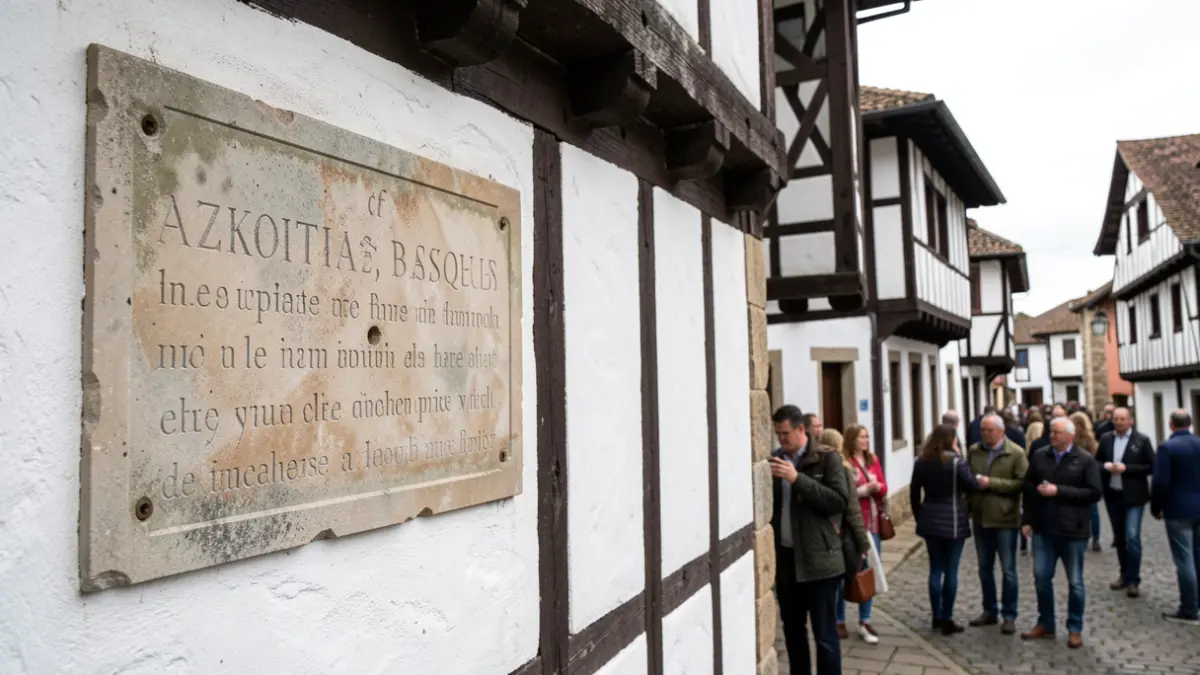
The practice of installing commemorative plaques spread across Europe in the 19th century, as cities began to officially mark the homes of famous individuals, historical events, or significant locations. One of the first plaques was placed in London in 1866, initiated by the Royal Society of Arts. While initially made of stone, recent decades have also seen the installation of some iron plaques.
In Azkoitia, a specific area is known as Ikurrinaren plaza (Flag Square) since 1997. It was here, in the Martzalkua premises next to the town square, that the Basque flag was first raised in 1907, under the name Azkoitiko Eusko Batzokiya. Although the building no longer stands, the square has preserved this memory.
Jose Ignazio Arana (Azkoitia, 1838-Oña, 1896), a writer and member of the Society of Jesus, has also been honored. A plaque was placed at his birthplace, now located at number 35 Klara Donea street, on the centenary of his birth, by the Azkoitia Town Council and Euskaltzaindia (the Royal Academy of the Basque Language). Arana published numerous works in the magazines Euskal-Erria and Euskera, and also undertook translation projects.
The most recent plaque commemorating the Azkoitia sculptor Joxe Alberdi Burruntxali (Azkoitia, 1922-Denia, Catalan Countries, 2008) is located within Ibaiondo street. The Town Council dedicated it in 2022, after he bequeathed his work to the town. Burruntxali initially worked with wood and returned to the Basque Country after the war.
At the Santa Kutz convent, there is a memorial to the site where the Special Assemblies of Gipuzkoa were held. From 1457 onwards, these assemblies convened there, and a memorial on the left wall of the convent reads: "XVIII. eunkiaren asiera-arte emen bildu zan Gipuzkoako Batzar Berezia" (Until the beginning of the 18th century, the Special Assembly of Gipuzkoa gathered here).
Valentin Olano (Azkoitia, 1808-1851), who served as mayor of Azkoitia and a deputy, was honored with a plaque at his birthplace, now on Klara Donea street, a hundred years after his death. He was a man of liberal ideology who defended the regional charters (fueros).
Opposite Olano's plaque, at number 53 Kale Nagusia, stands the plaque for Nemesio Etxaniz (Azkoitia, 1899-San Sebastián, 1982). He was a priest and writer renowned for his work in favor of the Basque language, authoring numerous poems, musical compositions, and plays. The Town Council and Euskerazaintza placed his plaque in his birthplace in 1987.
Xabier Munibe, Count of Peñaflorida (Azkoitia, 1729-Bergara, Gipuzkoa, 1785), a writer and composer, is commemorated at the entrance of the Intsausti Palace. He was instrumental in founding the Society of Basque Friends (Euskalerriaren Adiskideen Elkartea), and the society itself erected his plaque in 1929.
Mayor Ricardo Otaño (Azkoitia, 1884-1939) promoted the construction of affordable housing for workers in San Martín. Otaño's plaque is located at the entrance of the building that now houses the Ardatz association. During his tenure, he also spearheaded the development of the Urola train station and other projects.
At the entrance to the plenary hall of the Town Hall, there are three memorials not linked to individuals but commemorating significant events: the decision made in 1758 to publish an appendix to the fueros of Gipuzkoa, the designation of Azkoitia as the Principal City of Gipuzkoa, and the fact that the Society of Basque Friends also convened at the town hall.