In this work, Ugarte has created a narrative voice that yearns to escape an suffocating life. According to the author, we currently live an existence full of anxiety and self-exploitation, and many, like the protagonist, have at some point felt the need to take a stand.
“"Often our instinct or our body tells us that we must take another path, that we have reached a limit, and that we must change our way of life."
The reader will accompany the protagonist through the complexities of this decision, discovering that change often brings movement, collateral damage, contradictions, doubts, and discomfort. The novel's narrative thread is composed of three main themes that exert a counter-force to the protagonist's desire for change: profession, relationships —especially family ones— and the farmhouse.
Alejandra Garmendia, known as Alex, has worked for years as a screenwriter, bringing to light the lives of unknown women and earning a lot of money. Although she has new professional assignments, she realizes that she cannot continue this way. Her instinct calls for creativity, a freer form of writing. Thus, almost in secret, she begins to write a novel about her own life.
It is no coincidence that she chooses as protagonist a woman who makes a living by exploiting her imagination, and intersperses numerous reflections on imagination through her voice in the novel. This is one of the book's central themes. The writer from Tolosa is very interested in when, where, and how subjectivity appears in the writing process. Alex feels the need to write from her own experience, especially after losing her parents during the pandemic.
Relationships are the novel's second main thread, not only the ups and downs Alex experiences with her parents, ex-partner, and colleagues, but also how social networks, supposedly created for connection, actually distance us. Ugarte believes this trend has intensified since the pandemic, and the novel recounts the protagonist's attempts to confront it and reconnect with herself.
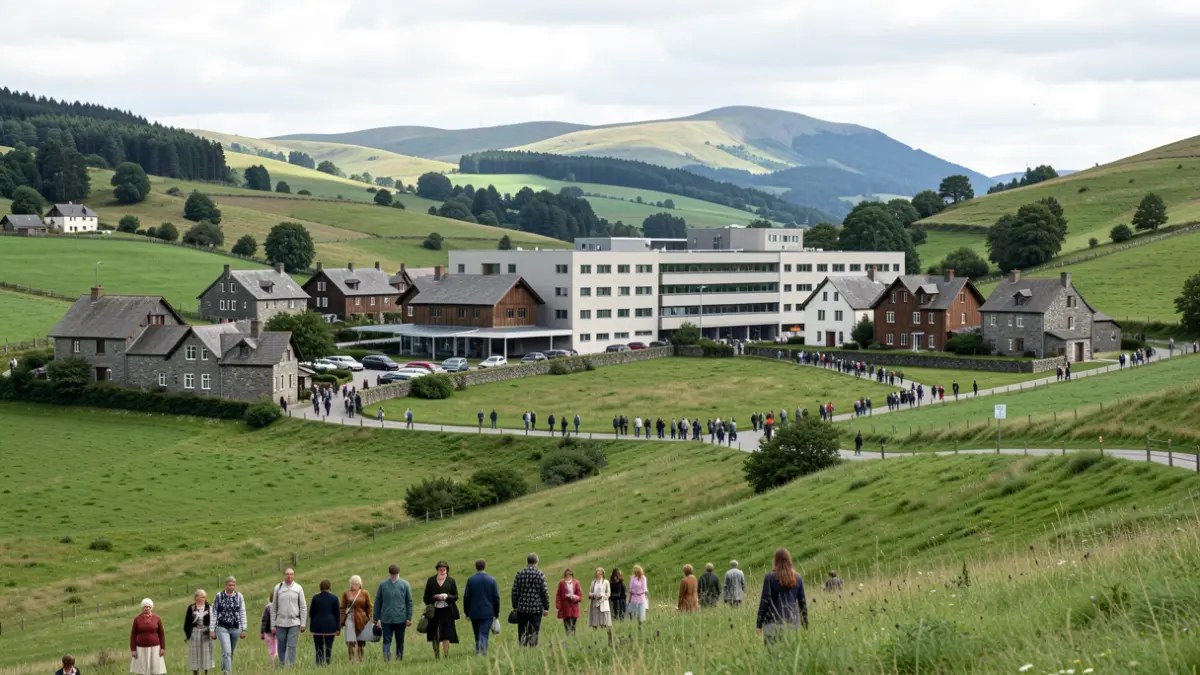
Alex also feels a desire to unite with herself and her natural environment, and the inherited Saroia farmhouse is precisely the third narrative thread explored in the novel. Ugarte wanted to portray the rural area as a living world in fiction, and thus, the book describes how the protagonist discovers with her own eyes the animals and plants around her, realizing that they are not objects created for humans, but beings with their own life.
“"Reality will often put Alex in her place. The novel leaves these questions: when you have made the decision to change, to what extent is it change and to what extent is it not? Within the life we have been given, what can we do to change? How can we build a new life?"
Change, therefore, is not a tension-free process, nor is it something closed, and that is what Ugarte wanted to represent in the novel. This work, titled Harakinen alaba, has several ramifications, and the writer from Tolosa has confessed that it has been a space of freedom for her, feeling very comfortable while writing. As in previous works, she has also drawn on her experiences for this one, but has made it clear that it is fiction and that the character's life and hers have nothing to do with each other.
Ugarte is satisfied with the reception the novel has received so far and with the initial feedback. She hopes to be able to present the book publicly in Tolosa soon.