Pedro Mendizorrotz, a resident of Ibarra, requested permission in 1577 to build the Franciscan monastery, offering land he had purchased on the road to Gaztelu. Religious orders needed to conduct a study before settling in a town, and in Tolosa, at the end of the 16th century, four orders attempted to establish themselves. Francisco de Tolosa was the general of the Franciscans at that time. Being outside the walls but near a town gate and the Montesquiu springs aided its location, though the building remained vulnerable.
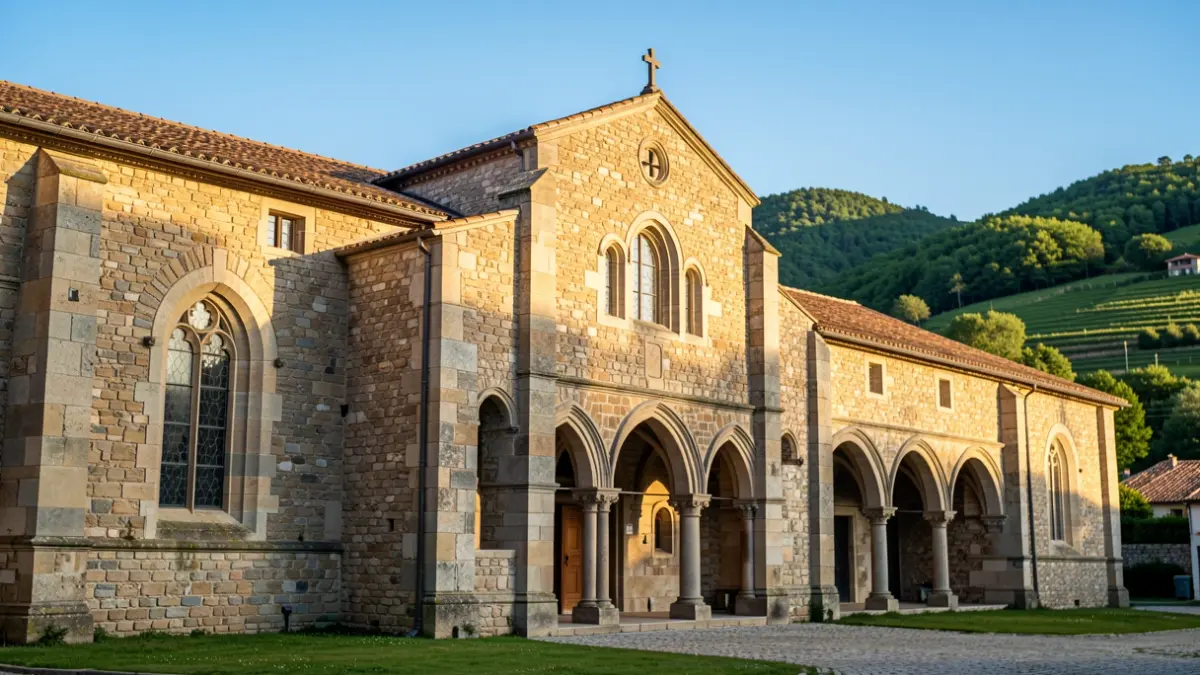
The design was by the Zerain friar Miguel Aranburu, and the construction was carried out by the stonemason Pedro Mendiola, completed in 1597. The church is simple, with a limestone ashlar facade and two coats of arms. It has a single nave and a barrel vault, featuring frescoes by the painter Pablo Uranga. It is designated a Historic-Artistic Monument.
In 1604, Ambrosio Bengoetxea of Alkiza was commissioned to create the main altarpiece, which was installed in 1615. It is a significant work in the Renaissance style, notable for the expressiveness of its figures and its polychromy. Throughout the 17th century, Manuel Rekalde, Domingo Idiaga, and Nicolas Zumeta worked on the construction, which concluded in 1674. The property spanned 12,300 m2, including mountains and gardens.
As a complement to the convent, Isabel Idiakez, widow of Admiral Juan Martinez Rekalde, opened the San Jose school in 1612. Stonemason Manuel Rekalde undertook the construction work between 1631 and 1644. The school operated for two centuries, and the tower was built by the same architect, Aranburu, between 1640-42.
Emperor Napoleon Bonaparte visited the convent in 1808. In 1814, a fire destroyed everything except the church, and the school was closed. During the 19th century, due to confiscations and Carlist wars, the convent had to vacate its premises multiple times, serving as a barracks, hospital, and warehouse. Another fire in 1901 affected the empty convent and school.
In the latter half of the 19th century and the early 20th century, several new buildings were erected around the convent: a promenade (1848), the railway (1863), a pelota court (1890), the Provincial Archive (1904), and others. In 1915, the Franciscan community returned to Tolosa and built the current modest convent.
After the 1936 war, the Basque language and culture gained significant prominence within the community. Standard Basque was created at the Arantzazu sanctuary, and some of its friars were stationed in Tolosa. The magazine Goiz argi, promoted by Jose Antonio Garate, and the Arantzazu Calendar originated there. The administration of the magazine Jakin was also based at the convent from 1968 to 1978. The Franciscan choir existed from 1949 to 1965, under the direction of Pedro Peñagarikano.
In the mid-20th century, pilgrimages to Arantzazu were highly successful. In 1970, they took responsibility for the churches of Eldua and Berrobi, and in 1979, the San Francisco church was designated the town's third parish.
Today, due to a lack of vocations and societal secularization, few Franciscan churches remain in the Basque Country. Only three friars are left in Tolosa, and their future will be decided in June. The local council has expressed interest in establishing reception houses in the convent and organizing cultural events in the church.