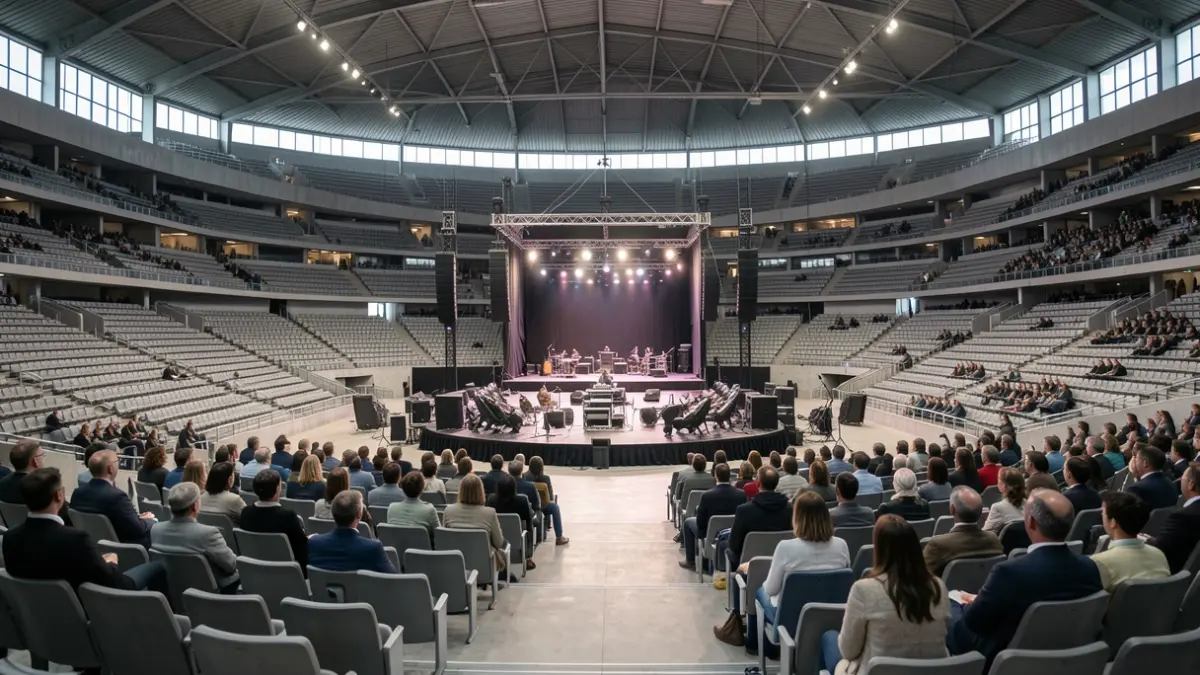
Itxaso made these statements during the institutional opening of the second day of the Berrilan Basque Tech Summit 2026 (BBTS26), which is gathering more than 400 professionals, companies, public administrations, and experts in architecture, engineering, construction, and asset management from Thursday to Saturday at the Anoeta stadium.
Under the slogan ‘Innovate and industrialize. The future of homes, cities, and people’, the congress celebrates its fourth edition with a three-day program focused on the opportunities offered by technological innovation, BIM methodology, artificial intelligence, digital twins, and new industrial processes to transform the construction sector.
During his speech, Itxaso argued that housing construction must fully integrate into the profound digital, energy, and industrial transformation already underway in other economic sectors. “The time has come to fully place housing construction within that same transformation process,” he stated, emphasizing that the residential challenge involves not only having land, streamlining planning, facilitating financing, or ensuring legal certainty, but also transforming the sector's own productive capacity.
In this regard, he called for the incorporation of technology throughout the value chain, industrializing processes, digitizing projects, improving productivity, reducing uncertainties, and having increasingly qualified professionals. “We need housing construction to achieve a technological and productive leap comparable to that of other major sectors of our economy,” he affirmed.
The minister stressed that industrializing construction goes far beyond moving part of the on-site work to a factory. It involves rethinking the entire process, from building design to construction, maintenance, and adaptation to future needs, leveraging digital models, more precise component manufacturing, waste reduction, and improved working conditions to build more efficient and sustainable buildings.
Regarding Eraiki Hub, Itxaso highlighted the importance of collaboration between public administrations, companies, and technology centers to accelerate this transformation and transfer innovation to productive reality. In this context, he recalled the launch of Eraiki Hub, the construction industrialization hub promoted by the Basque Government in collaboration with Tecnalia and BUILD:INN, the Basque construction cluster. This initiative aims to connect technological knowledge with companies' capabilities, foster innovation transfer, drive new industrial processes, and contribute to increasing the production of quality, sustainable, and affordable housing.
To this end, the minister emphasized the importance of the sector having predictable demand to enable investment, technology adoption, professional training, and the development of new productive capacities, as well as the need to ensure continuity in this process so that innovative experiences can spread and achieve scale. He also warned that the modernization of construction also requires transforming how public administrations plan, contract, and manage. “Administrative time is part of the cost of a home. And also of the time a family waits to access it,” he remarked, advocating for increased agility and management capacity so that innovation translates into more housing and better residential solutions.
Itxaso's intervention also addressed the digital transformation of the Administration, with advances in interoperability, data standardization, and the automation of files, benefits, and subsidies. The goal is to improve management capacity, streamline processing, and strengthen supervision and inspection mechanisms, using artificial intelligence tools to detect errors and better guide contract control, always subject to professional verification and with guarantees for individuals.
In this area, he argued that “gaining management capacity is also gaining protection capacity,” linking the technological modernization of public services with a greater ability to prevent breaches and protect citizens' rights. The minister also emphasized the importance of applying these technologies to the management of the public rental housing stock once the homes have been built and delivered. Through Alokabide, the Basque Government is working to advance in the monitoring of its buildings and the use of digital twins to relate information on consumption, temperature, humidity, property characteristics, and maintenance needs.
These tools will allow for anticipating breakdowns, detecting comfort issues, identifying rehabilitation priorities, and preparing homes for challenges such as more intense heat episodes or population aging. Furthermore, the knowledge gained from the real operation of buildings can be transferred to the design of future developments, improving their performance and adaptation to residential needs.
Itxaso recalled that responsibility for public housing does not end with handing over the keys but must extend to its care, maintenance, and adaptation throughout its useful life. In this regard, he argued that information and digitalization should also be useful for residents, helping them understand their consumption, identify factors that increase their bills, and save energy without sacrificing well-being. “An efficient home must also be efficient in the daily experience of its inhabitant,” he stated.
In the final part of his speech, the minister championed Euskadi's capabilities to face this transformation, highlighting its business fabric, industrial experience, technological knowledge, and innovation capacity. The challenge, he pointed out, is to connect all these resources with one of the main social, urban, and economic challenges of the moment: producing more housing, doing it better, more sustainably, and ensuring it reaches those who need it.
“Industrialization, digitalization, and innovation are not ends in themselves. They are tools to increase our collective capacity to guarantee access to decent and affordable housing,” concluded Itxaso, who called for collaboration among all sector stakeholders to translate knowledge and technology into tangible improvements in citizens' living conditions.
The Berrilan Basque Tech Summit 2026 will continue this Saturday with a day dedicated to training and the practical application of new technologies, through specialized workshops on artificial intelligence, automation of technical tasks, and digital transformation of organizations.