The "discomfort and indignation" of hundreds of families from Bilbao's public school network regarding the high temperatures students endure in classrooms for years was highlighted. "What disaster must happen for measures to be taken?" asked Mari Carmen, a representative of the AMPA at the public school Luis Briñas.
Representatives from AMPAs of schools such as Luis Briñas, Birjinetxe, Indautxuko Eskola, Pagasarribide, Karmelo, and Zurbaranbarri held a press conference in Basarrate square to denounce the "unsustainable" situation. Other public centers in the Biscay capital, including Concha, Uribarri, San Adrián, San Ignacio, Basurto, Cervantes, Arangoiti, Zurbaran, and Gabriel Aresti, also showed their support.
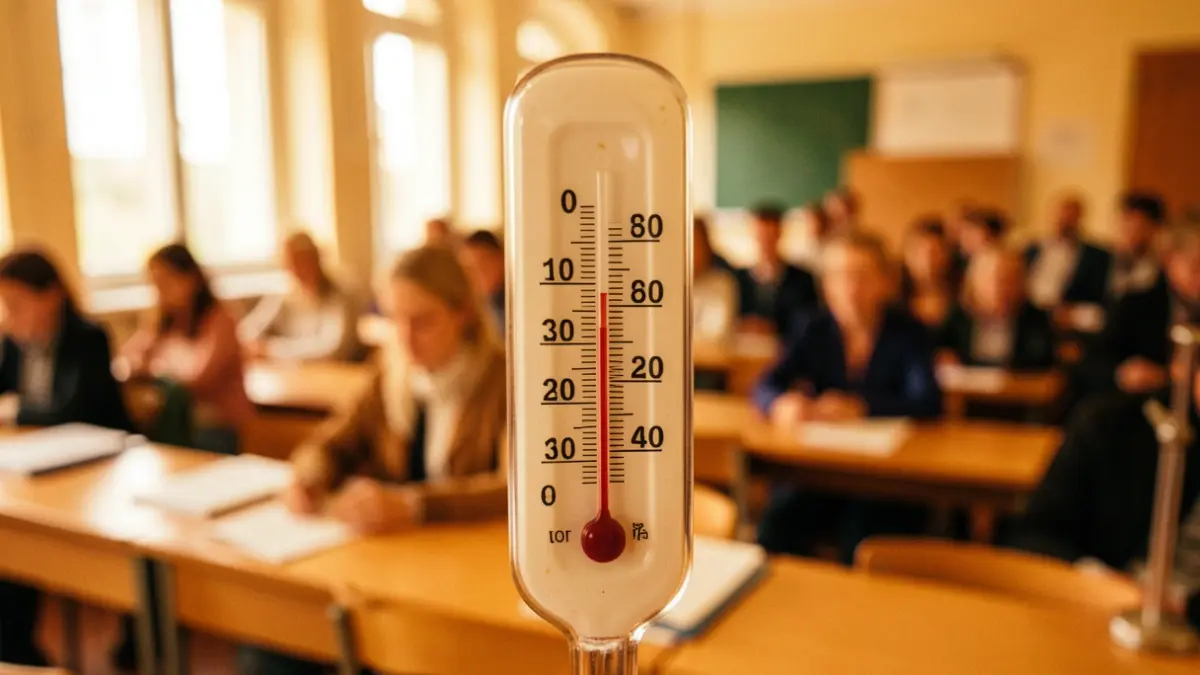
Families have stated that in some schools, temperatures reach 35ºC, "well above the maximum of 27ºC set by regulations for sedentary work." Consequently, students suffer "lamentable conditions," including fainting spells, gastroenteritis, exhaustion, and headaches. They also live "increasingly glued to the phone in case the school calls because someone has suffered heatstroke."
Mari Carmen insisted that the problem affects not only students' physical well-being but also their learning capacity. "We don't bring our children to school to survive the heat. They come to learn, and at 35ºC, learning is impossible," she stated.
During the press conference, families criticized the "institutional neglect" of the Bilbao City Council and the Basque Government, holding them responsible for the planning and maintenance of school buildings. "Heatwaves are not new and are also predictable. We are in the 21st century. There are fans, awnings, blinds, covered spaces, and air conditioning systems. What is lacking is political will," they denounced.
One of the aspects causing the most indignation is the "slowness of interventions." In the case of the Luis Briñas school, Mari Carmen explained that there is a project to install awnings, but only in certain areas and in phases. "The center is huge, and they will start with the upper floors. Early childhood education, which is on the ground floor, is currently left out," she lamented.
From Pagasarribide, they recalled that last year awnings were installed in seven of the center's 21 classrooms, confirming a temperature reduction. However, the second phase of the work is still pending. "If they already know it works, why isn't it applied in all schools?" they asked.
Families consider the temporary solutions proposed so far to be "insufficient." "They talk about buying fans, but that's a patch," criticized Mari Carmen. "We have reports from 2016 that already warned of extreme heat in classrooms, and for ten years, curtains and fans have been installed that solve nothing."
They also questioned the use of heritage limitations as an excuse to avoid action in certain historic buildings. "The Bilbao City Council is also a protected building, and they do have air conditioning there," they pointed out. "Can anyone imagine the mayor and councilors debating in a plenary session at 34ºC?" asked Mari Carmen.
Furthermore, the AMPAs criticized that just this week, a four-year-old girl suffered heatstroke at the Pagasarribide school and had to be attended by a medicalized ambulance. After the press conference, it was also reported that another student from the same center, an adolescent, had to be transferred to Basurto Hospital with symptoms associated with heatstroke.
In addition to demanding effective air conditioning and insulation plans, families are calling for the adaptation of schedules, activities, and school menus during extreme heat episodes. They also request a profound transformation of school playgrounds to reduce the "impact of concrete" and increase green and shaded areas.
"We want to naturalize the playgrounds and turn them into more habitable and educational spaces. Not cosmetic crumbs or dependence on participatory budgets. We want real investments," they stressed.
The AMPAs also denounced the situation of teachers and non-teaching staff, who work under "inadmissible" conditions. Therefore, they have requested the intervention of Labor Inspection to verify the temperatures in the centers.
The families' discontent will be accompanied by mobilizations in different neighborhoods of Bilbao. In Pagasarribide, a "protest water fight" and a road blockade will take place, while at Indautxuko Eskola, a rally has been called under the slogan "We are not chickens," referring to the high classroom temperatures.
Families assure they will continue mobilizing until definitive solutions are obtained. "The City Council and the Basque Government constantly pass the ball to each other," lamented Mari Carmen. "But while they argue about who has the competence, those who suffer are our daughters and our sons."