The death of Carlos Garaikoetxea, this Monday, May 4, has reopened a wound and, at the same time, a memory: that of a time when politics was not only management, but also a symbol, dignity, and resistance. Among all the episodes that mark his career, there is one that today acquires special force: the reception of the exiled lehendakari, Jesús María Leizaola.
That act was much more than an institutional ceremony; it was the staging of a historical continuity that the dictatorship had failed to break. The return of the old lehendakari was not simply the return of a man, but –they say– that of “a legitimacy.” For decades, the Basque Government had survived in exile as the custodian of the will expressed in 1936, after José Antonio Aguirre's oath under the Tree of Gernika.
When Leizaola crossed the doors of the Casa de Juntas again, he did so carrying that legacy, with the weight of a suspended history that, at last, found solid ground in his homeland. On December 15, 1979, the exile embodied by Leizaola definitively returned. They were waiting for him at Sondika airport, according to a former EA militant from that time.
“"Lehendakari Leizaola was not given to grand or bombastic gestures, but his emotion and ours were eloquent and palpable. His words, his speech, vibrant and contained, naturally began under the Tree, a symbol of our freedoms."
Inside, solemnity mingled with contained emotion. Political representatives, among others, historical members of Basque nationalism, “reborn institutions,” all were “aware that it was not just another act.” It was to close, metaphorically, a cycle that began with the Spanish coup d'état, the war, exile, and the long night of the dictatorship. And at the center of it all, two figures: the returning lehendakari and the lehendakari who embodied the present.
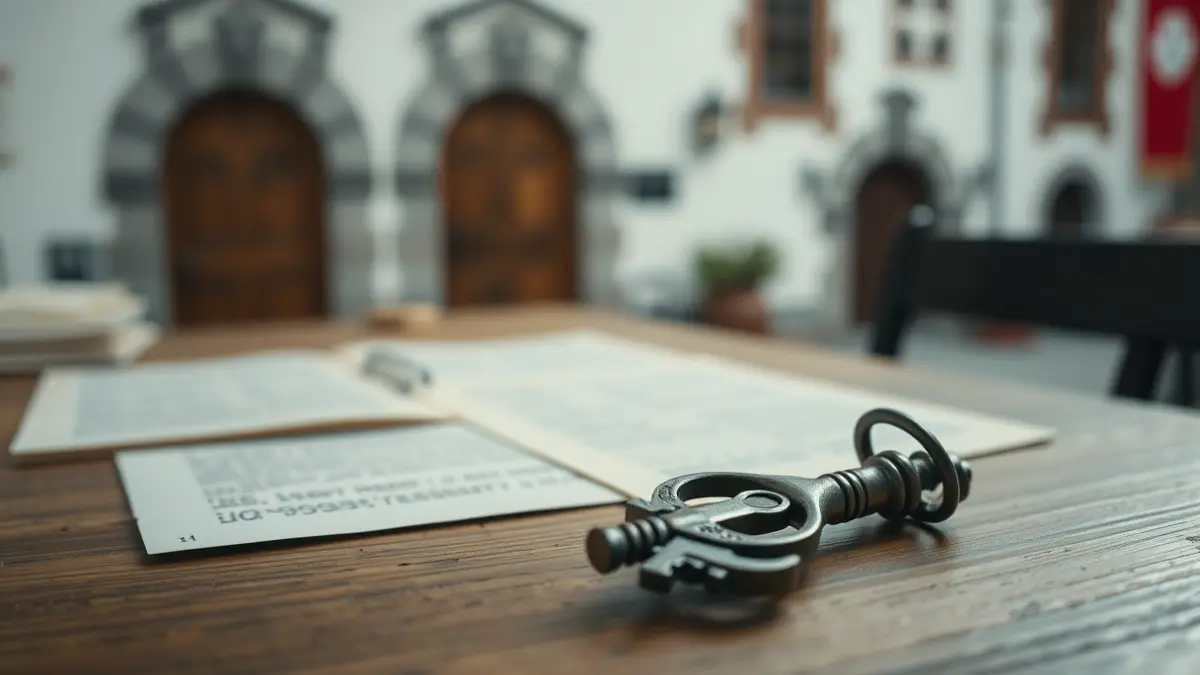
It was then that one of the most powerful gestures of that day occurred. Jesús María Leizaola handed over the symbolic keys to the headquarters of the Paris exile Delegation, those that had represented institutional continuity for decades. The then president of the Basque General Council, Carlos Garaikoetxea, received them with “reverential respect” and, in an act full of meaning, kissed them. That contact was not a protocolary gesture: it was the affirmation of “an inherited legitimacy, the recognition that the new era was not born out of nothing, but was the fruit of a history of resistance.” Then, two presidents were sealed with an embrace.
The speeches that accompanied the act reinforced this idea. There was talk of reconstruction, self-government, the future, but also of memory. Of the need not to forget the sacrifice of those who kept the flame alive in the darkest years. Of “the obligation to build a democratic Euskadi without renouncing the principles that had given meaning to that long journey.”
That day, the Casa de Juntas de Gernika was a space for reconciliation between past and present. The lehendakari of exile and the lehendakari of the new era met not as opposing figures, but as “links in the same chain.” And in that encounter, they say, “politics recovered something that today often seems lost: its ethical and symbolic dimension.”