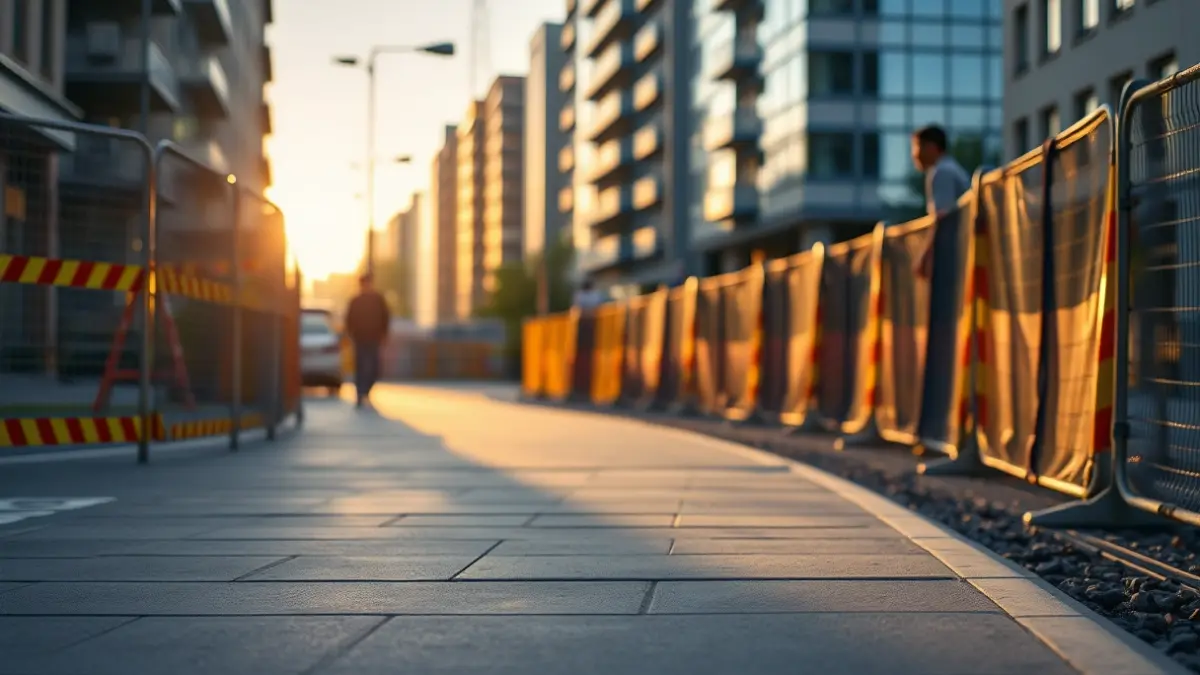
Walking through the streets of Bilbao often means encountering areas cordoned off by construction work, fences delineating sidewalks, or closed sections of roads. A multitude of small and large construction projects coexist in the city's urban landscape. To put it in context, for this week, the Bilbao City Council has four active notices issued last week, indicating which roads will be closed due to various ongoing works.
One such project involves the redevelopment of Rafaela Ybarra street, which for 11 months will lead to sidewalk, parking, and road closures between Lehendakari Aguirre avenue and Madariaga avenue. These works will involve widening sidewalks to improve accessibility and renovating urban furniture, connecting it with installations in recently reformed areas like San Pedro square and the aforementioned Madariaga avenue. This project has a budget of 1,049,415 euros.
Street interventions are constant, and the most central thoroughfares attract the investments most observed by residents of Bizkaia when they visit the capital. One area undergoing a complete renovation project is María Díaz de Haro street, which is nearing completion of its second and final phase. From September 2025, this central street will see works to create a large green corridor between Doña Casilda park and Ametzola park, via La Casilla. With a budget of 6,327,253 euros and a 14-month execution period, this road will prioritize pedestrian use with six-meter-wide sidewalks, depending on the street's elevation. New lighting and urban furniture will showcase a rehabilitation of this central street by early 2027.
One of Bilbao's busiest streets is Autonomía, whose remodeling has sometimes required night-time asphalt work. This road is one of the city's main arteries, and with nearly one million euros, the first phase of these works is underway, aiming to widen sidewalks, create green spaces and resting areas for citizens, and reduce vehicle speed on this access to the capital. This project has no completion date as it is intrinsically linked to the construction of the Tramway Ring, which in turn depends on the development of the future Abando station.
One of the essential projects for the Bizkaia capital is the new fire station in Deusto, which is already rising above the Ribera. Over 13 million euros have been allocated for this building, expected to be ready by June 2028. Its location, as stated by the Bilbao City Council, will make “rescue and salvage operations” more accessible, ensuring “rapid and efficient coverage throughout the area.” This station has been designed to consolidate all necessary spaces for workers, from administrative areas to changing rooms and a training tower, in addition to a hangar and a maneuvering area.
With an investment of over 8.5 million euros, residents of District 8 will soon enjoy a new Municipal Center in the Zorrotza neighborhood. In just a few months, construction work on this space will be completed, having started in October 2024. This accessible building will bring local administration closer to residents, who have long demanded this facility. Spanning 4,365 square meters across a ground floor and six upper floors, it will house a library, gym rooms, and youth spaces. A key feature of this new construction is its commitment to sustainability, achieving an A energy rating thanks to 50 photovoltaic panels on the roof and thermal insulation, among other measures.
One of the cultural hubs shaping the future of Zorrotzaurre, Pabellón 6, is also undergoing urban intervention. With a budget of 4,153,305.04 euros, the renovation of this building has been underway since October last year and is expected to be completed by the end of 2026. The works will create a 1,300 square meter space and accommodate 228 people to enjoy scheduled performances. The facilities will include a scenic hall, retractable seating, dressing rooms, rehearsal rooms, a technical control area, as well as offices and workshops.
Linked to culture and within the same area, the works for the Bilbao Bizkaia Audiovisual Hub in Punta Zorrotza are currently being tendered. The deadline for companies to submit their proposals is open, and in a few months, work will begin to shape a space that will be a reference for cultural creation in the Historical Territory.
Accessibility is one of the pillars of the Bilbao City Council's budget. Eliminating architectural barriers and connecting high points is one of the goals to help citizens overcome the uneven terrain that complicates their daily lives. Consequently, in a few months, the Bizkaia capital will have nearly 90 urban elevators.
This year, the inclined elevator in Masustegi and the San Joaquín elevator in Bolueta have been put into operation. The nearly 30 million euros planned for this legislative term for the implementation of elevators are also reflected in those being executed in other neighborhoods of Bilbao. An example is the one in Txurdinaga, which will overcome a 12-meter elevation difference and will have two stops, being built along Julián Gaiarre avenue.
The 57 stairs separating Cantera square from Concepción street in the San Francisco neighborhood will be overcome with an elevator that will have two stops and eliminate a 9.65-meter elevation difference. However, residents will notice the biggest change in Zurbaranbarri, where three new elevators are being installed, which will overcome a 15-meter elevation difference between the lowest and highest areas.
Furthermore, two months ago, the tender for the Sagarminaga Group elevator was announced, with the deadline for proposals closing a few days ago. Construction of this elevator will begin as soon as the company responsible for its construction is decided. Once works begin, the operational period will be eight months. Another project set to start soon is the Irala elevator, which will connect this street with Kirikiño avenue to overcome a four-meter elevation difference. Works are also expected to last eight months.
In addition to large-scale and long-term projects, sidewalk and parking occupations are also occurring for smaller works, such as the construction of "orejetas" (curb extensions), designed to ensure pedestrian safety at intersections. Thus, since yesterday, the intersections between Sorkunde and Zumarraga streets and between Travesía Iturriaga and Pintor Anselmo Guinea street will be affected for three weeks. For the same reason, but for a month and a half, work will be carried out between Iparragirre and Egaña streets. These are small investment works but crucial for pedestrian safety.