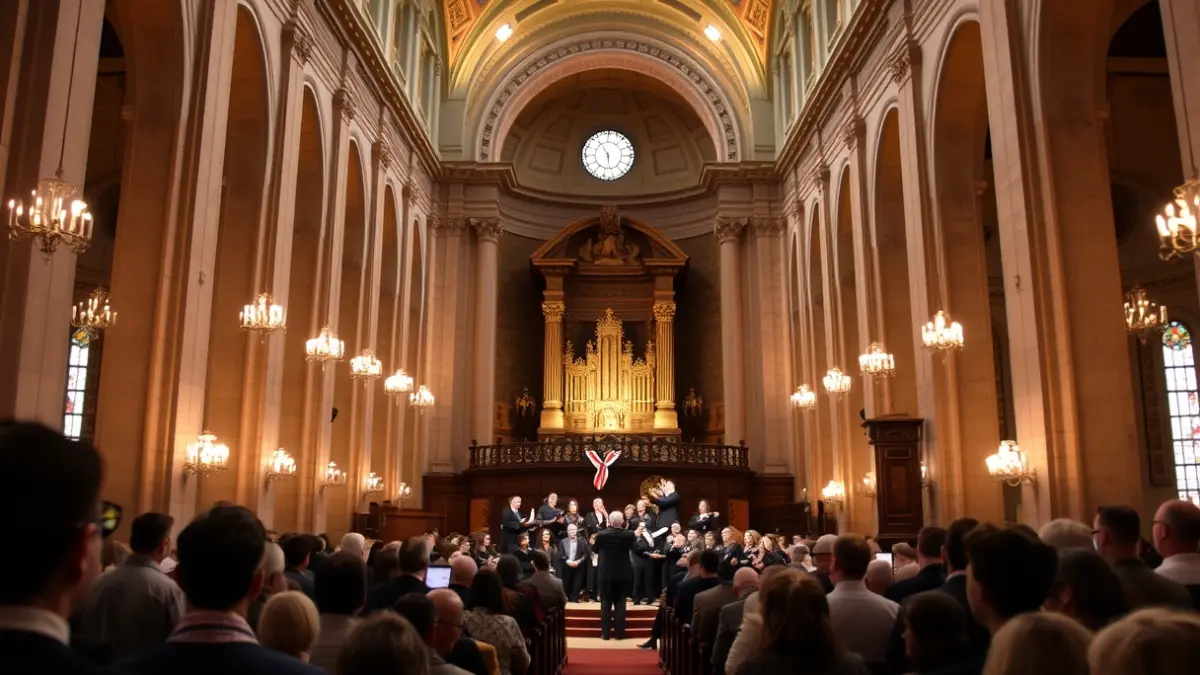
The choir reviewed its extensive trajectory and, at the same time, looked towards the future, demonstrating that it remains alive, active, and eager to continue singing. This event was one of the central acts of its 40th-anniversary celebration, gathering a large audience in the basilica.
The new album compiles eight works selected for their significance in the choir's history, rather than chronological order. It is a musical journey through these 40 years since the group's refoundation in 1986, promoted by Juan Alcayaga and led by Xabier Sarasola.
The recording took place in February at the Basilica of San Martín de Loinaz itself, with the technical work of Jean-Michel Olivares and the collaboration of pianist Javier Pérez de Azpeitia and violinist Xabier Zeberio, who also participated in Saturday's concert.
Under the direction of Aitor Garitano, the Loinatz Abesbatza revisited various memories of its trajectory through a repertoire that reflected the musical variety worked on by the group over these four decades. The concert had an emotional close with the piece 'Muruko Mari', also by Xabier Sarasola, announcing the upcoming festivities of Beasain.
“"The history of Loinatz Abesbatza dates back to 1986, although its origins are in Coral Loinaz, founded in 1939 by Pedro José Iguain."
The choir's direction has been led by Xabier Sarasola, Junkal Guerrero, Jon Aizpuru, and, since 2023, Aitor Garitano. Each stage has left its mark on both the repertoire and the group's evolution, which has maintained constant activity both within and outside Euskal Herria during these years.