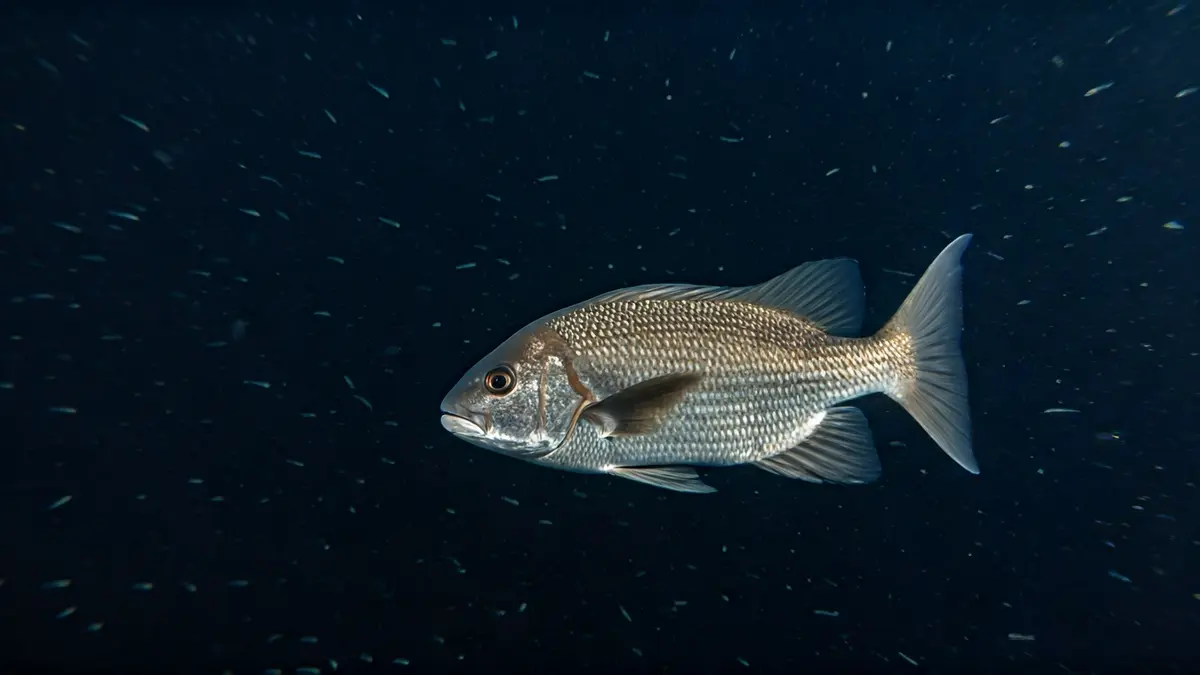
The appearance of this fish is not the most common: it has an oval and flattened body, with a color ranging from dark gray to almost black, with a silvery sheen. In the towns of the Basque coast, it receives different names; in Mutriku and Gipuzkoa, for example, it is called “papardo,” and in Bizkaia “papardo beltz.” In the Donostia area, however, it is known as “palometa,” perhaps because its fins resemble pigeon wings.
The pomfret, with the scientific name Brama brama, is a vertebrate fish that can reach 40-50 cm, although in the Mediterranean it is limited to 30 cm. It lives in the open sea, in the water column between 100 and 400 meters, feeding on small fish, cephalopods, and krill. It is not currently on the list of protected species.
Although a solitary species, it gathers in small groups for protection. In the darkness of the depths, its black body is an advantage for hiding from predators. The silvery glow it emits when sun or moon rays hit its skin is a strategy for finding each other. Its large eyes, similar to an owl's, allow it to hunt in the dark and confuse its prey.
It reaches sexual maturity at 3-4 years old. In autumn, it migrates to subtropical areas to reproduce, and females release thousands of eggs in each spawning. Towards summer, it extends to higher latitudes where there is more food, seeking temperatures of 14-15°C at 200 meters deep. If the Cantabrian Sea is colder at this depth, it will remain in the south.
If it manages to avoid predators and fishermen, it can grow up to half a meter and live up to 10 years. Its solitary nature makes large-school fishing difficult, but it can do little against the giant nets that filter the pelagic area. Artisanal fishermen, however, hold it in high esteem, and when caught with bottom gear, its flesh acquires a texture and color similar to chicken, making it highly valued.