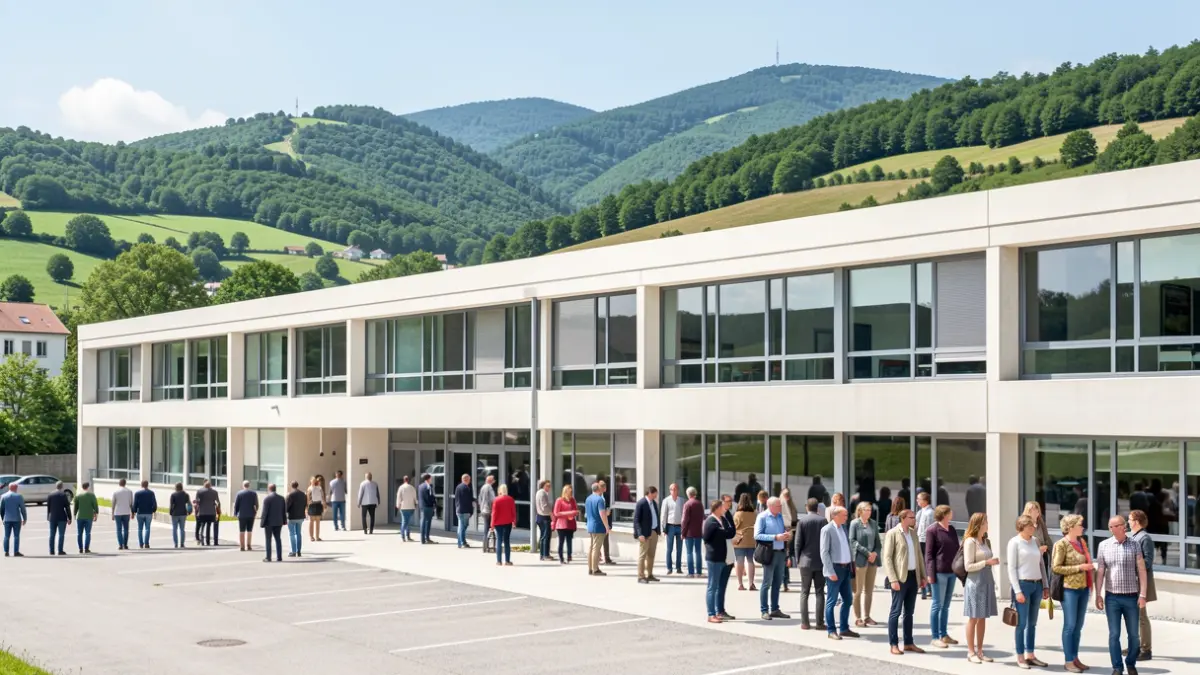
The new Penitentiary Center of Gipuzkoa, located in Zubieta, will be officially inaugurated next Monday, June 15th, with the presence of Lehendakari Imanol Pradales and Interior Minister Fernando Grande-Marlaska. This new infrastructure, representing an investment of over 45 million euros, has a capacity for 400 individuals and promotes a more modern, specialized penitentiary execution model with enhanced intervention capabilities.
The Minister of Justice and Human Rights, María Jesús San José, visited the new facility today. Situated in San Sebastián, it marks a qualitative leap for the Basque penitentiary model by incorporating spaces for both security and individualized treatment aimed at fostering reintegration. It covers a total area of 284,255.43 m2, with 80,714 m2 dedicated to the penitentiary precinct, and will employ a staff of 255 professionals.
The minister highlighted that, with the opening of the new center and the closure of Martutene, the Basque penitentiary model is consolidated, championing "a more modern, specialized penitentiary execution oriented towards social reintegration." The new facilities align with a model where security and treatment mutually reinforce each other, ensuring coexistence and facilitating genuine change processes for individuals who have committed offenses.
The Zubieta Penitentiary Center is organized into modules allowing for better internal classification, tailored pathways for each individual, and specific programs for different profiles. According to the minister, it represents "an evolution of the penitentiary model in Euskadi: it offers better spaces for coexistence, more opportunities for training and employment, and more personalized intervention, with the ultimate goal of promoting social reintegration within a framework of security and responsibility."
“"They were murdered for doing their job. Their lives were unjustly and violently taken. It is an irreparable loss for their families, for the prison institution, and for all of society. Their memory challenges us and will also be present every day in Zubieta. Keeping it alive is our commitment."
Furthermore, the center will enable inmates to serve their sentences in dignified conditions through individualized, person-centered intervention. Special attention will be given to mental health and addiction issues, with a transversal integration of the gender perspective. The infrastructure adheres to sustainability and humanization criteria, ensuring high energy efficiency and full accessibility.
The facility will also house an autonomous Social Insertion Center (CIS) in Zubieta, featuring workshops, classrooms, a library, and an assistance area. Inmates with ties to Euskadi and Gipuzkoa will be able to serve their sentences within their community, avoiding transfers to other autonomous regions due to space limitations.