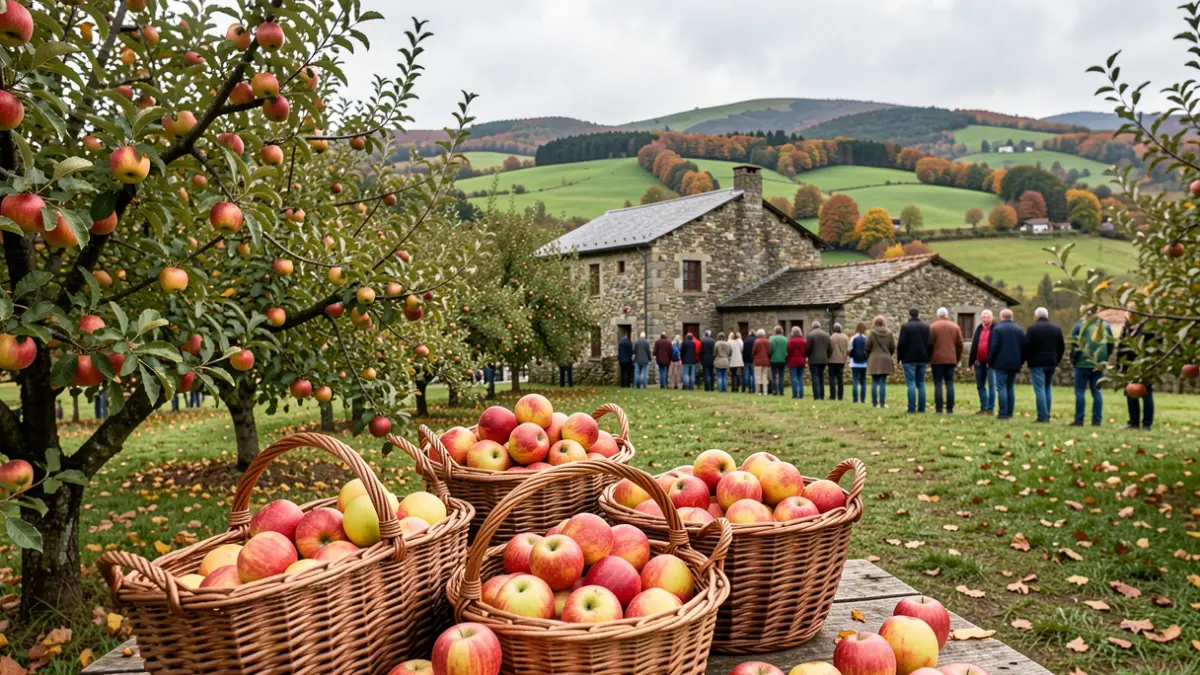
Affected by the lack of winter cold and significant heat, this year's apple harvest shows regional variations. Overall, the yield is lower than last year, with the Regulatory Council anticipating the collection of around 1.5 million kg of Basque apples. The apples contain more sugar and less water than last year, primarily due to higher temperatures.
The apple yield varies by territory, with the majority concentrated in Gipuzkoa's Goierri region and certain areas of Araba. Most of the harvest will be collected by hand, dictated by the local topography and climate. However, some have begun hand-picking from the trees, and there are also apple-harvesting machines adapted to local orchards.
A key objective for the sector is to balance the harvest and explore new, adapted methods of apple collection in the coming years. Compared to last year, the apples are smaller this year, and ciders with a more pronounced character are expected.
Apple technician Aitor Etxandia has outlined the sector's main projects, including: selective thinning (removing flowers or apples in years of high yield to achieve more balanced harvests annually), Geneva rootstocks (to study the results of grafting local apple varieties), and the importance of soil condition.
All these details were presented at the Otalarrea Experimental Orchard in Villabona, a facility owned by the Gipuzkoa Provincial Council, where many of the recent experiments are conducted. The Regulatory Council aims to extend these research efforts to experimental orchards in other regions and private orchards.
Participants in the press conference included Maite Retolaza (president of Euskal Sagardoa Denomination of Origin), Ainhoa Larrea (member of Euskal Sagardoa Denomination of Origin and president of Fruitele), Aitor Etxandia (apple technician), Olatz Mitxelena (member of Euskal Sagardoa Denomination of Origin), Joseba Aranburu (Director of Green Territorial Balance for the Gipuzkoa Provincial Council), Nora Beltran de Otalora (director of Food Quality and Promotion of the Basque Government), and Unai Agirre (coordinator of Euskal Sagardoa Denomination of Origin).
The Malus Bi project has been launched for 2025 and 2026, bringing together cider sector stakeholders from Gipuzkoa, Bizkaia, Araba, Navarre, and Northern Basque Country to analyze the state of apples, cider, and cider houses, and to define important projects and a roadmap for the future. The main goal will be to identify and agree upon the necessary projects and means to produce quality apples.
The sector is working on establishing reference theoretical costs for apples and cider, with calculations expected by next year.
Within Euskal Sagardoa, approximately 500 hectares of apple orchards are registered, supplying 48 cider houses. An additional 166 hectares are newly in production or will enter production in the coming years. Most new orchards have been planted in Gipuzkoa, largely with support from the Provincial Council.
The sector and administration have set a clear goal: to produce all local cider using 100% local apples within 15 years. However, a challenge of generational succession exists in older orchards, a matter the Denomination of Origin is addressing with the administrations.
The Denomination of Origin is aligned with the sectors of Navarre and Northern Basque Country, and the process is progressing. The Regulatory Council awaits the European Union's final response for the inclusion of Northern Basque Country.
In 2021, the Denomination of Origin presented three strategic projects: the use of Geneva rootstocks, inter-pollination (analyzing pollination capacity between different apple varieties), and selective thinning. Furthermore, increasing importance is placed on soil cultivation and composition.
Euskal Sagardoa Denomination of Origin has 106 registered apple varieties, with 24 being the most commonly used. With the inclusion of Navarre and Northern Basque Country, this list will expand to 250 varieties.
The Apple Harvest Festival will take place in Astigarraga on September 27th, the Igartubeiti Farmhouse Museum will host the Week of Cider from October 9th to 19th, and in the Bidasoa valley, the XXIV Apple Day will be celebrated on September 27th at the Ola cider house.