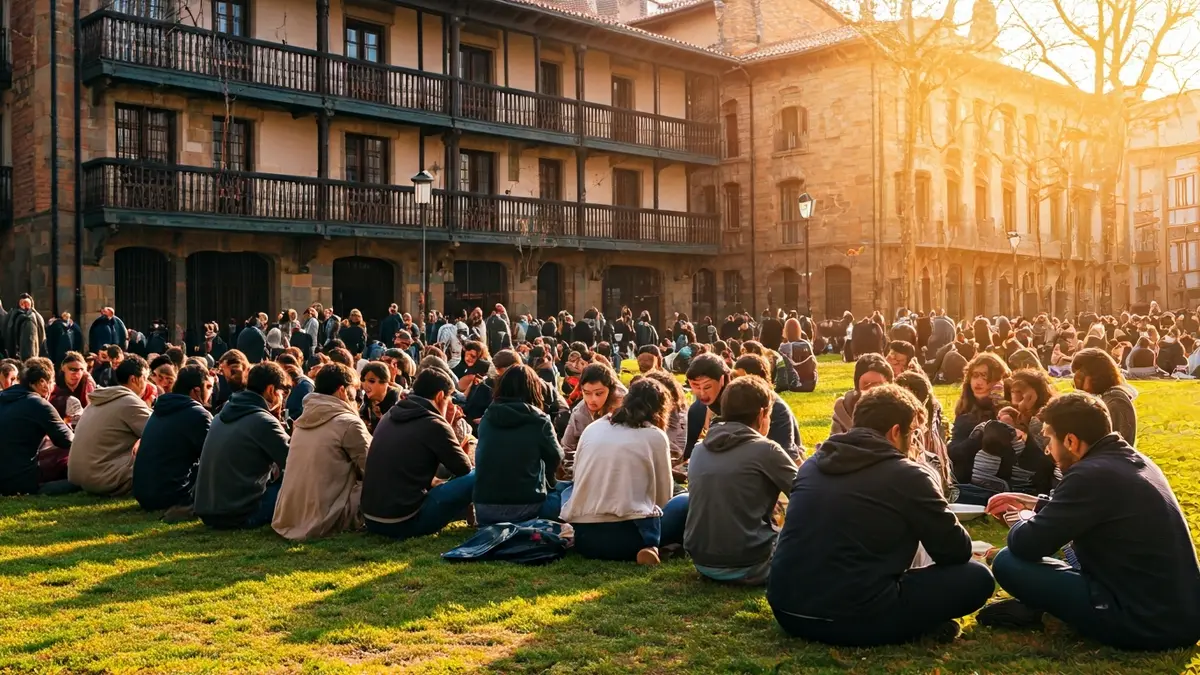
Based on the idea that food is a universal language, SOS Racismo Gipuzkoa is once again celebrating Bizilagunak, an initiative designed to bring together people from different backgrounds, both local and foreign, around a table. The goal is to break down stereotypes and promote integration and social cohesion through a meal where each participant prepares typical dishes from their home country.
These gatherings are “more necessary than ever to combat the rise of hate speech and distrust” towards foreign individuals, as stated this Wednesday at a press conference by Itziar Gorostidi, the program coordinator, and Ion Gambra, the Director General of Human Rights and Democratic Culture.
Thus, on May 10th, homes will open their doors to host these intercultural encounters. In this new edition of Bizilagunak, the initiative will also extend to parks and gastronomic societies to facilitate access, under the new slogan 'At home or in the park, Feeding relationships!'. Participants will therefore be able to choose whether to enjoy their meal outdoors or in the comfort of their home.
Gambra emphasized that “Gipuzkoa is a very diverse territory.” In fact, almost 15% of Gipuzkoa residents were born in another country, and that figure “is set to increase.” Therefore, as the Director General of Human Rights and Democratic Culture argued, both institutional intervention and societal management are needed “to build better coexistence. To achieve this, the first step is mutual understanding,” fostered through Bizilagunak, which aims to be a first encounter to develop friendships among strangers from different origins and cultures.
Lorea Zeberio, a participant in a previous edition of Bizilagunak, shared her experience at the press conference, describing it as “very positive.” Zeberio participated approximately ten years ago, when she was a child. “It was very natural. I didn't know that encounter was part of a program; in fact, I thought we were just meeting some friends of my parents,” she recalled. She expressed gratitude that this meal “allowed us to meet a family that we probably wouldn't have gotten to know if it hadn't been for Bizilagunak,” she added, excited to participate again in this upcoming edition. This time, she will do so out of her own interest, not by her parents' decision.
All those interested in participating must register – either individually, as a family, or in a group – via the website www.sosracismogipuzkoa.org/bizilagunak and choose from three different participation modalities: as a host (opening their home or gastronomic society), as a participant, or as a dynamic coordinator (an option available to students from the University of the Basque Country (EHU)). The registration period will be open until May 1st.