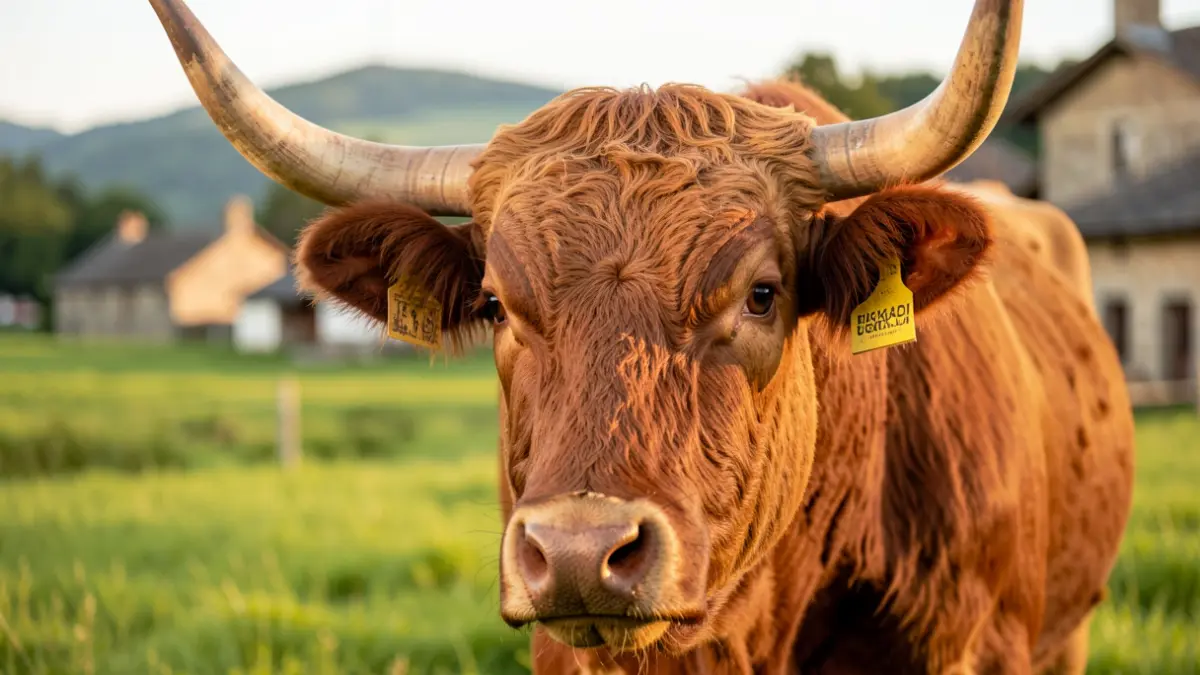
The recent history of the Bergarako Zezenak ranch began at a critical juncture: the sacrifice of its entire herd. "We had to sacrifice 90 animals due to a tuberculosis case," explains Iñigo Almorza, co-owner of the ranch and member of Euskal Zezen Elkartea, recalling the start of this difficult process.
Currently, the ranch is in a repopulation phase, acquiring new animals, a task the farmer describes as a constant challenge. "Everyone thinks it's easy, that you buy when you want, bring them in, and do as you please, but that's not the case. It's one of the most difficult worlds there is, especially in Gipuzkoa, because it demands requirements not found elsewhere in Spain."
When asked about the specific requirements that hinder the introduction of cattle, Almorza details a complex interplay of sanitary deadlines. Foral regulations mandate that animals test negative for IBR (Infectious Bovine Rhinotracheitis), a test valid for only 15 days, a timeframe that conflicts with other obligations.
"We buy cows in Navarra, they are tested for tuberculosis and IBR, and vaccinated against nodular dermatosis," he recounts. The problem lies in the waiting times: "If you vaccinate for dermatosis, the animals must be immobilized at the origin for 28 days. And the IBR tests expire in 15 days. So, after the 28 days for dermatosis have passed, the IBR expires. You have to re-test for IBR, but in the meantime, the tuberculosis test expires."
This cycle forces ranchers to continuously bring animals into handling chutes for blood extraction, adding laboratory waiting times. "Last week we drew blood on Wednesday, a week has passed, and we still don't have any test results," illustrates the farmer, noting that from a recent batch of 90 acquired cows, fewer than half are expected to pass this filter to reach Gipuzkoa. Almorza attributes this rigidity to managers who, in his opinion, "have no connection with the primary sector."
Despite breeding difficulties, Bergarako Zezenak maintains intense activity. Its animals not only travel around Gipuzkoa but also regularly to Bizkaia, Araba, Nafarroa, La Rioja, Cantabria, and the Valencian Community.
When questioned about the health of bullfighting in the region, the rancher is firm, differentiating the attitude of institutions from that of the public. "Honestly, from the people, the attitude is unbeatable," he states. As proof, he lists towns in Gipuzkoa and surrounding areas that have recently revived these festivities, such as "Eskoriatza, Leintz-Gatzaga, Antzuola, Mutiloa, Nanclares de la Oca, or Eibar".
Almorza emphasizes attendance figures, using the recent festivals in his own town as an example: "In Bergara, across seven events, over 7,000 people passed through the bullring, being the only festival event requiring a ticket purchase. And even if people didn't go to the plaza because it was very hot, they paid for the ticket because they like it and want it to continue."
To channel enthusiasm and structure the sector, stakeholders have begun weaving an unprecedented organizational network. This has led to entities like Euskal Larrabe Elkartea, which brings together about ten ranchers in the sector in Euskadi, and Euskal Zezen Elkartea, with over 300 members, as well as numerous local groups in municipalities like Oñati or Azpeitia. "Five or six years ago, we weren't united. Now we are associated, and now you have to receive us because we will all play with the same cards," Almorza warns regarding dialogue with institutions.
At the regulatory level, all current events are authorized individually by the Directorate of Games and Shows of the Basque Government. The next horizon, as the rancher advances, is the regulation of shows involving minors, which they expect to be released "in July." "We have submitted a bill to the Basque Parliament that theoretically will be released by July," he explains, highlighting the support on this point from the PNV, a party that "has shed its complexes" by deciding to regulate rather than prohibit, and from the PSE-EE, in contrast to the contradictions he observes in other parties depending on the size of the municipality they govern.