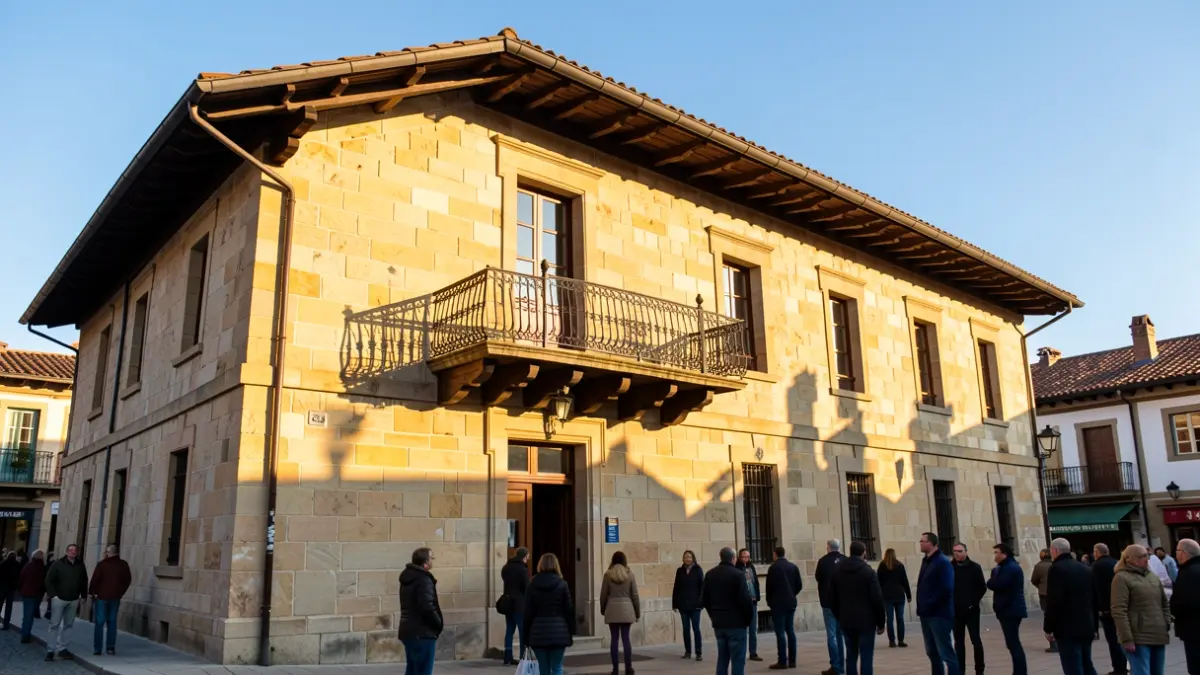
The cultural and historical heritage of the municipality of Zuia is set to suffer a significant loss with the demolition of the old Convent of the Sisters of Charity (or Daughters of Charity of Saint Vincent de Paul), located on Domingo de Sautu street in Murgia. This building, developed around the central volume of the Church, features a neoclassical facade, a curved pediment, and decorative moldings. With over 5,500 square meters of constructed space, it has served various purposes, from religious to educational and residential.
Neither its 150 years of existence nor its imposing stature have been enough for the property owner to reconsider the demolition decision. As early as 2016, the left wing was torn down to expand the new residence, breaking the existing symmetry and causing the loss of its monastic, compact, and harmonious image. The town council has made numerous contacts with different institutions to prevent the demolition, but all efforts have been in vain.
“"The property owner has not altered their stance in the slightest, claiming that the decision had already been made by the community's high-level bodies, and they have not even agreed to meet with town council representatives."
Specifically, a joint visit was conducted with technical personnel specialized in rehabilitations and representatives from the Basque Government's Housing Department and the town council. The conclusion was clear: the building presented no imminent danger of collapse, and furthermore, its configuration regarding floor heights and wall openings gave it great potential for residential use.
The efforts of the cultural heritage department of the Provincial Council of Álava have been equally fruitless. It has been noted that the possibility of giving this building another lease on life would have an undeniable positive social impact, bringing vitality, preferably to young people, to the area and uniting two realities that, unfortunately, are so distant in society.
The town council's project envisioned the majority use of the building for residential purposes, and it did not rule out enabling common public use spaces within the property to foster intergenerational coexistence, as well as service or commercial spaces.