Since the post-war period, a majority of Basque families owned a replica of Guernica and a Zeus bicycle at home. These two symbols, one universal and the other deeply rooted in local industry, encapsulate a significant part of Euskadi's social and economic memory in the 20th century. It is noteworthy that, decades after the conflict and in a completely different international context, a high-level representative from the Soviet Union traveled to Abadiño to personally observe this industrial reality.
The 1972 visit of a Soviet delegation to the Zeus plant in Traña-Matiena introduces an unexpected element that places this company in a scenario transcending local boundaries and projecting into the political sphere. A former mayor of Abadiño and current councilor has studied the history of this firm, indicating that Zeus Industrial S.A. began its journey a century ago. Its founder, Nicolás Arregui Gallastegui, started in Eibar manufacturing bicycle components and spare parts in a small mechanical workshop, at a time when the local arms industry was beginning to reorient itself towards new productions.
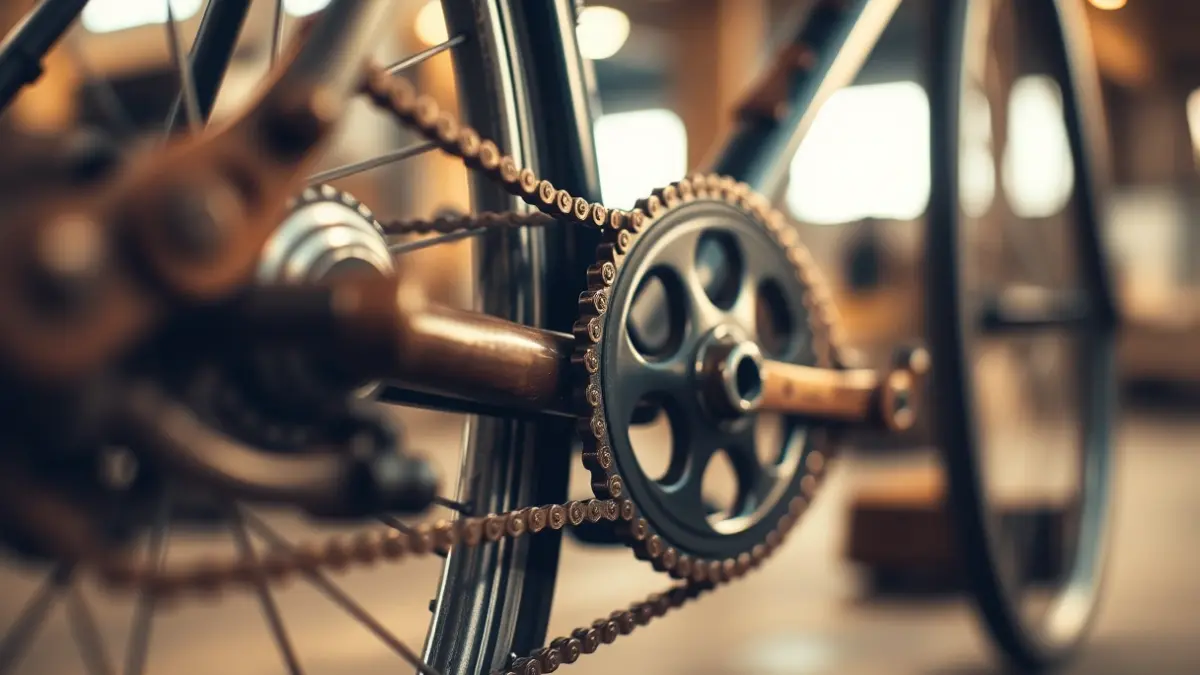
The major leap occurred in the seventies, with the opening of the Traña-Matiena plant, in the building still known as the Zeus pavilion, on Zubibitarte street. There, the company experienced its greatest expansion: it came to employ around 200 people and exported components to more than 60 countries. Significant technical innovations were also developed from these facilities, such as a freewheel presented at the Brussels Motor Show that allowed combining sprockets and configuring different gear ratios according to the cyclist's needs, an advanced solution for its time.
In parallel, Zeus also achieved notable sporting prominence. Its components were present in world titles in road, track, and motor-paced disciplines, as well as outstanding victories in national cycling, such as the 1985 Vuelta a España. The brand sponsored cyclists like Julián Gorospe, Leanizbarrutia, Urien, and Juan Tomás Martínez, consolidating its presence in the cycling elite of the era.
“"Considering that in 1972 Euskadi was under a dictatorship and the Communist Party was illegal, the appearance in Abadiño of a prominent communist leader from the USSR accompanied by an entire delegation must have caused astonishment among the authorities of the time."
It was in this context that, in 1972, Soviet leader Serguéi Pávlovich Pávlov visited the Traña-Matiena facilities accompanied by a USSR delegation. He had been the head of the Komsomol —the youth organization of the Communist Party— for almost a decade, and at that time served as the main leader of the country's physical culture policy, an area that in the Soviet system also encompassed sport. Linked to neo-Stalinist positions, he was part of a generation of cadres for whom industry, social discipline, and physical performance were inseparable elements of the political project.
The Basque factory was then a benchmark in the sector and an example of European industrial development in the cycling field. Its presence, apparently, was not coincidental: the USSR closely observed Western production models amidst the symbolic competition between blocs. The trip was part of a logic of exchange and observation typical of the Cold War, where industry and physical activity also served as ideological showcases. In this context, the visit to Zeus connected a local reality with the global dynamics of the time.
Zeus, at its peak, thus became more than just a company: a meeting point between technical innovation, cycling culture, and international projection.
The company's end came between 1988 and 1989, amidst a deep industrial crisis. Orbea acquired the brand rights and ceased productive activity. The Traña-Matiena pavilion, built in 1960 with more than 2,500 square meters, was subsequently reconfigured. Part of the building was transformed into garages —today used by nearly 70 owners, mostly local residents—, while other floors were allocated for storage and small workshop uses. The old complex still retains the imprint of its industrial past.
Today, the memory of Zeus lives on through the CDCC Zeus Spain, a curious sports club that seeks to preserve its legacy and revive the experience of those bicycles that marked an era in the country's cycling culture. All in all, the history of Zeus allows drawing a line connecting the industrial reconversion of Eibar, the international expansion of the seventies, and the subsequent crisis of Basque industry. In this journey, the initial image —the Guernica painting on the wall and this firm's bicycle at home— ceases to be a domestic scene to become a synthesis of a century: memory, work, and modernity intertwined in the same material culture of Basque steel that for one day was under Soviet scrutiny.