Percussionist Nerea Quincoces (Artziniega, Bizkaia, 1993) boasts a rich musical career, having delved into rock, classical, and contemporary music before focusing in recent years on root music and world rhythms. She passionately engages with pure traditional rhythms, singing, and new compositions, researching Basque percussion alongside traditions from the Iberian Peninsula, Africa, and Cuba.
Although she studied classical percussion, she now teaches folk percussion at the Bilbo Beat music center. Since 2019, she has led Kuttune, a folk and world music band of about ten musicians, aiming to create vibrant music that evokes ancient songs. Additionally, this summer she is organizing the Artzi Folk event for the second time in Lanteron (Araba), offering an intensive course on percussion and traditional singing.
Her decision to pursue percussion, which began at age nine at the Conservatory of Bilbao, stemmed from an innate connection. She was drawn to the "tribality of the instrument," even though at the time "it was unusual for a girl to play percussion." After completing her studies, she decided to explore Afro-Cuban music, and today she considers being able to work in her passion a "life achievement."
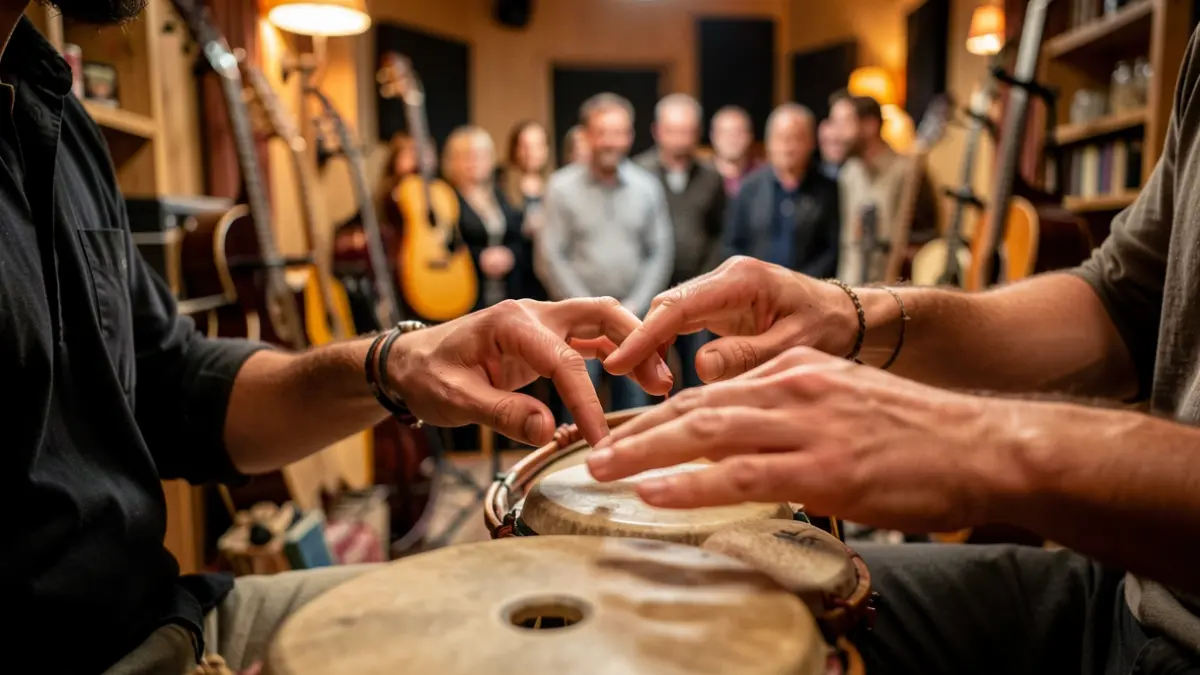
Quincoces is eager to explore global percussion but has primarily focused on the traditions of Euskal Herria and the Iberian Peninsula. She is particularly drawn to African music (Guinea Conakry, Mali, Senegal), Cuban music, and that of the Middle East. Among her favorite instruments are the pandero cuadrado, panderetas, conga, djembe, and the Daf, a traditional Kurdish instrument she is currently learning.
“"When I started playing percussion, due to social stigma, it was unusual for a girl to play percussion"
At Bilbo Beat, she teaches folk music classes, imparting the essence of roots and tradition to her students by analyzing field recordings and works by musicologists. She conveys her perspective, focusing mainly on folk music, such as the original playing style of the well-known pandero from Peñapardo (Salamanca).
Classical percussion is academic music, geared towards orchestras (timpani, marimba, bass drums), and also covers 20th-century contemporary percussion. Folklore, on the other hand, "is the music our ancestors played, passed down through generations," and has not yet been academized.
She recently performed with rapper La Basu in Diyarbakir (Kurdistan) at a festival aimed at highlighting marginalized cultures. The virtuosity in playing the Basque pandero (with its 'tarrapatak' and accents), linked to the trikitixa, distinguishes her, but she finds more similarities with other cultures, such as her experience with musicians from Calabria. The pandero, with its variants found across Europe and the Middle East, has traveled through history.
The pandero is not exclusively a Basque instrument; it can be found throughout the Iberian Peninsula (Galicia, Asturias, Castilla, Extremadura), in Italy (Tamburello), and the Middle East (Riq), as well as in northwestern Africa. Quincoces states, "I've never counted how many types of panderos there are in the world," and she discovers new things daily.
The band Kuttune, founded in 2019, is based on root music but incorporates novel compositions and structures. She has been inspired by references such as the Catalan group Coetus, Eliseo Parra, Oskorri, and the Euskal Barrok Ensemble. Currently, the band consists of ten musicians, and they have released two albums, receiving a positive response from the public.
The Artzi Folk intensive summer course, organized last year, is now in its second edition. It originated from a desire to offer teaching "outside the classroom," attracting new participants. "Folklore is gaining popularity; we live in a social era where people need to connect with their roots," she notes. The course will provide intensive training in traditional Iberian percussion and will include a small concert by musician Carlos Herrero (El Naán).
“"Investigating the differences and richness of each place and folklore seems very interesting to me"