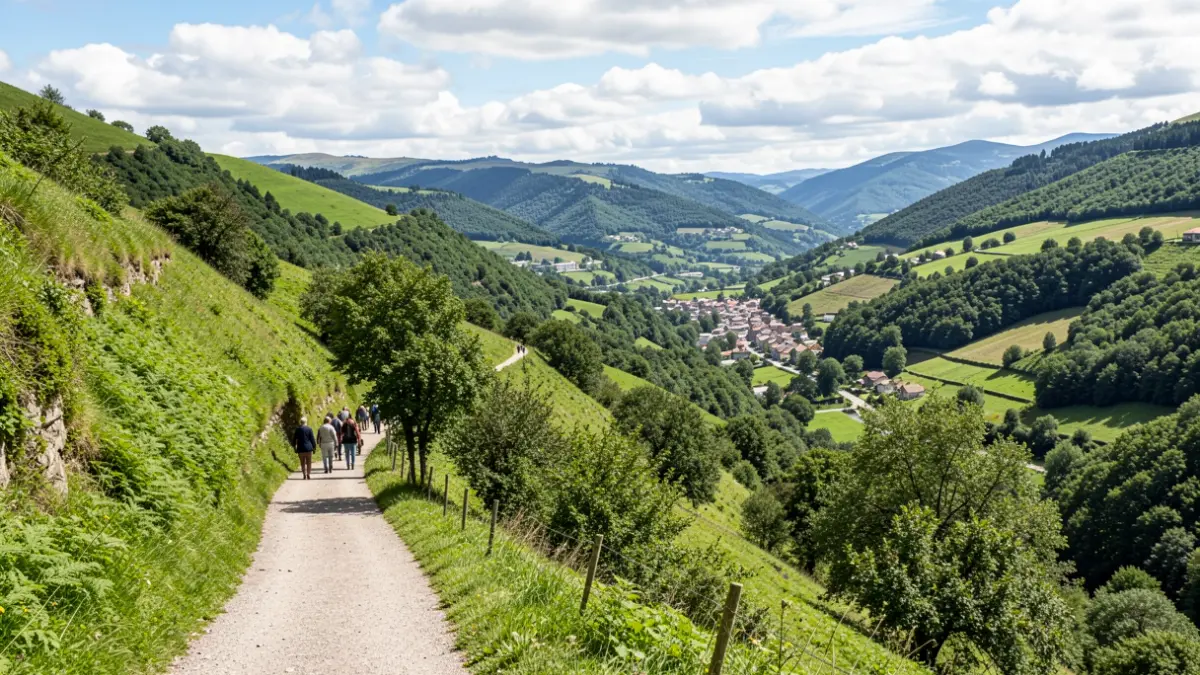
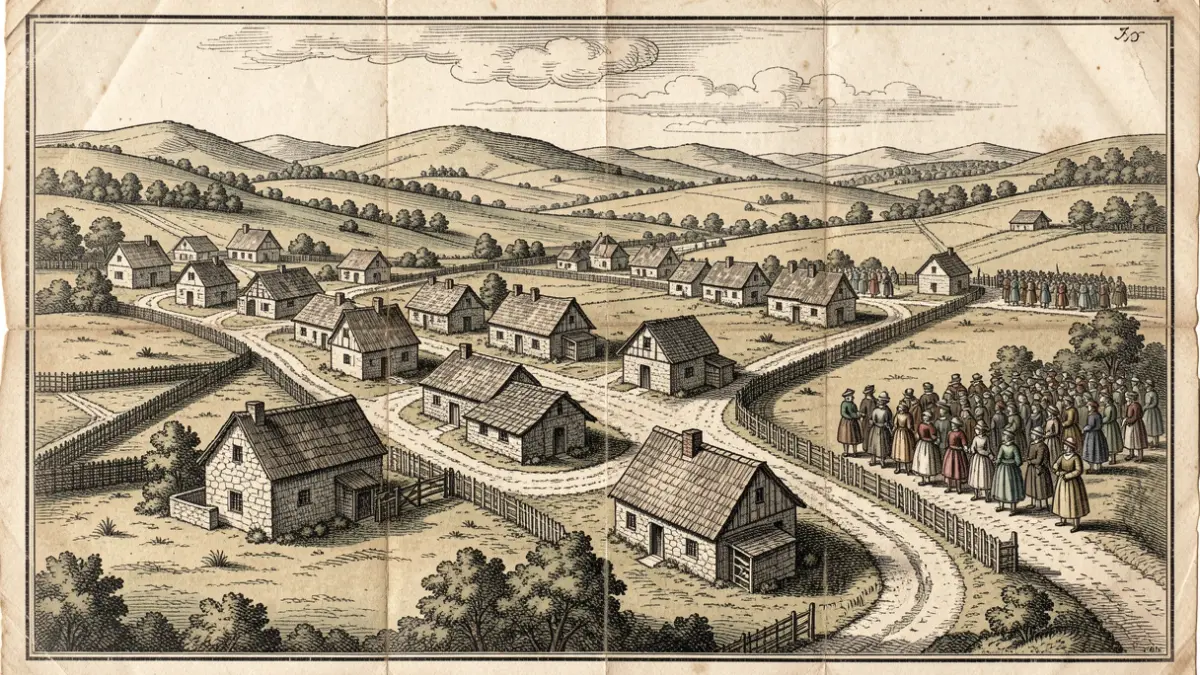
The first street in Zumarraga was Eitzaga. The roots of this neighborhood, which had a rural character, extend deep into history, as demonstrated by two graphic documents recently discovered in the archives of the High Court of Justice of Valladolid and disseminated by journalist Gotzon Aranburu.
The upper plan, created in 1767 by Manuel Ignacio de Murua, shows numerous farmhouses still standing and the ‘new royal road for coaches’ built at that time. It also clearly outlines the route of the previous main road: it went through the stream gully at the bottom of the valley to the Aldasbarren farmhouse, and from there directly upwards, to Eitzaga. The village road that connected both routes, leading to Agirretxeberri, is also shown.
The new royal road used to reach the area between the houses Kortaberri and Ameztinetxeberri, and a few meters below it connected to the old path, which is now slightly altered.
The second plan, from 1877, shows that Eitzaga was a long street. From the hermitage onwards, it had double-numbered doors on one side and single-numbered doors on the other. Although numbered, each house was known by its unique name.
Among the even-numbered houses were: Koletokoa, Serotetxea, Izagirre, Jaureginea, Katekoa, Kalemusu, Labekoa, Urbiskoa, Galantekoa, Urtenea, Tantelu zaharra eta berria. The odd-numbered ones were: Mujikanea, Junrdangoa, Kortaberri, Aranburu, Maioranea, Artetxene zaharra eta berria, Barberokoa, Ameztinetxeberi, Izurtza, Matxinea, Pilutokoa, Sagastiberria, Araizteginea and Ameztinea.
The names of the houses also tell their stories, indicating occupation, location, or tenants. In Katekoa, for example, they used to close the road with a chain to collect the regional tax.