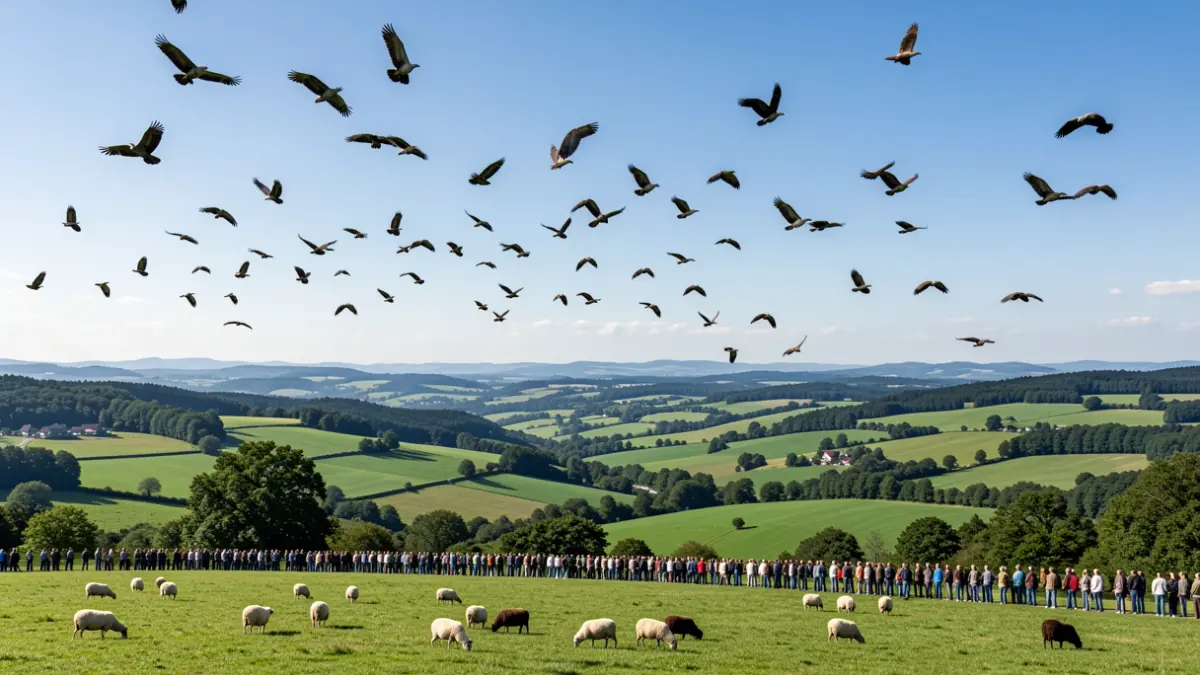
Although vultures are scavenger birds, both farmers and institutional technicians have noticed a change in their behavior in recent years. Attacks by these birds on weakened animals are becoming increasingly common. The latest incident reported in Durangaldea occurred last Friday, at a farmhouse in the Gerediaga neighborhood, where a group of about a hundred vultures killed a sheep and its lamb. The sheep's owner approached the flock upon hearing the dogs bark and was left stunned by what he found: a large group of vultures attacking a sheep and its lamb. Faced with the situation, the farmer could do nothing. "The lamb was born just two days ago and we had taken it out to the pasture with the other sheep. The situation was unbelievable. The vultures were as high as my waist and there must have been about a hundred. This has never happened to us before," explained those affected.
The Provincial Council of Bizkaia has a service to analyze cases of attacks. If cows or sheep are killed due to attacks by protected animals, there is an option to request compensation. Last year, 72 vulture attacks were recorded in Bizkaia, 80% of which occurred in the Karrantza area. In Durangaldea, attacks took place in Elorrio and Zornotza. So far in 2026, 41 cases have already occurred, 26 of them in Karrantza, and the rest in various towns in Durangaldea: Berriz, Zornotza, Mallabia, Mañaria, and Abadiño.
Iñaki Arrazola, head of the Livestock Service at the Provincial Council of Bizkaia, explained that there are two large vulture colonies in Bizkaia that have been growing in recent decades: "The largest vulture colony is in the Karrantza area. After that, we have the one around Urkiola." Considering that the vultures' range is about 100 kilometers, Arrazola clarified that the behavioral changes are due to several reasons: "In the last 30 years, the cattle population has decreased significantly. With less livestock, there are not as many animals in the mountains as before. Furthermore, in 2000, due to the 'mad cow' crisis, all dead animals began to be burned. As a result, the food source for vultures has diminished."