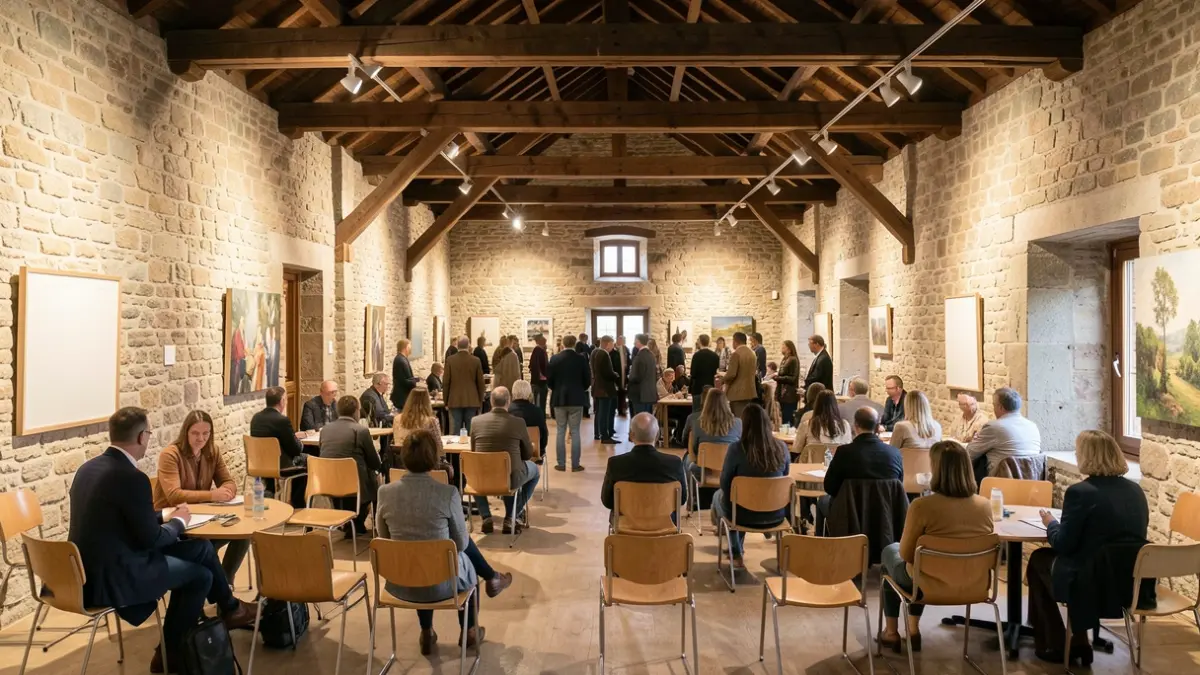
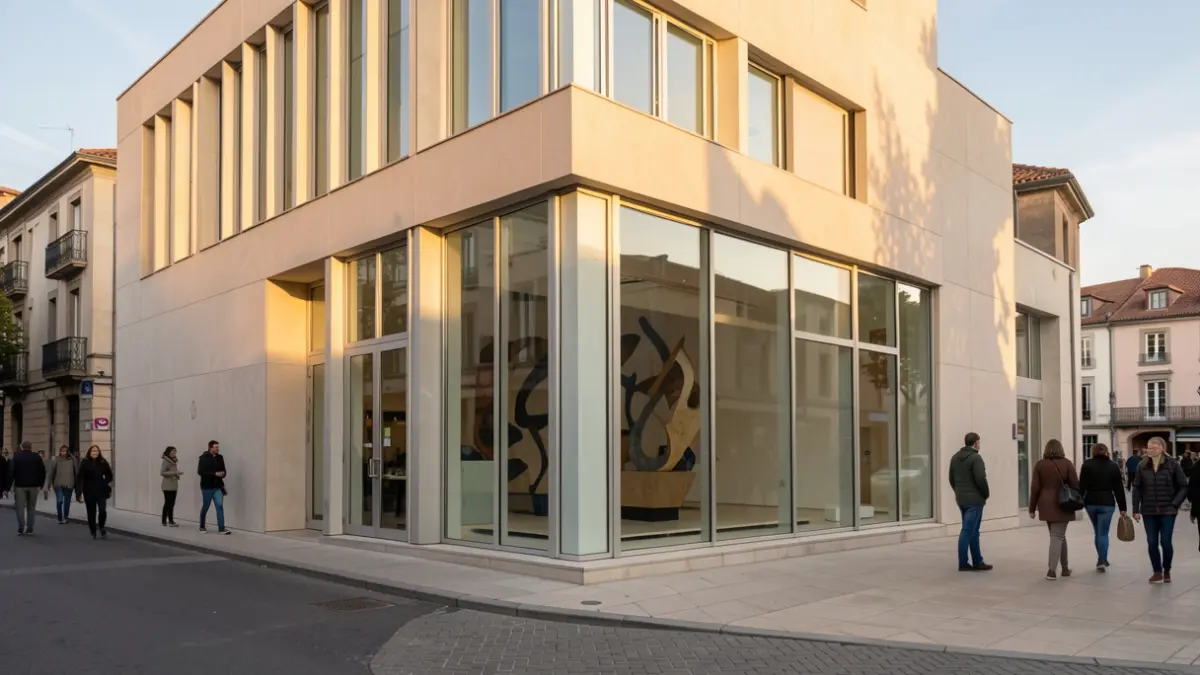
Donostia-San Sebastián. Denis Itxaso, Minister of Housing and Urban Agenda for the Basque Government, has inaugurated the exhibition ‘Peña Ganchegui, arquitecto ilustrado’ at the Euskadi Architecture Institute in Tabakalera. The exhibition brings together fourteen graphic interpretations of the work of Luis Peña Ganchegui (Oñati, 1926 – Donostia, 2009), coinciding with the centenary of his birth. Organized by the Peña Ganchegui Archive, it is the entity's first activity at the Institute's new headquarters and proposes a dialogue between architecture and illustration.
During the opening ceremony, Itxaso highlighted the exhibition's value in approaching the architect's legacy from contemporary perspectives. “It does not invite us to contemplate his work as something finished, nor to admire it from a distance. It invites us to look at it again,” stated the minister, who championed architecture's capacity to continue generating new readings long after its construction.
The exhibition features the work of fourteen illustration professionals from Euskadi and Navarre, invited to freely reinterpret some of Peña Ganchegui's most representative projects. The result is fourteen prints: one dedicated to a caricatured portrait of the architect and thirteen focused on buildings and urban interventions from different stages of his career, using diverse resources such as watercolor, comic, architectural drawing, editorial illustration, or caricature.
The selection allows for a journey through a significant part of the Oñati-born architect's output, from the Vista Alegre Tower in Zarautz, one of his early major projects, to mature residential buildings and facilities. Some of his most recognized public space interventions are also present, such as the Trinidad and Tenis squares in Donostia or the Plaza de los Fueros in Vitoria-Gasteiz, alongside housing, industrial, educational, and religious architecture projects.
“"Suddenly, we understand something essential: the true meaning of that square is not only in its proportions, its materials, or its extraordinary relationship with the environment. It is also in the children playing, in the people meeting, in the life that happens there."
Among the interpretations, the minister particularly highlighted Elena Odriozola's work on the Plaza de la Trinidad, where children playing on the stone steps shift the focus from architectural forms to the people who inhabit and give meaning to the space. He also praised César Llaguno's reinterpretation of the Aizetzu dwellings in Mutriku, transforming them into a mountainous formation connecting architecture with the landscape, as well as Javier de Isusi's proposal for the Plaza de los Fueros in Vitoria-Gasteiz, built from sketches, perspectives, and annotations that recover the close relationship between thinking, drawing, and building.
These different approaches reflect one of the main identifying features of Peña Ganchegui's architecture: his understanding of the project as an intervention necessarily linked to its place, considering topography, landscape, existing city, materials, and ways of life as fundamental elements.
The prints are accompanied by brief biographical résumés of their authors, essential information about each project, and black-and-white documentary photographs of the original works. This combination allows visitors to confront the artistic interpretations with the built reality and discover the multiple readings a single architectural work can evoke.
Denis Itxaso took the opportunity of the inauguration to advocate for the social dimension of architecture and its connection to one of Euskadi's main current challenges: housing access. “Architecture matters because our life happens within and around it,” he stated, emphasizing that the quality of buildings must be accompanied by special attention to public spaces, coexistence, and the relationship of neighborhoods with their environment. The minister acknowledged that good architecture alone does not solve the housing price issue, which requires effective public policies, investment, regulation, land, and agreements. However, he argued that it can decisively contribute to improving the solutions promoted by institutions through smarter resource use, more efficient buildings, quality shared spaces, and more inclusive neighborhoods.
In this regard, Itxaso highlighted the role that the Euskadi Architecture Institute should play, aiming in its new phase at Tabakalera to consolidate itself as an open space for meeting, learning, and reflection, capable of bringing architectural culture closer to the general public. “We want it to be much more than a place to exhibit architecture. We want it to be a space for meeting, learning, reflection, and public conversation,” he explained.
The minister argued that bringing architectural knowledge closer to society is also a way to strengthen citizen participation in decisions affecting the environment. “Architectural culture is also a democratic tool,” he stated. In his view, better understanding the places we inhabit allows us to value what deserves to be preserved, identify what needs to change, and demand higher quality in public interventions.
The exhibition's title, ‘Peña Ganchegui, arquitecto ilustrado’, holds a double meaning. Beyond the fourteen graphic interpretations illustrating the architect's work, the reference to the Enlightenment points to Peña Ganchegui's personal and professional convictions, a staunch defender of culture, education, and critical thinking as drivers of progress and social transformation. In a 1966 letter, the architect defended the need to “achieve progress and civilization through the path of culture and education,” and advocated for a “responsible democratic path.” His admiration for Basque illustrators and the work of architect Silvestre Pérez reflects a conception of architecture inseparable from civic responsibility and commitment to society.
Itxaso emphasized the relevance of that approach, stressing that culture must be part of how institutions face major collective challenges. “Culture does not replace public action. But it can help us imagine it better, demand more from it, and give it greater depth,” he stated.
The inauguration of this exhibition thus marks the beginning of a new phase for the Euskadi Architecture Institute at Tabakalera, with a proposal that connects disciplines, generations, and perspectives, seeking to bring Basque architectural heritage closer to new audiences. The minister concluded by inviting citizens to visit the exhibition and discover the different interpretations of Peña Ganchegui's work. “Cities are not definitively finished realities. They are shared constructions that each generation receives, transforms, and passes on to the next,” he recalled. “Because, sometimes, to start transforming reality, the first thing we need is to learn to look at it differently.”