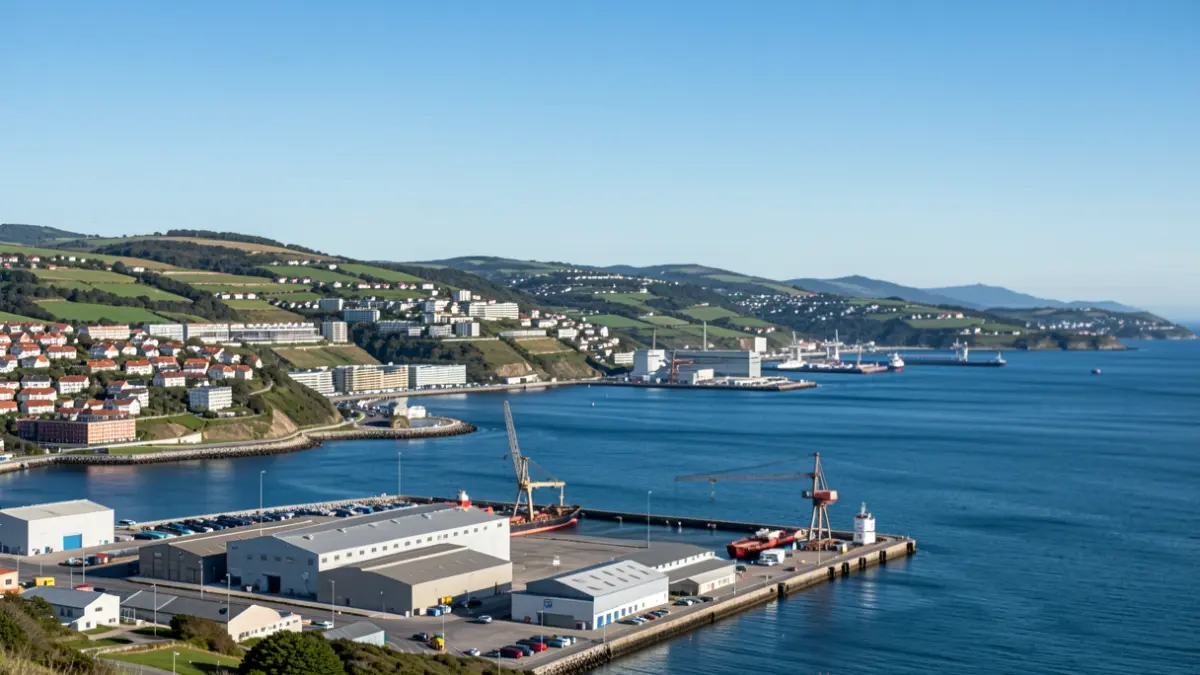
The mayors of Lezo, Pasaia, and Errenteria, led by Mikel Arruti, Teo Alberro, and Aizpea Otaegi, met with the press in Pasai Donibane today to reaffirm the validity of the 'La Bahía del Futuro' document, presented in 2023, and to demand the transfer of competencies from the Port Authority of Pasaia (APP). The three representatives emphasize that the proposals presented three years ago are «fully current» and, moreover, «necessary» to guarantee the social, economic, and environmental future of the bay.
In their appearance, they argued that the Bay of Pasaia cannot continue operating with 19th-century logic and that it is «urgent» to adapt the port-city model to 21st-century challenges. In this regard, the mayors highlight the need to combine port modernization with citizen quality of life, decarbonization, and economic competitiveness.
Arruti raised the issue of truck traffic and recalled that the 2023 document already proposed the need to separate heavy traffic from urban centers. In this regard, the mayors of the Oarsoaldea region recently presented a comprehensive proposal to directly connect the industrial estates of Lezo and Oiartzun with high-capacity roads. Likewise, given the forecast that 90% of port cargo will continue to be moved by truck, the mayors consider it essential to develop a new access to the port.
The mayor of Lezo also denounced the «inadequacy» of the Logistics Plant project and recalled that the four municipalities in the region and several political groups had already agreed on a shared position against this project. In the mayor's words, «it is not legitimate to play politics with fear. Port traffic cannot continue to be organized behind the citizens' backs; the solutions the bay needs require a future vision, not past recipes».
On the other hand, the mayor of Pasaia recalled that years of requests, citizen pressure, and legal obligations have led the port of Pasaia to begin implementing a series of measures, such as the electrification of the docks. In Alberro's words, «this measure not only directly affects decarbonization but also noise reduction and citizen quality of life, but it arrives a decade late». Along the same lines, he pointed out that the integration of sustainable air, noise, and water quality measurement systems into the port's strategic plan, as the bay's mayors had requested, is «a step», but he noted that until now, pollution control has been subject to citizen complaints: «Modernization cannot be mere propaganda; it must have a real impact on the quality of life of the residents».
Blue Economy
The mayor of Errenteria, for her part, considered a change in the governance model between the port and the neighboring towns «essential». According to Otaegi, the interests of the port and the citizens are not opposed: «we have been with port workers and operators, and many of the measures they propose coincide with those demanded by the citizens, and go against what the port has proposed in its strategic plan».
The mayors argue that the transfer of port competencies is key to accelerating the necessary public investments. They also ask the Government to reactivate the Berpiztu fund, considering that the bay still needs major transformations.
Finally, the mayors highlight that the Port of Pasaia plays a strategic role in the Basque economy, with blue economy, decarbonization, and opening new opportunities related to innovative activities. To this end, they ask that port spaces be made available to companies that promote innovative activities and new jobs.