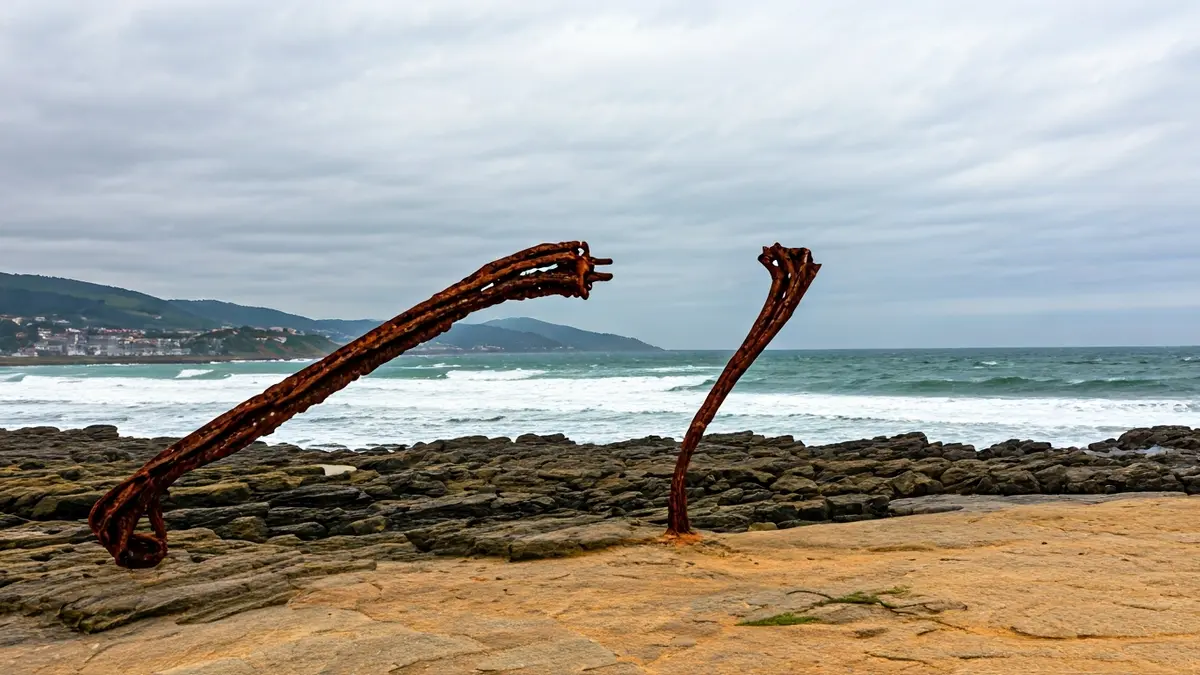
The Central Prison of Saturraran, demolished in 1987, was one of the most repressive symbols of Franco's regime for women. Between 1938 and 1944, over a hundred inmates and an unknown number of young children disappeared within its walls. In 2007, the Basque Government inaugurated a memorial, an iron diptych by the great Basque artist Néstor Basterretxea, to commemorate the horror suffered by more than 4,000 women.
Initially, survivors and their families watched with hope as memory seemed to pave its way. However, during a first visit in 2019, the memorial was found to be decontextualized and deteriorated, sharing space with a shabby and degraded picnic area. This situation highlighted the extent of the work's abandonment and decay.
During a second visit in 2021, although the two parts of the ensemble were more easily located, corrosion had already affected the entire structure. The latest visit, made during the past Easter Week, has confirmed that Néstor Basterretxea's work has literally lost its verticality, with one part expected to fall soon. The damage is irreversible.
This situation raises questions about the responsibility of the Mutriku City Council in maintaining the memorial. Why are metals allowed to rust? Is it not the responsibility of the Mutriku City Council to keep them polished? Does the fact that only three of the 118 inmates whose names are engraved on the diptych were Basque diminish the weight of our memory's foundation? Does the recognition of violence weigh less when it is perpetrated against women and against specific women?
It is documented how mothers imprisoned there had their children taken from them, but to what extent can the denial of the crime of baby theft unfold in the Spanish State? Some answers lie in the empty mold of Saturraran.