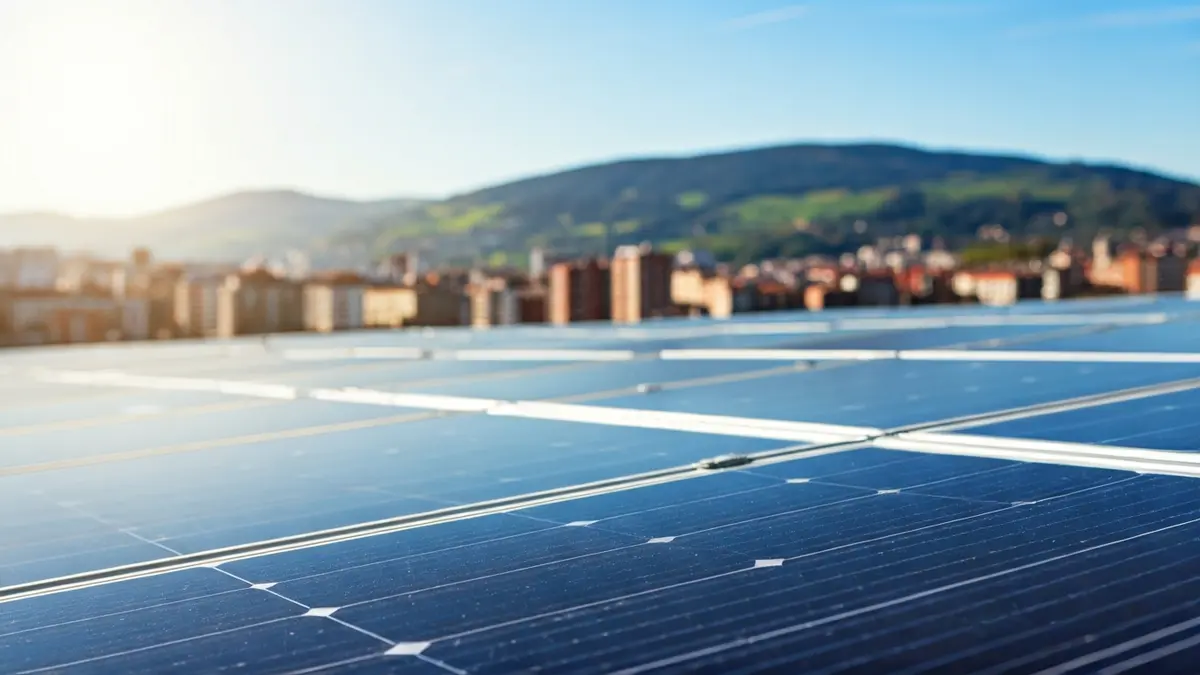
This study, named the Laudio Solar Map, provides detailed information building by building, specifying the potential for renewable energy generation and its contribution to emission reduction. According to Councilor Carmen Altuna, the document facilitates the path towards the sustainability of the municipality's energy model.
Laudio's solar generation potential amounts to 90.09 GWh/year, meaning that photovoltaic production could cover 47% of the electricity demand. This could lead to self-sufficiency in the residential and tertiary sectors. The residential sector, with 1,462 buildings, could generate up to 22.59 GWh/year, exceeding the consumption recorded in 2023 (16.47 GWh/year).
The industrial sector, with 403 buildings, has the largest rooftops and, therefore, the greatest generation potential, reaching 49.99 GWh/year. However, this production would only cover approximately 31% of its high annual consumption (160.81 GWh/year). The tertiary sector and others could generate up to 17.51 GWh/year, a figure also higher than their reference consumption in 2023 (14.46 GWh/year).
“"Overall, the total solar generation potential of the municipality amounts to 90.09 GWh/year, compared to a global consumption of 191.27 GWh in 2023. This means that photovoltaic production could cover approximately 47% of the total electricity demand, achieving self-sufficiency in the residential and tertiary sectors."
In addition to the study, the City Council has also launched an interactive online viewer, available on the municipal website. This tool allows citizens to easily ascertain the solar potential of any building in the municipality. Through an intuitive search system, anyone can locate their home or building and obtain immediate information on the total roof or plot area and the usable area available for the installation of photovoltaic panels; as well as data related to the installable power, potentially generable energy, and avoidable CO₂ emissions.
The tool also provides information on the estimated cost of the installation, along with additional indicators that facilitate decision-making and investment prioritization. With the solar map and the interactive viewer, the Laudio City Council, which has been installing solar streetlights in the most rural areas for several years, reinforces its commitment to energy transition, making information available to citizens to promote renewable projects and self-consumption in the municipality.
Some projects are already underway thanks to educational centers. In fact, in 2024, the institute installed 72 solar panels on the roof of its fronton to reduce its electricity bill; and the ikastola also has another 100, which generate a large part of the energy consumed by the center.