
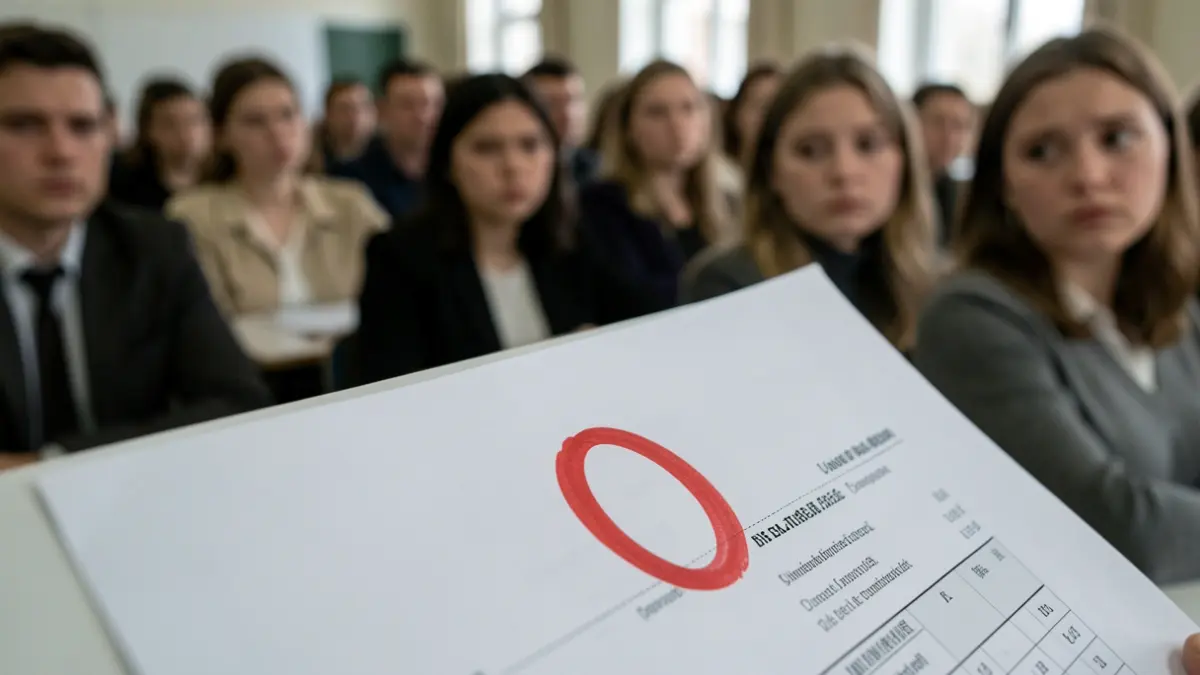
Several state-subsidized schools in Bizkaia, such as Ayalde-Munabe, have voiced concerns regarding the zeroes received on the Basque language exam for the University Entrance Exam (PAU). Eloy Olabarri, director of Ayalde-Munabe, stated that the review of the grades was "very poor" and that the results "almost replicated the initial scores," with no failing student managing to pass.
This situation, described as "unexpected," has caused significant unease within the educational community. In response, school associations, the institutions themselves, and families are discussing "what next steps to take." The primary demand to the UPV is to "guarantee student anonymity," not just nominal identification, so that "it is not known which school they are from".
Furthermore, an explanation is sought for the "statistical anomaly," as the second correction has not clarified why "the vast majority of bad grades and zeroes correspond to a single examiner and among surnames ranging from i to z." The ultimate goal is to "support our students as much as possible so they have equal rights of access to public universities".
Begoña Pedrosa, the Minister of Education, revealed that nearly half of the zeroes on the Basque Language and Literature exam were assigned by a single examiner. Specifically, 79 out of the 162 registered zeroes, 49% of the total, are attributed to one corrector. This fact has led Pedrosa to demand "a transparent explanation" from the EHU Rectorate.
During her appearance before the Basque Parliament, the minister stated that the concerns of students and their families "were not unfounded," as the data shows "a distribution of results that deviates from what is statistically expected." According to information provided by the EHU itself, tribunals 11 and 12 concentrate 64.3% of the zeroes, and in tribunal 11, with one exception, all exams graded with a zero "were evaluated by a single person".
In response to these accusations, the rector of the EHU, Joxerramon Bengoetxea, defended the "independence and objectivity" of the evaluation process against "social, media, and political pressure." Bengoetxea described it as "unacceptable to convey to society the idea that generalized arbitrariness exists or to question the professionalism of those involved in the evaluation, without objective evidence to support it".
The rector insisted that grades "must respond solely to the application of evaluation criteria and legally established review procedures." As proof of the system's "thoroughness," he indicated that after the second correction, zeroes in tribunal 11 decreased from 76 to 11, and the total for the subject dropped from 168 to 110. "This demonstrates that the review system is guarantor-based".
As a possible "hypothesis" for the increase in zeroes, Bengoetxea pointed to "new evaluation criteria," established by "royal decree," for language exams, which penalize spelling errors more heavily. "It's possible that students reached a score of 1.5 or 2 and then, upon applying the spelling criteria, ended up with 0," he argued.
For her part, Minister Pedrosa lamented the lack of formal communication from the EHU and emphasized that, while the Basque Government "does not correct exams, it does demand guarantees." She recalled that the future of thousands of young people is at stake and that, therefore, "it is not enough to simply review the grades".
Pedrosa has proposed several lines of improvement, such as "enhancing inter-institutional communication protocols," "publishing the composition of the tribunals," and studying more "balanced" distribution methods for students. Additionally, she proposed moving towards a "much more precise and clear internal regulation" for the organization of the tests. These improvements are open for analysis by the minister, while more than one unresolved question remains.