Bea Campos, a content creator known on social media as @beacamposgv, has published a video that has captured the attention of weekend getaway enthusiasts. The destination is San Miguel de Ereñozar, a viewpoint located in the municipality of Ereño that, in her own words, is “spectacular”.
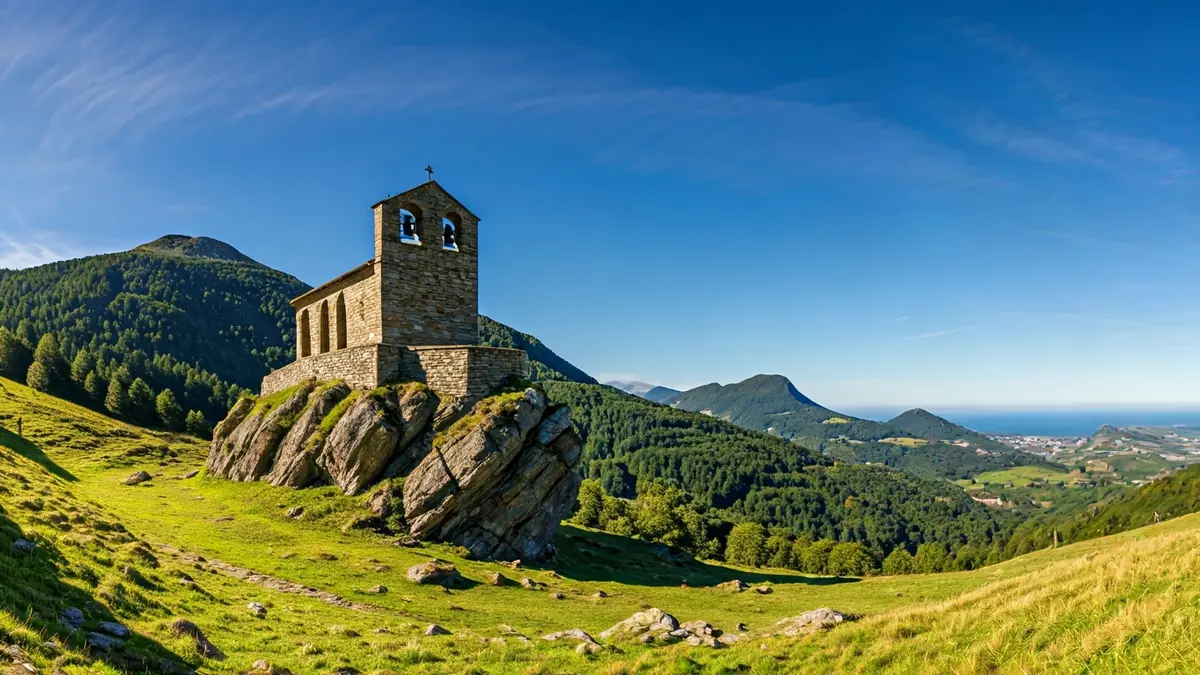
“"San Miguel de Ereñozar is located in the municipality of Ereño, above the Santimamiñe caves, on the summit of Mount Ereñozar."
The hermitage stands at an altitude of 446.5 meters and, as Campos emphasizes, is “visible from almost all points of the Urdaibai Biosphere Reserve”. However, this humble hermitage is the last survivor of a place with a rich history dating back to before the year 1000. Bea Campos also points out that “this hermitage was apparently the original parish of Ereño, and long before that it was a castle”.
The hermitage was built in the 10th century by tenant farmers dependent on the lords of Bizkaia, and served as the parish of the anteiglesia of Ereño until 1660, when the current parish church was built in the Elexalde neighborhood. But before being a hermitage and parish, it was indeed a castle, whose existence is documented in the chronicles of Alfonso XI. Archaeological excavations in 2008 confirmed the presence of defensive structures and a medieval necropolis next to the hermitage. The foundations of the ancient wall are still visible around the mountain's esplanade. In 1409, during violent factional struggles, the castle was razed, and only the hermitage survived.
The easiest access starts from the urban center of Ereño, via an asphalted road that begins just behind the Town Hall and ascends along the northeast of the mountain. By car, one can reach about 200 meters before the hermitage, and on foot, the ascent takes between 45 minutes and an hour.
Mount Ereñozar is not only notable for its medieval history. At its foot, on the slope descending towards Kortezubi, are the Santimamiñe caves, declared a World Heritage Site by UNESCO in 2008 as part of the Paleolithic cave art complex of the Cantabrian coast. Inside, 47 cave paintings from the Magdalenian period are preserved, dated between 14,500 and 12,000 years before the present. Since 2006, the cave has been closed to the public for conservation reasons, although the archaeological vestibule can be accessed, and a 3D virtual tour can be taken at the interpretation center located in the San Mamés hermitage.