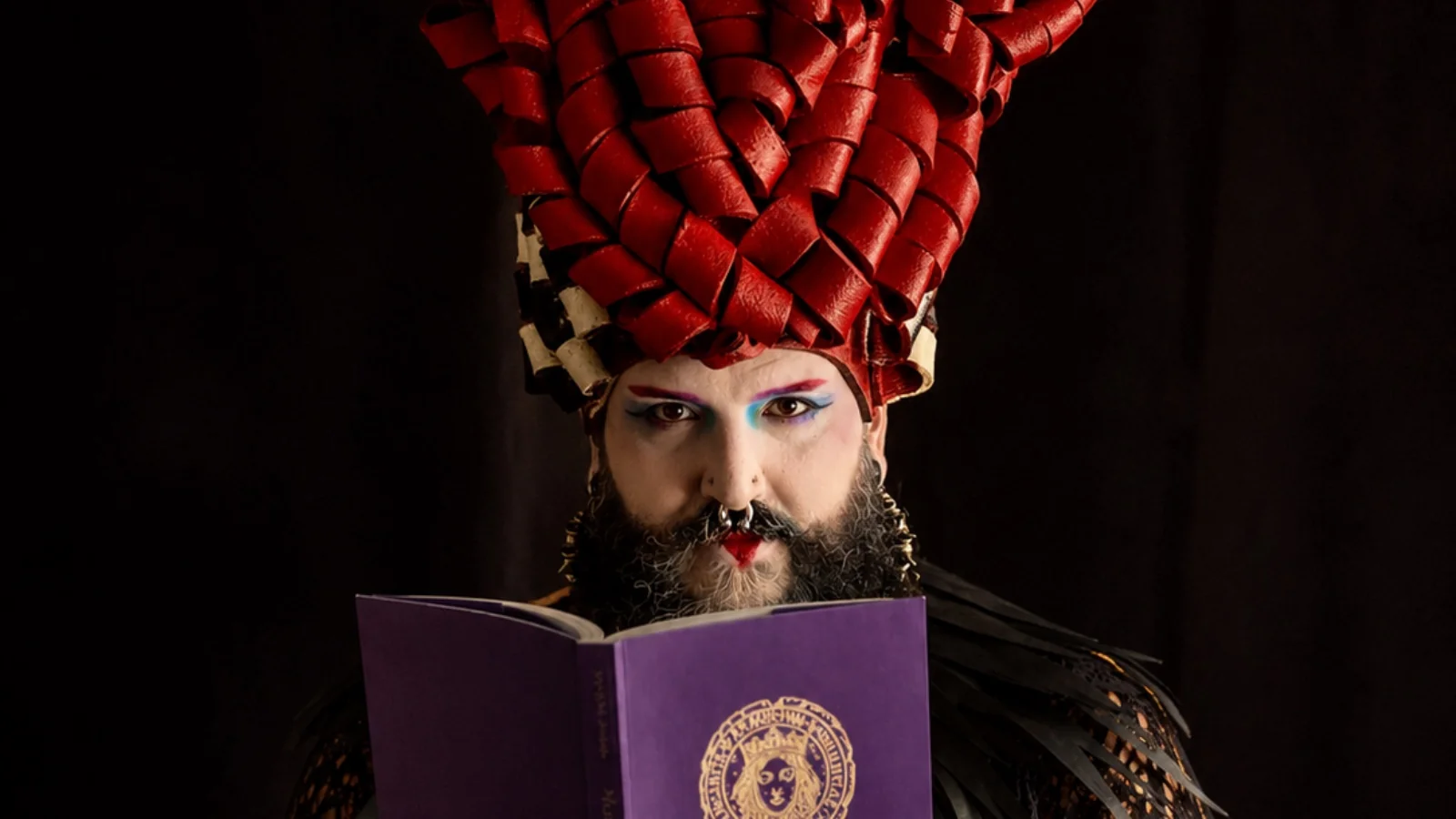
“"I have mixed historical research, illustration, spirituality, and queer memory to reconstruct Margarida's figure from another place."
There are stories that survive for centuries reduced to a few lines in a document. Margarida Borràs's is one of them. In 1460, in medieval Valencia, a person born male in Mallorca and belonging to a family of notaries was publicly executed after having lived as Margarida. Her story was recorded by the chronicler Melcior Miralles and, more than five hundred years later, continues to raise questions about life, gender, and forms of dissent in medieval society.Now, Rubén Antón recovers her story in Margarida Borràs, the one who was man, a historical novel that stems from years of research, archival work, and study of the social context in which Margarida lived. The book does not focus solely on the end of her life. Its purpose is to literarily reconstruct all that might have existed behind the few lines that have survived in the documents.
A novel built from research
For years, Rubén Antón has been developing an artistic and research project dedicated to recovering LGTBIQ+ historical memory. Through Drag is Burning, she has researched and disseminated stories of transvestism and sexual and gender dissent through exhibitions, publications, television, and other cultural projects.
Margarida Borràs, the one who was man represents a new step in that work: transferring that research to the field of historical fiction. To construct the work, Antón has worked with medieval sources and archival documentation, attempting to reconstruct both Margarida's life and the social world that surrounded her.
The novel starts from known historical data and uses fiction to explore what the documents did not preserve: her childhood, her family relationships, her arrival in Valencia, the people she might have known, and the circumstances that might have led her to build a life of her own away from Mallorca.
The result does not aim to present as historical facts what belongs to fiction, but rather to use literature to give life to the spaces left blank by documentation.
A Mallorcan woman in 15th-century Valencia
Medieval sources indicate that Margarida was of Mallorcan origin and the daughter of a notary. She later moved to Valencia, where she lived as Margarida Borràs and was recorded in Melcior Miralles's diary. On July 28, 1460, she was publicly executed in the Plaça del Mercat in Valencia.
The exceptional nature of her story also lies in the information that, despite the centuries, has reached us about her way of life and public presentation.
Antón avoids automatically transferring contemporary categories to a 15th-century person and places her in the limbo of gender binarism. The novel draws on the words and deeds preserved in the sources to try to understand Margarida as an androgynous person within her own historical time. The book's title comes precisely from the way the medieval chronicler referred to her.
A new finding about the Borràs family of Inca
During the research for the novel, Rubén Antón visited the Arxiu de la Corona d’Aragó in Barcelona, where she located documentation related to members of the Borràs lineage involved in notary work in Inca during the first half of the 15th century.
Among the records found, the name Arnau Borràs appears repeatedly, documented in the years preceding Margarida's execution. The coincidence is particularly relevant when cross-referencing different elements: the surname Borràs, the profession of notary, the location in Inca, and the chronology of the records.
Furthermore, the name Arnau Borràs appears across different generations of the family lineage linked to notary work in the north of the island. One of them is registered in archives authorized by Alfonso V of Aragon (the Magnanimous) on a date compatible with the generation to which Margarida's father would belong.
The located documentation does not contain an explicit formula identifying one of these Arnau Borràs as Margarida's father. The connection is a genealogical reconstruction based on the set of records found. However, the finding provides a new avenue for investigating the family origin of a woman whose Mallorcan provenance was already recorded in historical sources.
For Antón, this archival work allows placing Margarida's story within a specific family and social context: that of the notary families of Inca in 15th-century Mallorca.
A story between Mallorca and Valencia
Margarida's life journey thus connects two territories of the Crown of Aragon. Mallorca appears as the place of family origin; Valencia, as the setting where she lived her adult life and where she was finally executed.
This displacement also constitutes one of the central elements of the novel, which reconstructs a person's journey between two societies and two moments of her life, exploring the family, social, and affective relationships that may have been part of her existence.
Beyond the circumstances of her death, Margarida Borràs, the one who was man poses an essential question: who was Margarida really? We knew how she died but not how she lived.
Memory as a starting point
The publication of the novel continues Rubén Antón's trajectory in recovering stories that have been left out of traditional historical narratives.
Her work combines research, artistic creation, and dissemination to recover LGTBIQ+ characters and experiences, giving them back a space of memory and celebration within contemporary culture.
With Margarida Borràs, the one who was man, Antón now turns a documented figure from 15th-century Valencia into the protagonist of a historical novel and, at the same time, recovers part of her life and her own Mallorcan origins.
More than five hundred years after her death, Margarida Borràs and her story are more alive than ever.
Through writing that blends archive, symbolism, and contemporary sensibility, Rubén Antón restores voice, dignity, and presence to a figure erased for centuries by official history.