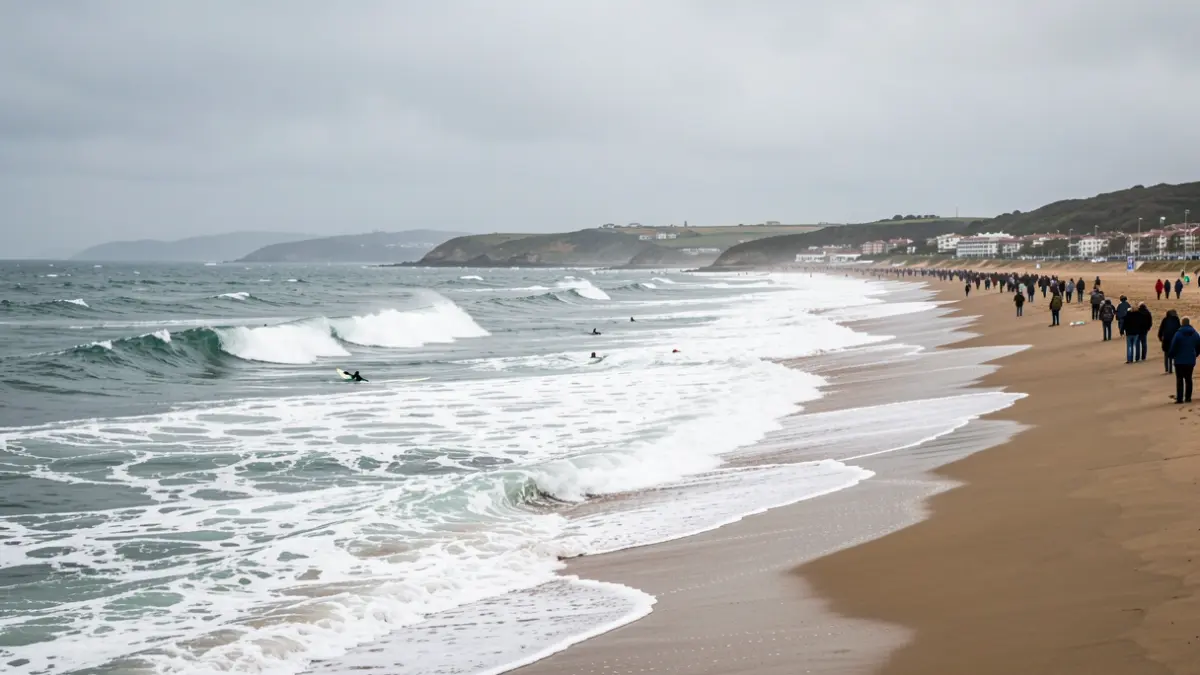
With summer just around the corner, the quality of water at Bizkaia's beaches is a crucial parameter for both locals and visitors to enjoy the season without issues. For the upcoming campaign, the Basque Government's Department of Health has planned more than five hundred samplings to ensure that the sandy areas meet the necessary sanitary requirements. These samples, supplemented by additional or extraordinary ones if needed, will be taken at 36 points distributed across all beaches in the territory.
For over 35 years, the Department of Health has been responsible for monitoring the sanitary condition of bathing areas in Euskadi, controlling both the hygienic-sanitary conditions of the water quality and its surrounding environment. This surveillance relies on the collection of water samples to control mandatory parameters and their subsequent qualification based on analytical results. Based on this qualification, recommendations are then made for healthy bathing conditions, informing citizens about water quality and any potential contamination episodes, exceptional circumstances, or anomalous situations that may arise.
Each season, a specific number of samples is scheduled, taking into account the number of bathing areas and sampling points per area. The collection frequency varies depending on the point, intensifying in those with a higher possibility of short-duration contamination episodes. Thus, in most cases, during the official bathing season for each beach, samples are taken weekly, although in others, it is done every fortnight. Prior samplings are also carried out to ensure that the beach season begins with the water in good condition.
In Bizkaia's beaches, 36 sampling points have been established, depending on the extent of the sandy area: some, like La Arena, Gorliz, or Arriatera-Atxabiribil, have up to three; Ereaga, Barinatxe, Laida, or Karraspio have two; while a single sample is taken in the remaining ones: Portu Txiki (Zierbena), Las Arenas, Arrigunaga, Azkorri, Muriola, Plentzia, Armintza, Laidatxu, Toña, San Antonio, Ea, Isuntza, or Arrigorri. Points are chosen to be representative of water quality and the area where most bathers gather.
Samples are usually taken in the mornings, starting from 6:45 AM, provided there is natural light. In case of incidents, samples can also be collected in the afternoon, which must be kept refrigerated (below 8ºC) until delivered to the laboratory the next day. It is recommended to take them at a depth of at least one meter and 30 centimeters from the surface, whenever sea conditions allow. Labeled and accompanied by a form including the state of the beach, sea conditions, temperature, or possible incidents during collection, they are then transported refrigerated to the Sub-directorate of Public Health and Addictions of Bizkaia, located in the Derio Technology Park, where they are analyzed before 11:00 AM. In the case of extraordinary samples collected the previous day, they are delivered to the laboratory before 9:00 AM.
In most of these points, 19 samples will be taken during the four months of the beach season, between June 1st and September 30th, totaling 570 throughout the summer. Samplings will be weekly in La Arena, Portu Txiki, Las Arenas, Ereaga, Arrigunaga, Muriola, Plentzia, Gorliz, Armintza, Laidatxu, Aritxatzu, Toña, San Antonio, Laida, Ea, Isuntza, Karraspio, and Arrigorri, and fortnightly in Azkorri, Barinatxe, Arriatera-Atxabiribil, Bakio, Aritzatxu, Laga, and Ogella. In Las Arenas, Toña, San Antonio, and the Karraspio estuary area, controls will be intensified, up to three in the same week, in situations of rain or incidents. Ordinarily, controls are carried out every Monday of the season.
This ordinary dynamic is modified when contamination episodes or other circumstances alter water quality; in these cases, samples are repeated until the water is confirmed to be suitable for bathing again. Over recent years, the number of these unscheduled samples has increased considerably. This is partly because water quality standards are becoming stricter, and partly because intense rainfall is recorded every season, altering water quality with increasing frequency and intensity due to climate change. Furthermore, the processing time for samples and obtaining results is becoming shorter, allowing for multiple samples to be collected within the same week.