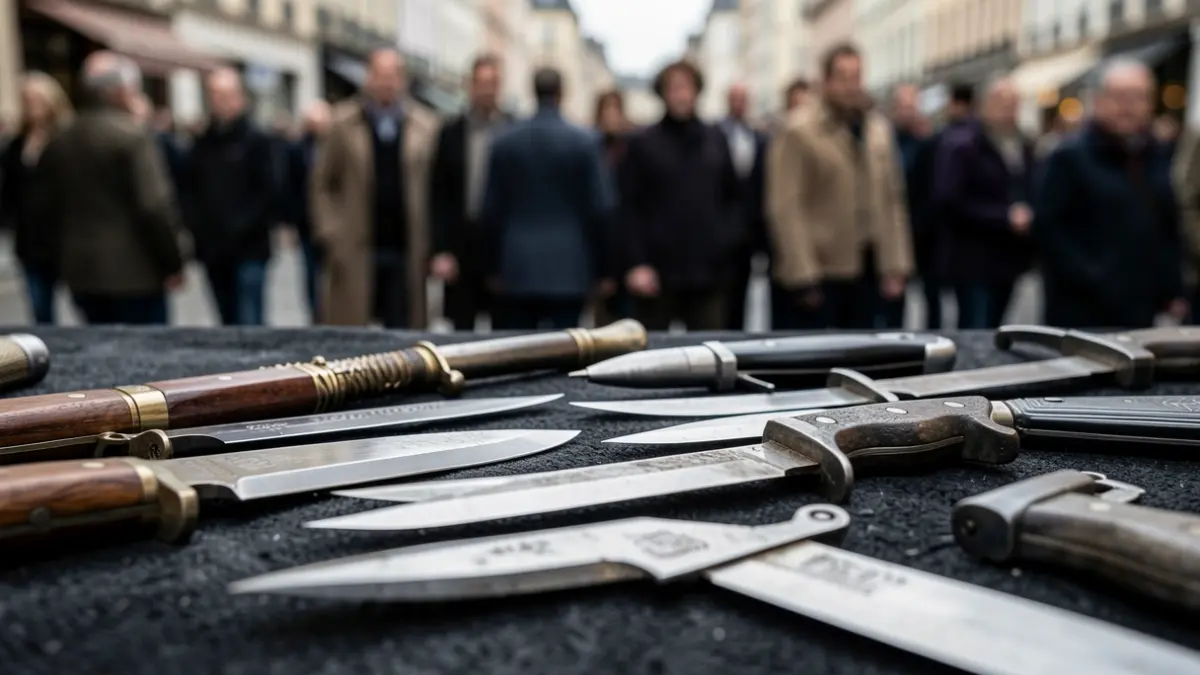
The Ertzaintza and local Basque police confiscated a total of 1,999 bladed weapons from the streets of Euskadi last year, 117 more than in 2024, according to data from the '2025 Report on the State of Public Security in Euskadi', presented by Minister Bingen Zupiria at the Basque Parliament. Half of these were knives, a quarter were kitchen knives, and the remaining 520 objects included items like brass knuckles, batons, or metal bars.
Zupiria warned that their use is becoming "normalized among certain social groups," something to which they are not accustomed, due to the "cultural changes" and "customs" that Basque society is experiencing. The crimes where bladed weapons are most frequently detected are robberies, assaults, and public disturbances, particularly during weekends and at night, between 10:00 PM and 5:00 AM.
The seizures primarily occur in public spaces, parks, and gardens. 57% of those carrying these weapons are of Spanish nationality, meaning 43% are foreigners. Crimes involving bladed weapons account for only 1% of the total, and in some typologies, a higher presence of "citizens with integration problems" is noted.
“"We cannot normalize carrying a bladed weapon on public transport or at a crowded event."
The minister acknowledged that crime involving bladed weapons has seen "a resurgence in some urban areas and those with high activity," despite the plan implemented by the Ertzaintza, and that videos of these incidents have "rapid visibility on social media, generating social alarm." He recalled that the PNV has promoted legal modifications to toughen their possession.
Zupiria admitted his "concern" over the increase in completed homicides, which doubled in 2025, due to "settlements, drug trafficking, or gender violence (5)." Among these, three street attacks occurred due to "psychotic episodes from mental illnesses and addictions or misuse of medication."
For the PP's spokesperson on Security matters, Ainhoa Domaica, the bladed weapons plan has "failed," as it "has not achieved the objective of removing them from the streets; instead, there are more and more, and the danger is increasing." Regarding the rise in the "most serious crime," which is taking a life, a "75%" increase seems "unbearable" to her.
While Domaica sees the presented statistics as reflecting an increase of 2,216 crimes (+2%) compared to the previous year, with 1,303 more cybercrimes and 913 more in-person crimes, Zupiria interprets it as a "stabilization" of crime.
The popular representative highlighted the "exponential increase" in some crimes in Álava and its capital, Vitoria, compared to the decrease recorded in Bizkaia, Gipuzkoa, Bilbao, and San Sebastián. She cited thefts as an example, which are up 5% in Euskadi and 15% in Álava; home burglaries, which grew 16% in the Alava territory versus only 5% elsewhere. Robberies with force in businesses generally decreased by 21%, but in Álava they rose by 30%, as did violent robberies, which saw a 3% decline in Euskadi but increased by 28% there. "What is happening?" she asked.
Security issues have risen to second place, after medical matters, as the main reasons for the majority of the 803,000 calls received by the 112 emergency phone line.
Miren Gallastegi, from the PSE, stated that "public security cannot be analyzed from the coldness of statistics or the impact of a headline" and urged to "flee from simplistic and alarmist discourses." "Euskadi is a safe society. We must avoid denying problems, but without falling into political confrontation."
For Gorka Ortiz de Guinea of EH Bildu, "the negative perception of security is being spread with a political objective," but "our country is a safe place to live, when compared to its surroundings or other European regions." "Things happen, sometimes serious ones. We need prevention and Police, but we cannot fall into the right-wing discourse," he reproached.
The Basque firefighting helicopter, which began operating in September 2024, had to leave Euskadi twelve times to participate in firefighting efforts in Navarra, León, and Burgos in 2025, mostly in August, as revealed by Minister Bingen Zupiria. Additionally, it was mobilized over a hundred times and completed 70 days of training. Among other notable data from the 2025 report, traffic accidents and driver fatalities increased by 190. Although motorcyclist victims on the road have decreased, cyclist fatalities have grown by 16%. The Arkaute Police and Emergency Academy trained a total of 15,600 people, and 28 security forums have been held in Basque regions, the latest in Erandio.