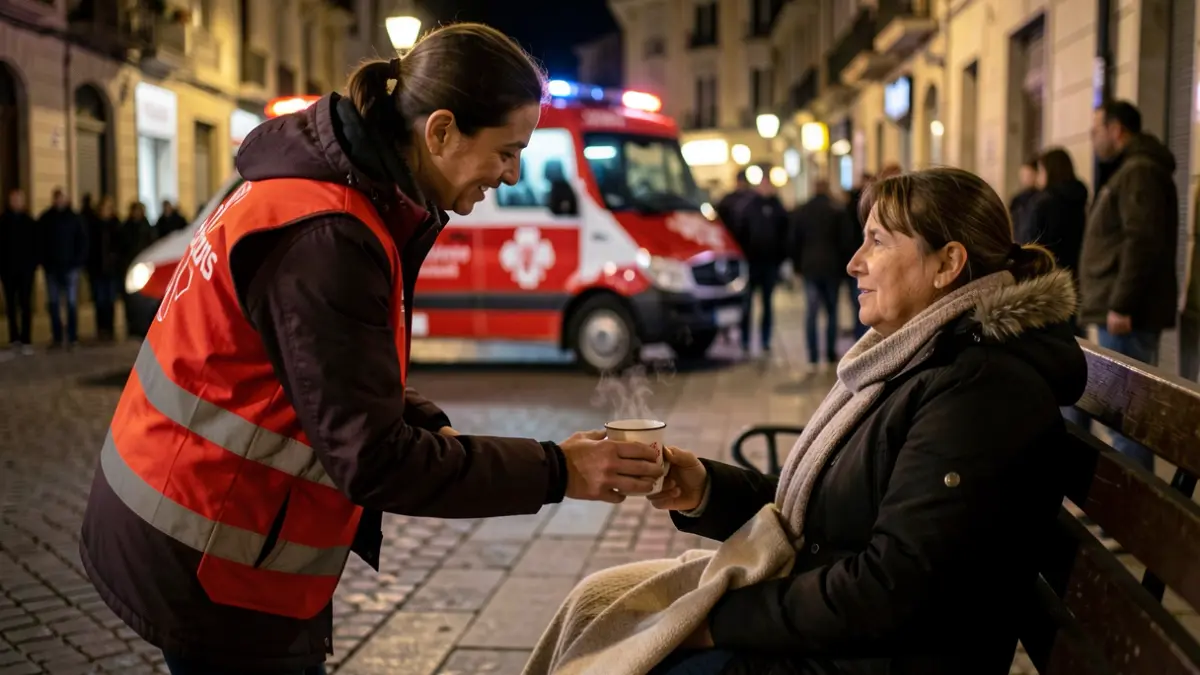
Before midnight, at the Cruz Roja garage in Vitoria-Gasteiz, volunteers are busy preparing. They make hot coffee, prepare sandwiches, and check blankets and sleeping bags. Afterwards, several vehicles begin their routes through the city streets to find people who will spend the night outdoors.
These are the Social Emergency Units (UES), a service that assists homeless individuals year-round. They offer food, hot drinks, and hygiene kits.
Josebe Amado, a volunteer, has been on these routes for over a decade. "I heard about this UES project and thought, I'll take a look", she recalls. Initially, there were only four volunteers, but she enjoyed the experience so much that she has continued ever since.
“"For me, it's a satisfaction to be able to do something for people who are on the street. At the end of the night, you think: I know this person has eaten something warm today."
The UES have been operating in Vitoria-Gasteiz since 2014. They typically go out at least four nights a week, although the program is prepared to run from Monday to Friday. The routes start around 10:00 PM and finish around one or two in the morning. The first stop is always the Cruz Roja garage, where some individuals are already waiting.
The number of people assisted varies depending on the time of year. On some nights, they assist 70, 80, or even close to 100 individuals. Winter is the toughest period and when they find the most people on the streets.
Josebe recalls finding more people in areas such as near the Jesus Guridi Conservatory and in the El Pilar neighborhood, where makeshift settlements had formed.
Contrary to what many might think, cold weather does not empty the streets; sometimes the opposite happens. Many people try to spend the night in shelters or temporary resources, but there isn't always space. "The cold season is when there are more people", explains Josebe, "the shelters are not enough for everyone".
In 2025, they counted around 200 homeless individuals, and so far in 2026, they are approaching 130. Most of those assisted are men over 40, although there are also women, in smaller numbers. Behind each case are diverse stories: economic problems, family issues, or complex personal situations.
“"I don't look at them as being on the street. I see them as people."
Not all nights are easy. Sometimes someone refuses help or does not want to be woken up. There is also concern when the route ends and it's time to go home: "I hope tomorrow they are okay, that nothing has happened", she admits.
After twelve years of going out on the streets, Josebe is clear about what she would ask people for: "More respect and empathy". Because, as she repeats several times during the conversation, "they are not strange creatures. They are human beings".