
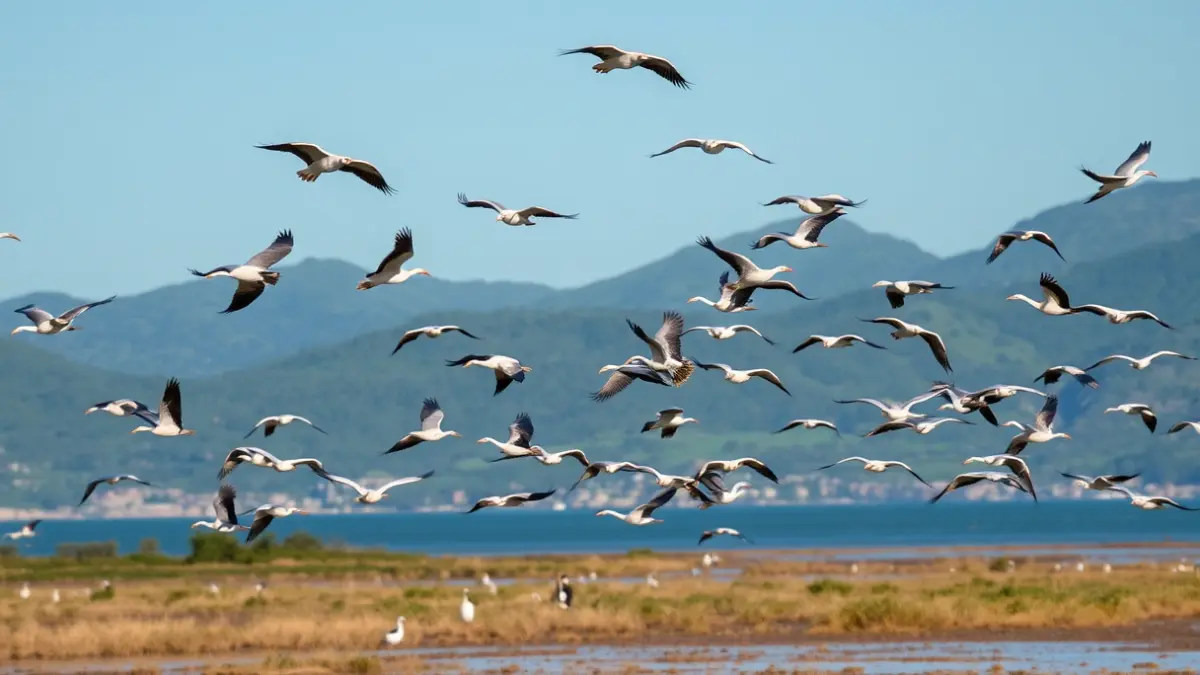
Migratory birds travel from one part of the world to another in search of food, with some covering over 20,000 kilometers from the Arctic to the Antarctic. These birds, including ospreys, herons, and storks, as well as swallows and robins, seek more favorable climates for reproduction. Bizkaia, especially the Urdaibai marshes, is a crucial transit point for them, where over 300 different species stop each year.
Just like humans, the animal kingdom has both sedentary species and those that undertake long migrations at certain times of the year. While popular belief often links migrations to better weather, the true driving force is the need to find food. Some birds make short-distance migrations, while others can exceed 20,000 kilometers. They always seek places to feed, nest, and breed, usually in milder climates. Swallows, for instance, will return to Africa in August or September when the local cold drastically reduces the availability of flying insects.
“"They move to places where they can find their food."
The same applies to many seabirds that visit the region in winter. During this period, temperatures in Norway can drop to 35 degrees below zero, freezing rivers and lakes and making fishing difficult for birds like kingfishers, which then move to warmer areas. Conversely, some birds winter in Africa and fly north to Greenland or Iceland in search of a short but highly productive summer, with 24 hours of daylight and an explosion of mosquitoes that makes the arduous journey worthwhile for successful nesting.
Bizkaia is located on the East Atlantic migratory route, which stretches from northern latitudes like Iceland or Greenland to southern Africa. All birds on this route converge in Euskadi, a natural paradise bordered by the Pyrenees and the Cantabrian Sea. Urdaibai functions like an international airport, where birds make stopovers to refuel and rest. An example is the swallows ringed in Urdaibai that travel from Finland to South Africa, covering stages of 300 or 400 kilometers, accumulating fat as fuel.
Each year, approximately 300 different species, from swallows to ospreys, pass through Urdaibai. Daily, over a thousand birds are counted in the Urdaibai lagoon, an area of just one square kilometer. Food and tranquility are the main attractions of Urdaibai for these birds, comparable to the rest stops humans seek on long journeys. There are also birds that migrate along the coastline, such as the sooty shearwaters, which arrive from Tierra del Fuego, Argentina, after traveling 12,341 kilometers before heading to the Arctic.
Urdaibai has established itself as an essential stopping point, but other areas like the mouth of the Barbadún river in Muskiz or the Lea also receive annual visits. Despite urbanization, Bizkaia boasts excellent locations for birds. It is estimated that centuries ago, the entire mouth of the Bilbao estuary, from La Peña to Getxo, could have been one of the largest wetlands in the Cantabrian Sea, a “Doñana of the Cantabrian.” Birds, by instinct, still recognize this area as a good place to stop, even within the city of Bilbao.