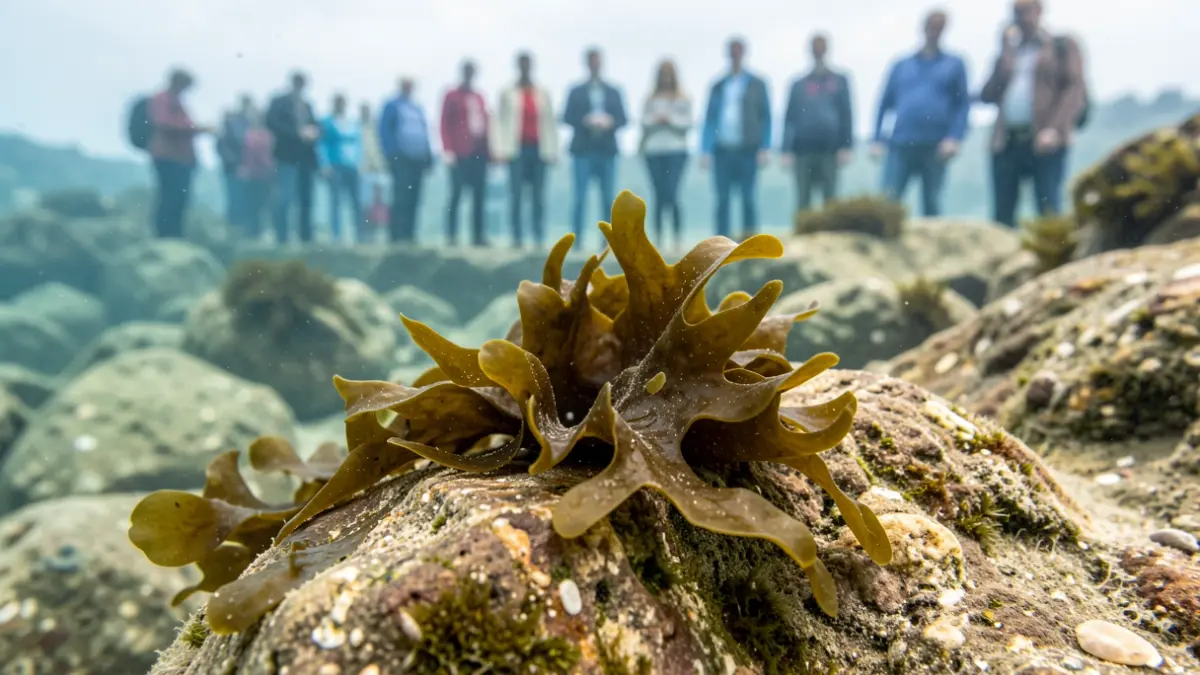
Originating from Asian waters, the Rugulopteryx okamurae species was first detected in Europe in 2002 in France. It has since spread across the southern Iberian Peninsula and has now reached the coasts of Gipuzkoa and the Basque Country, posing a significant threat to the local marine ecosystem.
This brown alga, ranging in color from ochre-brown to olive-green and reaching up to 30 cm in height, attaches itself to rocks and the seabed. Its rapid expansion and ability to thrive in suitable environments allow it to displace native species, as evidenced in Andalusia where it has formed exclusive meadows in some areas.
Iñigo Muxika, a researcher at Azti and an expert in benthic ecology, explains that while morphologically similar to the local Dictyota dichotoma alga, Rugulopteryx okamurae possesses invasive characteristics. In Gipuzkoa, it has been found in the natural pools and harbor beach of Mutriku, as well as in monitoring efforts between Orio and Hondarribia, where it has been detected in nearly all surveyed locations.
Potential introduction vectors include vessels, which may carry algal fragments attached to their hulls or through ballast water, and the translocation of species for aquaculture. For instance, mussels could transport fragments of the invasive alga, aiding its spread to distant waters.
The alga reproduces rapidly through sexual, asexual, and vegetative mechanisms. Fragments detached from its blades can float to find suitable substrates to attach and grow. The lack of local herbivores that prey on this alga further facilitates its expansion.
Removing this alga from beaches is challenging once its coverage is significant. Manual removal is impractical, and mechanical methods risk damaging native algae or further fragmenting the invasive alga, thus promoting its propagation.