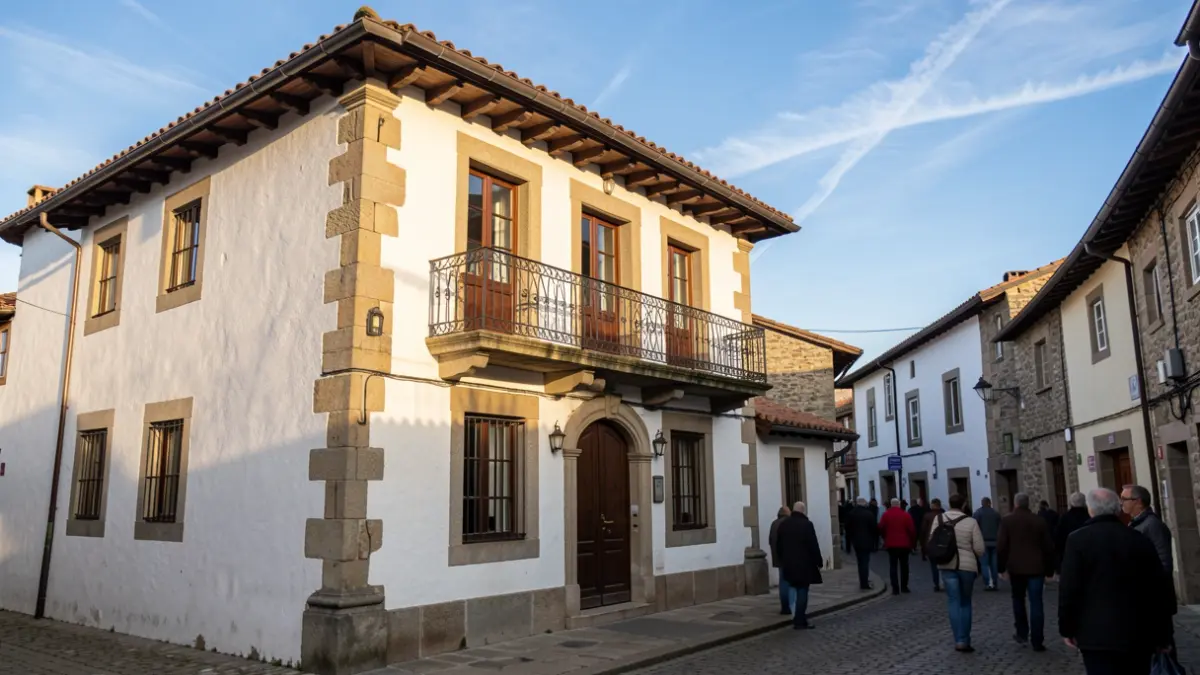
April 23rd, Book Day, is an opportune date to rekindle a passion for reading. Taking advantage of upcoming holidays, it's an ideal time to delve into new narratives. For those seeking something local, written from the region, and that speaks of its streets, landscapes, and people, five “made in Álava” books have been selected that deserve a second chance.
The first recommendation is El Libro Negro de las Horas (The Black Book of Hours) by author Eva García Sáenz de Urturi. This novel is once again topical with the arrival of its film adaptation on April 24th. Published in 2022, this book tells the story of former inspector Kraken, who travels between Vitoria-Gasteiz and Madrid. Unai López de Ayala, alias Kraken, receives an anonymous call that will change what he believes he knows about his family: he has one week to find the legendary Black Book of Hours, an exclusive bibliographic gem, or his mother, who has rested in the cemetery for decades, will die.
El Libro Negro de las Horas is the fourth book in Eva García Sáenz de Urturi's El Silencio de la Ciudad Blanca (The Silence of the White City) series, which has sold millions of copies. The story primarily takes place in Vitoria-Gasteiz and Álava. Previous books in this saga were El Silencio de la Ciudad Blanca, Los Ritos del Agua (The Water Rituals), and Los Señores del Tiempo (The Lords of Time). In 2023, El Ángel de la Ciudad (The Angel of the City), the fifth book in the saga, was published.
Secondly, El verdugo del agua (The Water Executioner) by Samuel Vernal is presented, initiating a new saga. The plot centers on an investigation following the appearance of young people's bodies in the reservoirs near Vitoria. Sub-inspector Gorka Larssen is the protagonist of this novel set between the Llanada Alavesa and Bilbao.
The third suggestion is Txorimalo. La Sociedad Maldita (Txorimalo. The Cursed Society), a suspense novel set in Vitoria-Gasteiz, a story of crime and mystery with a good dose of intrigue. It is a Txapela Noir starring a mixed pair of Ertzaintza agents, where Euskera is spoken and delicious dishes of Basque gastronomy are cooked. In this book, the crime genre intertwines with romance, through the peculiar relationship that arises between the two ertzainas investigating the case.
Fourthly, there is Vitoria desaparecida (Disappeared Vitoria) by Antonio Rivera. The author argues that the Vitoria-Gasteiz of the eighties stands on two disappeared cities: historical Vitoria and the revolutionized city, unrecognizable from the fifties onwards. The book is a compilation of old photographs showing the evolution of the city of Vitoria. Antonio Rivera is a professor of Contemporary History at the Faculty of Letters of the University of the Basque Country, where he has taught for forty years. He was vice-rector of the Álava Campus between 1997 and 2004, and director of the “Valentín de Foronda” Institute.
Finally, Los Fournier by Paz Larrumbide is presented. This is a thorough investigation by the architect and historian Paz Larrumbide, offering the most complete and rigorous approach published to date on the history of one of the most prominent family sagas in Álava's history: the Fournier-Alfaro. Through the pages of this book, an entire family saga parades, which turned playing cards into a true international icon associated with the Alavese capital: the Fournier-Alfaro. The history and evolution of a modest printing press, driven by its founder Heraclio Fournier during the years of the Democratic Sexenio, which grew to become one of the city's main factories.