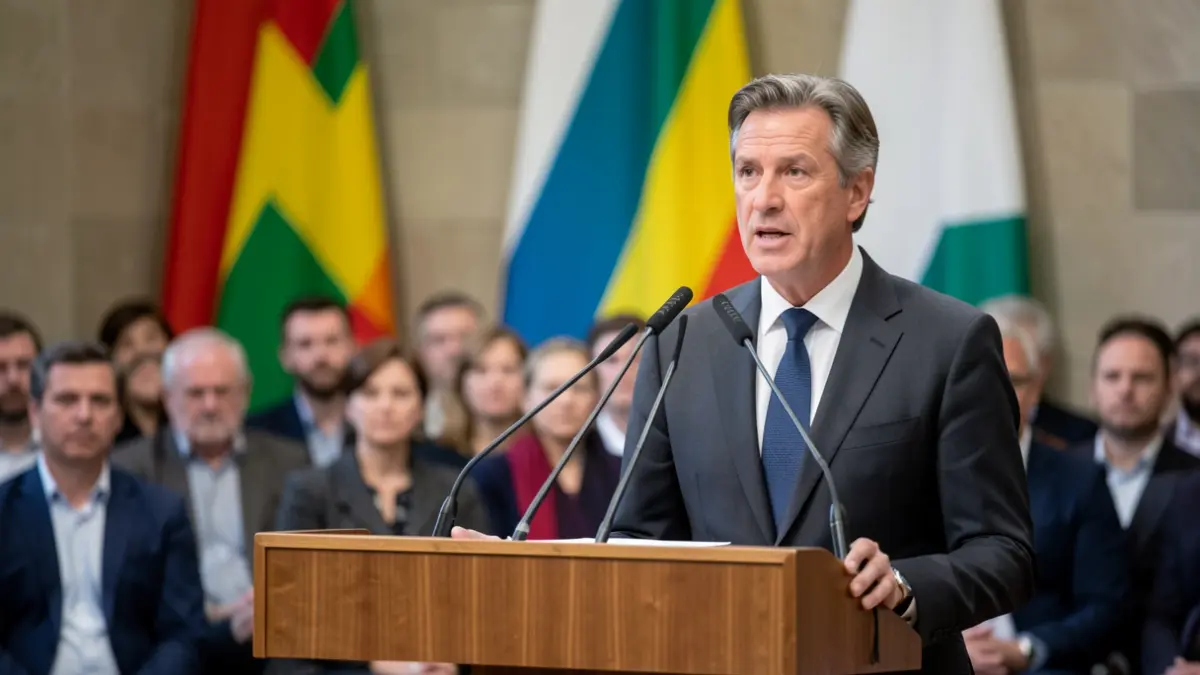

The parliamentary group announced at an information breakfast that the budget agreement signed in December with the Foral Government (PNV-PSE) has achieved between 40% and 50% compliance. Despite these accomplishments, which are already benefiting Álava, the group is not entirely satisfied and stated it will be “demanding” regarding the pending commitments.
This pact envisages mobilizing over 30 million euros in three years for various allocations, including elderly care homes, housing, homelessness, women victims of gender violence, mental health, and public transport. However, the group has expressed “concern” about improving the Social Intervention agreement, where the foral team “has not moved an inch”.
“"It is an issue we constantly bring to the dialogue tables. Let's hope this doesn't lead us to what we did with private residences. It could be a sterile year if the Foral Government does not take a step and get involved."
Another “obstacle” identified is in the disability agreement, allocated 250,000 euros in 2026, where no progress is seen either. Elkarrekin Araba also disagrees with the “imposition” of wind farms in protected areas like Labraza and Azaceta, institutional support for companies “that profit from the business of war, especially those related to the Gaza genocide,” and the presence of teams promoting “the Zionist cause” in public facilities like the Buesa Arena.
Seven main advances achieved between January and April have been highlighted, the first being the labor agreement for care home workers, signed in April. This was a crucial red line for reaching the budget agreement and “ended a conflict that had lasted six years.” Other achievements include the Pact for the Right to Housing, the increase in the Economic Benefit for Personal Assistance, the 0.7% Pact for International Cooperation, the increase in the Equality budget, the Foral Plan for Mental Health and Suicide Prevention in Álava, and the removal of eight honorary titles from the Franco regime.
Among the issues expected to come to light in the coming months, 13 are highlighted. The first is the Pact for Sustainable Mobility, with the expectation of an agreement in May to extend free transport to students under 20, with a budget of 100,000 euros in 2026. Additionally, conditions are being agreed upon for the Foral Public Transport-Leisure Promotion Plan, which will include extended weekend and night schedules. A study has also been commissioned to establish more commuter train stops within Gasteiz (Salburua, Zabalgana, and Jundiz).
Regarding the Pact for the Right to Housing, progress is being made on the First Foral Intermediation Plan, intergenerational, for renting properties owned by elderly people entering residences, at an affordable price for young families, throughout the territory, including Vitoria, Llodio, and Amurrio. Likewise, plots are being selected for the construction of 50 public housing units between 2026 and 2027 for protected rental. The Study on a Pilot Model of a 100% Public Care Center in Vitoria has also been put out to tender, with a budget of 60,000 euros in 2026.
The 0.7% pact for International Cooperation and Humanitarian Aid has been closed with Zehar errefuxiatuekin to provide humanitarian aid to Mali refugees, with a budget of 100,000 euros in 2026. Urgent humanitarian aid calls for the Palestinian and Cuban peoples are expected to be agreed upon soon, as well as a new call for Cooperation Aid.
Regarding the pact against homelessness, a new foral resource will be implemented in 2026 to address residential social exclusion, with an allocation of 2.7 million euros between 2026 and 2028. For the care of women victims of gender violence, 75,000 euros have been allocated to Besarkada Etxea to improve assistance at its reception center, with a total budget of 150,000 euros in 2026.
The guide to resources and services for the elderly by the Foral Council is being updated, including socio-health rights and end-of-life options. For people with disabilities and universal accessibility, the agreement with Eginaren Eginez has been increased from 105,000 to 139,000 euros in 2026. Progress is also being made on the tender to improve the Foral Council's special transport service for people with disabilities and on identifying accessibility problems in municipalities with fewer than 10,000 inhabitants.
In support of vulnerable AMPAS in Public Schools, work is being done with Denon Eskola to increase the allocation for school sports from 55,000 to 110,000 euros. For Local Energy Communities, the bases for a call for aid are being agreed upon with a budget of 300,000 euros in 2026. In organic farming, a support program has been launched for organic farmers, ranchers, and processors in Álava, increasing the agreement with Bionekazaritza and the Biomaisu project, with a budget of 95,000 euros in 2026.
In Animal Protection and Welfare, calls for aid for the management of feline colonies will be launched soon, implementing the CER method (Capture-Sterilization-Return), with 100,000 euros in 2026. In waste management, a project to promote and control separate waste management in IFBS centers has been put out to tender, with 35,000 euros in 2026. Finally, in Rural Architecture Heritage, a study on rural architecture in Álava has been commissioned, with a budget of 20,000 euros for 2026-2027.