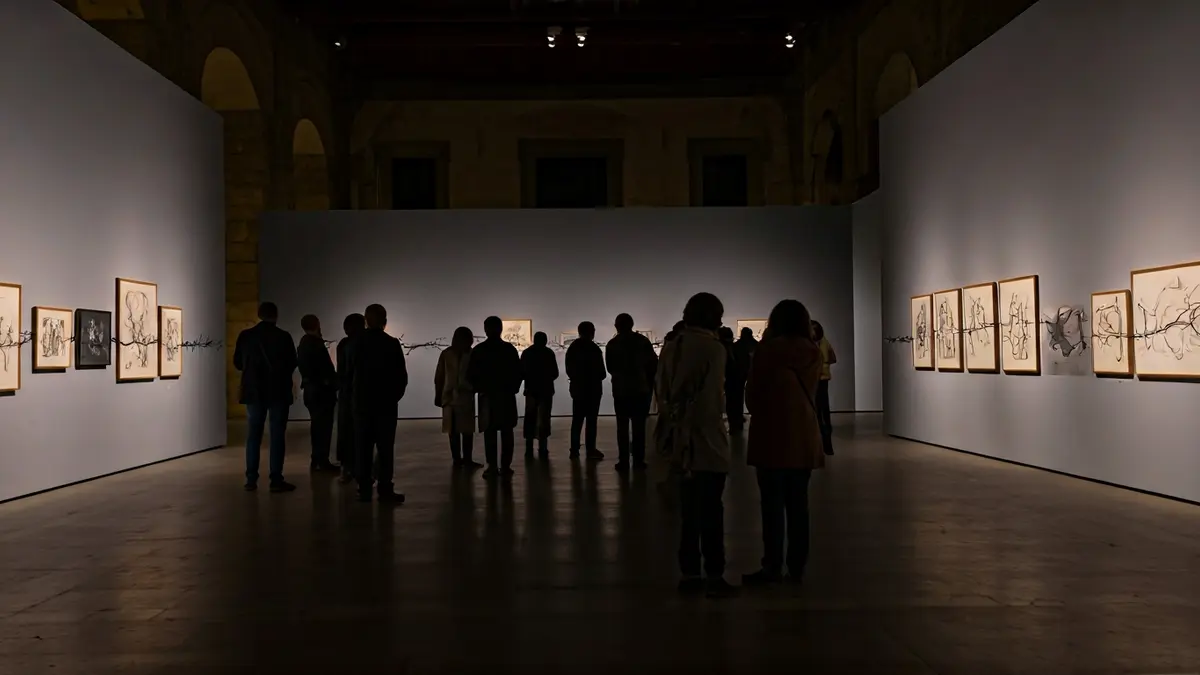
The exhibition hall at the University Pavilion of the Álava Campus, located at Los Apraiz 1, is currently showcasing Artur Heras's exhibition 'The Evil. Auschwitz 1945 – Gaza 2025'. The display will be open until April 30, from 9:00 to 20:00, with free admission. This initiative, promoted by EHUgune, reflects the university's stance on the situation in Palestine, aiming to engage through culture.
The exhibition recalls some of the most challenging moments in recent history and serves as a warning: what has happened could recur, perhaps not identically, but similarly. Heras's work begins with a specific image: an elderly woman surrounded by children, all bundled up with hidden faces, seemingly heading towards a tragic end. From this starting point, the artist develops 42 variations in the form of drawings that envelop the viewer, arranged like a horizon marked by barbed wire.
“"The university understands that it must denounce what is happening. And it does so from its own field: generating thought."
During the presentation, Rector Joxerramon Bengoetxea emphasized the university's commitment to denouncing current events through the generation of thought. He recalled an idea from philosopher Hannah Arendt that permeates the exhibition: evil can arise when we stop thinking. Ixone Fernández de la Bastida, Vice-Rector of the Álava Campus, summarized that the exhibition confronts us with some of the most difficult questions about the human condition, using a type of art that seeks not only to please but also to provoke thought.
Curator Anacleto Ferrer offers an interesting interpretive key by speaking of 'images that think,' works that do not seek an immediate reaction but demand time. Ferrer positions Heras as a chronicler who narrates events without hierarchies, without separating the grand from the small. His creations not only address the reality they represent but also reflect on how they represent it, functioning as 'images that make you think.' They do not offer definitive answers but invite calm observation and the drawing of personal conclusions.
The exhibition extends beyond the visual. Its inauguration featured live music from the Palestinian group Sol Band, and in the coming days, there will also be a recital with texts by the poet Muhammed el-Kurd. The aim is to open the space to various forms of expression, all contributing to the same goal: observing what is happening and dedicating time to reflection.