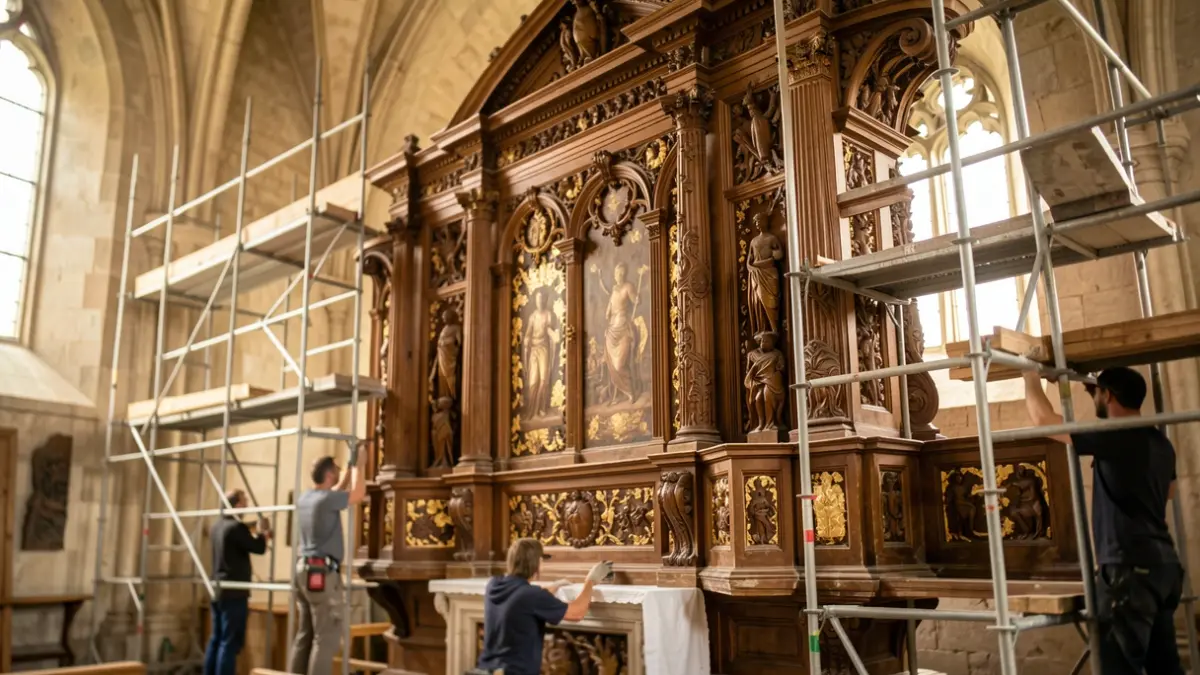
The main altarpiece in the church of the Santa Clara convent in Azkoitia is currently undergoing restoration. Restorer Carmen Martín and her assistant Aiora Elkoro are meticulously working to repair the damage caused by time and wood-boring insects.
Carmen Martín explained that "apparently it doesn't show significant damage, but the reality is different. The attack of wood-boring insects has mainly affected the predella area and other parts of the altarpiece, turning the wooden support into sawdust and weakening the affected zones."
The restoration efforts will also address the consequences of past maintenance actions. "Often, these interventions are carried out by untrained individuals or by applying outdated restoration criteria that alter the overall vision of the work. We aim to halt the deterioration and restore its stability and correct visual interpretation, respecting the passage of time."
These tasks are expected to continue until mid-July and will involve cleaning superficial dirt, removing extraneous elements and materials, consolidating weakened support parts, and reconstructing the volume, gilding, and polychromy in damaged areas.
The altarpiece restoration is the starting point for a more ambitious project by the Fundación Valle de Iraurgi. This group comprises individuals connected to Azkoitia and the Iraurgi valley through their ties to the casa-torre Balda.
They are descendants of the original Balda lineage who have now formed a foundation to promote the region's culture and traditions. Initially, they intended to link the project to the casa-torre Balda, but due to impossibility, they chose the Santa Clara convent.
The convent's origins date back to the early 17th century, with the first nuns arriving on September 27, 1607. For over 400 years, its walls were occupied by religious sisters dedicated to prayer and cloistered work. This situation persisted until December 2, 2017, with the departure of sor Piedad Iruarrizaga, the last nun.
The Fundación Valle de Iraurgi aims to fully restore the convent and return it, as much as possible, to its original 16th and 17th-century state. "We intend to remove additions made over the centuries that have altered the architectural harmony of the complex, recovering the building's original historical context and also rehabilitating its gardens."
This work will be complemented by a program to transform the convent into a cultural center, hosting the foundation's activities and organizing events to ensure its sustainability. "To guarantee its maintenance, it will be necessary to organize events and activities that generate economic resources. The cost of restoration and facility upkeep will be very high, and we will need to secure the means to face them," Balda emphasized.
Furthermore, the convent is expected to serve as a social and economic driver for the region, an objective in which the Fundación Valle de Iraurgi has placed great hope.