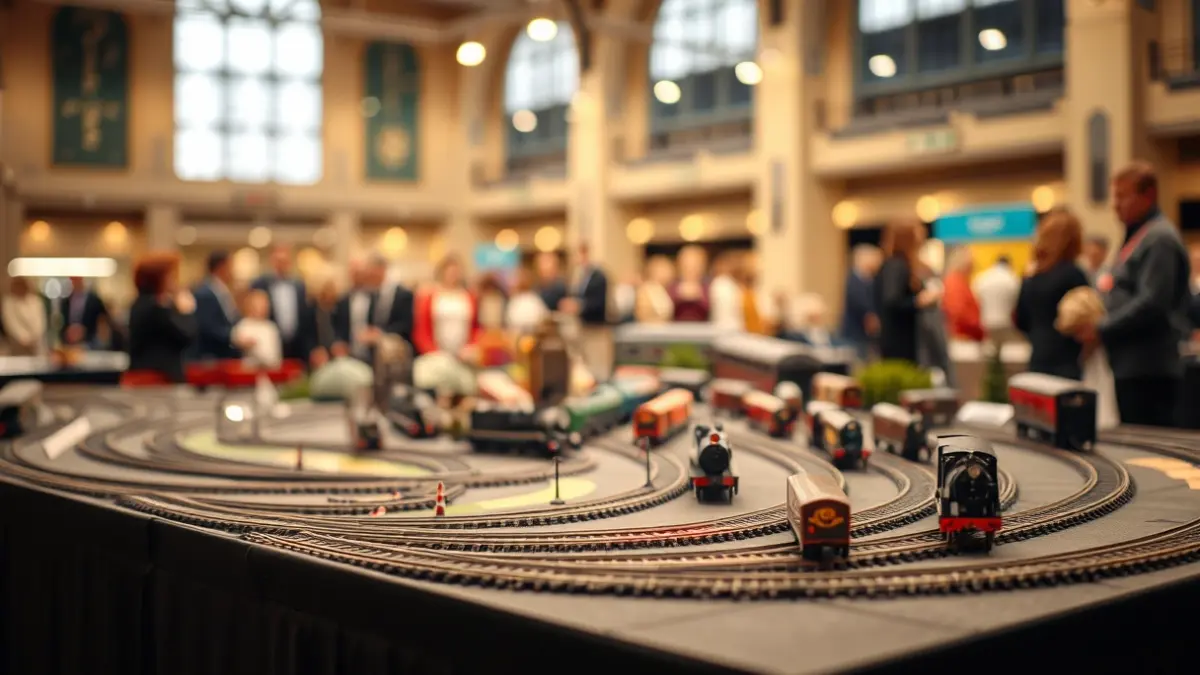
The lobby of Bilbao's La Concordia Station hosted the XXVIII Model Railway Market this Sunday, an event organized twice a year by the Bilbao Railway Friends Association (AAFB). This edition's success in attendance was boosted by its coincidence with the medieval market in Balmaseda, which attracted a “passing public,” as noted by the association's president.
With about 20 participants from various parts of the country, the association's president confirmed the importance of the city for the sector, noting that Bilbao attracts exhibitors because “this market is one of those where they obtain the most income” compared to fairs in other cities. An enthusiast from Durango, who is just starting to build his first model, attended the event and acquired “two locomotives and a Talgo branch.” For him, the physical market has no rival against online second-hand applications, as “personal interaction” is paramount. He emphasized that in this sector, detail is everything, and he valued above all that “the sellers are experts, they know and they advise you.”
Model making, however, does not only attract experts in traction and tracks. Among the public was also a resident of Portugalete, who browsed the stalls “out of hobby” and to look for pieces for a friend's model. She represents the visitor who admires the artisanal aspect of the hobby, a dedication that requires “a lot of work, a lot of patience.” Given the outlay required for these creations, the visitor noted that “models are not paid for with money.”
Behind the counters, exhibitors know the buyer's profile well and know how to appeal to their memories. From Zaragoza, a seller brought a diversified offer to Bilbao with “Indians and cowboys, Scalextric, and books,” although he admitted that the real magnet is “old train boxes, from when we wore shorts.” Despite managing a catalog with collector's items that can reach 1,000 euros, this veteran seller issued a warning about the future viability of the sector. The problem is not economic, but demographic. According to the seller, the hobby faces a generational barrier.
The event transformed as the day progressed into a lively intergenerational meeting point. After breakfast or the traditional Sunday aperitif, numerous families decided to come and browse among the stalls. In this hub of hobbies, other classic toys competed for attention with model railways, offering very different play experiences. As the seller from Zaragoza reflected, the train requires patience and the creation of its own ecosystem to avoid being “boring,” while Scalextric, by its competitive nature, inevitably forces you “to get together with a friend,” marking two opposing ways of understanding classic leisure.
Beyond the railway elements for models, the fair also served to highlight the work of the AAFB in protecting local heritage in real size. A member of the association's Board of Directors sold “books, mugs, keychains,” and a coveted collection of old train tickets. At his stand, he sold copies of the book Mis recuerdos del Azulito, which compiles hundreds of anecdotes related to this iconic Bilbao urban transport.
The association member took advantage of the event to confirm the good condition of the “Azulito.” After spending seasons outdoors, the vehicle “is quite well” protected thanks to a 15-year contract signed with the Mercedes Museum. In addition, its interior has been refurbished “with collaborations” from companies such as Bilbobus and Alsa, thus ensuring that a part of the city's rolling memory remains intact.