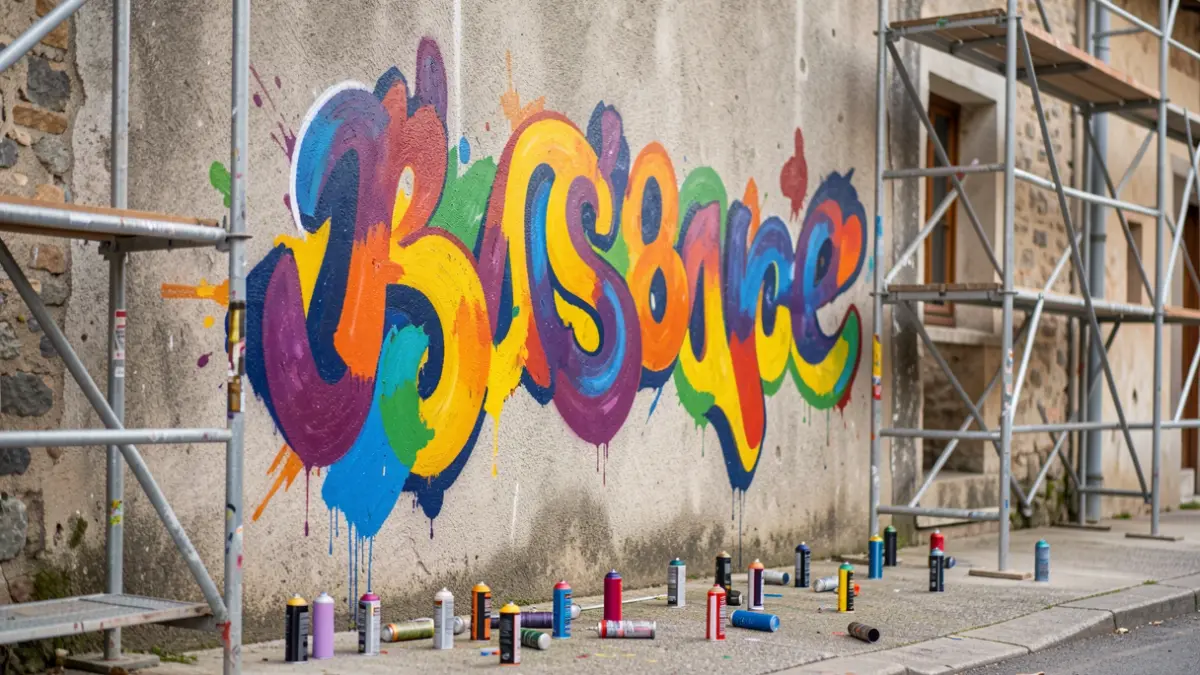
The nocturnal risk and the desire to express oneself are the cradle of graffiti for almost anyone who has picked up a spray can. However, this Saturday, the Basozelai Civic Center in Basauri offered a completely different atmosphere with a new edition of the Urban Festa. Since 2012, this initiative has demonstrated urban art's capacity to unite generations and create community, offering a unique opportunity to discover the world of graffiti.
Adding color to the walls were experienced graffiti artists, some painting since 1995, alongside youngsters just starting with their first sprays. Years of experience separate them, yet almost all share one thing: they wish to maintain their anonymity. Iñaki (fictitious name), a 15-year-old, traveled from Ermua to Basauri "to learn from the best." "I watch those who have been painting for many years to improve my technique; it's incredible to see up close how they do it," he says excitedly. In his daily life, he admits he usually paints illegally in the corners and alleys of his town. "What I enjoy is the adrenaline, experiencing that nervousness of potentially getting caught," he confesses. Therefore, he prefers not to be recognized and chooses to hide his name.
The same request comes from Aritz, who has been painting since 1995. For him, painting is a form of therapy that helps him disconnect. "After work, doing graffiti is what frees me and helps me stay calm," he says. He started at 14 and now, at 45, he looks back and remembers what the graffiti world was like when he first painted. "Before, everything was much more closed off, the domain of small groups. To see what was being done, you had to look for photocopied magazines. Now, with the internet, everything is known instantly," he acknowledges. However, he points out that "despite many things changing, graffiti still maintains its essence." Aritz explains that over time he has modified his painting style. "At first, you like to put your signature everywhere, to make it visible, but after so many years in this world, what I enjoy is drawing; it doesn't matter what I put, the point is to create," he explains.
The spray can as an improvised art school. This same evolution is shared by Heros (the name he signs his works with), who traveled from Zaragoza not to miss the event. What began in 2009 as an adolescent mischief in abandoned factories ignited his passion. It led him to discover a world he loved. He studied Fine Arts, graphic design, and now makes a living as a professional tattoo artist. "Graffiti opens your mind," he clarifies. At the Basozelai Civic Center, standing on scaffolding, Heros unleashes his imagination. "I start with some letters and then create as I go, improvising," he says. He also assures that being surrounded by other graffiti artists greatly aids creation. "We support each other, we see what's being done on the different murals, and that sparks ideas and helps us improve," he indicates.
And when it comes to building community, one only needs to look around. The atmosphere is purely familial. There is Itxaso Loubet, attentively watching her 9-year-old daughter Ane. It's her first time at the festival. "She loves drawing, and we wanted her to see up close that this is also art, that there's a lot of creativity behind it," says Itxaso.
“"I love seeing the walls full of life when I'm on the metro or the train; graffiti gives personality to cities"
A little further away, Andrea Luengo is enjoying the festival with her nieces, who have been waiting a whole year for this day to help their cousin. Far from seeing graffiti as a nuisance, she is clear about its value: "It gives a unique personality and identity to each city. I love seeing the walls full of life when I'm on the metro or the train." Her young daughter, enthusiastic, has been waiting a whole year for this day to help her cousin fill the wall sketches with color.
The essence of graffiti. Although the municipal youth service ZirtZart and the collective Aztarnak Muralismo have managed to offer this space for enjoyment, most experienced graffiti artists acknowledge that "if graffiti became legal, it would cease to be graffiti. It would lose its essence." "The tension has to be there always," they admit. They say that as the years go by and they get used to it and lose that adrenaline, they tend to seek new and more difficult places to feel that thrill again.
However, while that adrenaline is graffiti's main hallmark, the other side of the coin is undoubtedly camaraderie. Therefore, Saturday's event has been a great boost for this urban art form that gains more followers every day: it has served to make it known, for artists to meet face-to-face, and, above all, to unite and create community by sharing what they are most passionate about.