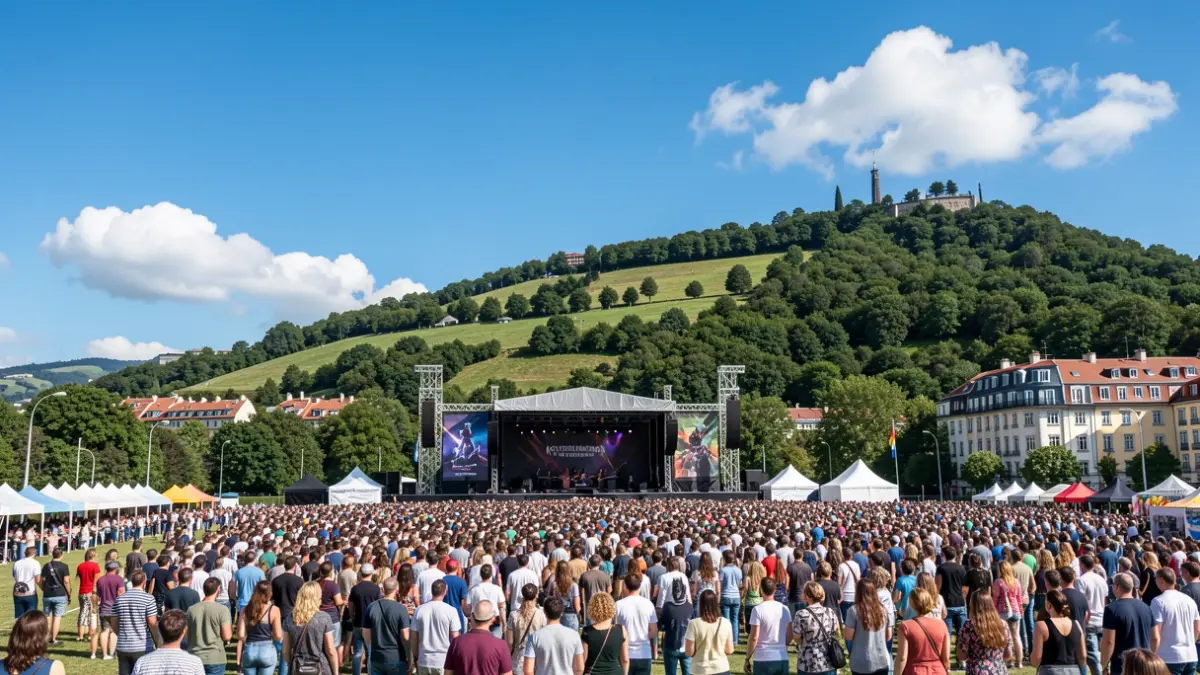
The Bilbao BBK Live festival will celebrate its 20th anniversary in 2026, thanks to a combination of “daring and a mix of coherence, adaptation, and long-term vision,” explains Yurdana Burgoa, CEO of Last Tour, the organizers. Burgoa also highlights the festival's success is due to “the special relationship achieved with Bilbao and its audience.” The festival is set to feature headliners such as Calvin Harris, Idles, David Byrne, Robbie Williams, Richie Hawtin, Lily Allen, and Belle and Sebastian from July 9th to 11th.
According to Burgoa, surviving 20 editions is achieved through daring, coherence, adaptation, and long-term vision. The festival has evolved without losing its identity, carefully curating both the lineup and the overall experience. The relationship with the surroundings, the city, and the audience has also been crucial, building a cultural project with the joint commitment of institutions, sponsors, the public, neighbors, the city, artists, and the organizers themselves.
Burgoa emphasized that the festival has become an international benchmark, and that current festivals are meeting points that go beyond cultural consumption, generating shared experiences, collective identity, and memorable moments. While music remains the core, something broader is built around it: social, emotional, and territorial. Last Tour holds B Corp certification for sustainability, integrating a commitment to environmental care and social cohesion into its DNA.
To commemorate the anniversary, a special program has been designed to extend beyond the three festival days, connecting music, culture, and territory. The aim is to celebrate the legacy of Bilbao BBK Live and project it into the future, bringing its spirit to new spaces, audiences, and formats. Burgoa describes this year's lineup as a reflection of the festival's vision for 2026: a blend of generation-defining artists, names shaping the current music scene, and proposals representing the future, featuring international stars, national talent, electronic music, and emerging artists.
The festival follows the general trend of eclecticism in its lineup, moving away from specialization. Burgoa explains that, unlike other festivals like Azkena Rock Festival which have a more recognizable identity, Bilbao BBK Live offers a more open and transversal program. She notes that the festival ecosystem in Euskadi is in a consolidation phase, with a broad and diverse offering, and that the market is demanding and tends to self-regulate, making differentiation and audience connection key.
Regarding criticisms about the festival model and the influx of large capital and investment funds, Burgoa considers it important to listen to these voices and highlights the challenge of finding a balance between scale, economic sustainability, and quality for the audience. She underscores the significance of public-private collaboration in the cultural development of Euskadi, pointing out that festivals generate cultural value, positioning, and year-round activity, in addition to employment and contribution to GDP through cultural and creative industries.
Burgoa assures that their festivals comply with current labor regulations and that social and environmental sustainability is a transversal and strategic axis of their activity. In addition to major festivals, Last Tour organizes over 650 concerts annually in smaller venues and spaces, emphasizing their importance for artist development and direct audience connection, thereby keeping the live music network vibrant.