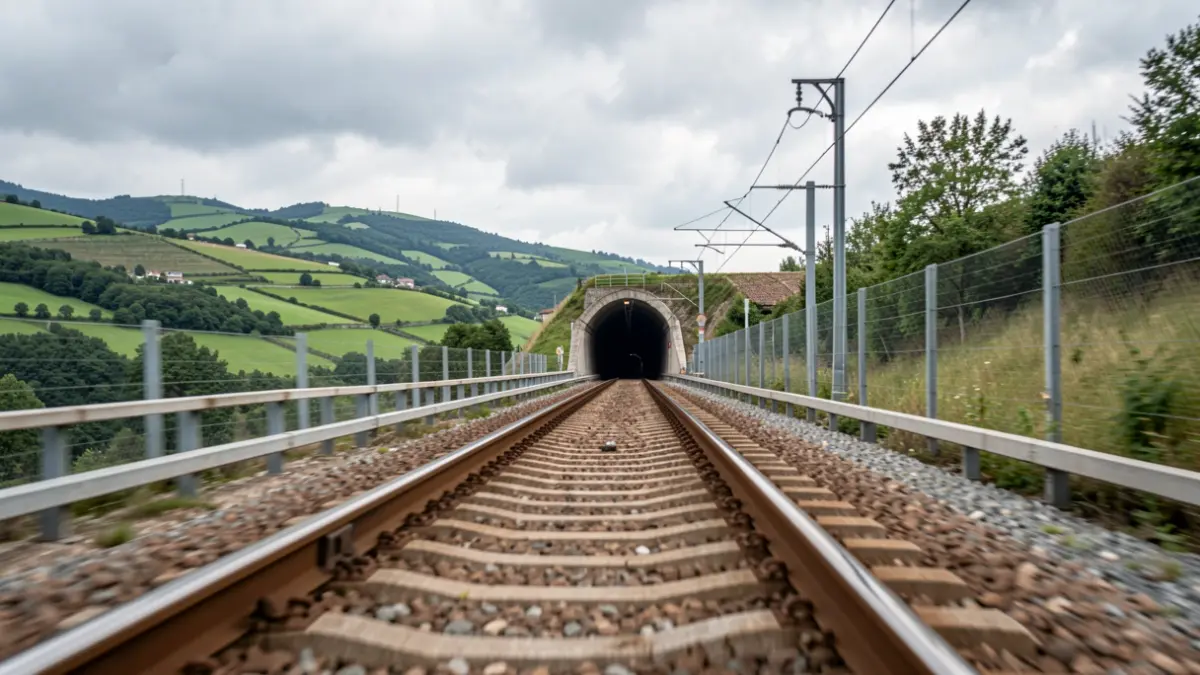
Lehendakari Imanol Pradales was very firm this Wednesday when referring to the delay in the arrival of the high-speed train (TAV) to Euskadi. "Not having a high-speed connection, being last in line, reduces Euskadi's competitiveness. We cannot continue to be the ugly duckling in this matter," declared the lehendakari, who urged the central Government to "resolve the pending technical issues," such as carrying out soil tests in the vicinity of the Aralar mountain range, in order to "reach a consensus" on the decisions to be made, regarding the connection with Navarra. He also criticized that the connection of the Basque 'Y' with Madrid still has no completion date and that "the French State has broken its commitments" for the TAV to connect with Paris.
"I am concerned about the loss of competitiveness and international connectivity" caused by the continuous delays in the TAV's operational start, the lehendakari emphasized during his speech at DV Gunea. He defined Euskadi as "a hinge within the railway Atlantic axis" that the European Union aims to promote, but lamented that "I do not see significant progress in the connection with Madrid and Paris."
When questioned about the lack of news regarding the Aralar soil tests and whether the Basque Government has a preference between connecting with Navarra via Ezkio-Itsaso or Vitoria, Pradales recalled that "a year ago, in another speech at this newspaper's headquarters, I replied that the Ministry of Transport had informed us that after the summer (of 2025) the results of the Aralar soil test could be known." However, he criticized that "it is now June 2026, and we still have no results from the soil tests, and I don't even know if they have been done. The Secretary of State for Transport (José Antonio Santano) said a few days ago that he was confident the report would be ready before the end of the year, and let's see if that is true."
The lehendakari recalled that "it was agreed that, once the soil tests are completed, the Spanish, Navarrese, and Basque governments would participate in the solution, but since we do not have the soil tests, we cannot move forward with the solution. We will wait for the soil tests, although as they say, waiting leads to despair, I must admit we are already in a phase of desperation."
Pradales demanded that "the technical issues be resolved and the best solutions be agreed upon, because we cannot continue to be last in line or the ugly duckling in this matter," a delay that causes "a loss of competitiveness for Euskadi in economic, social, mobility, and tourism aspects."
Pradales highlighted that Gipuzkoa is undergoing "a comprehensive transformation of its mobility," especially in Donostialdea, and cited four major projects promoted by the Basque Government: "The Topo variant that will complete the east-west axis in the territory; the Altza-Galtzaraborda connection, and the union of the Topo with the Commuter Rail Network; the Irun-Hendaia-Baiona project that will connect Northern and Southern Basque Country; and the completion of the intermodal station prior to the arrival of high-speed rail" in Atotxa.
The lehendakari assured that "these actions impact not only mobility; they also impact urban regeneration and the quality of life for thousands of people."
Furthermore, the lehendakari also emphasized the "social cohesion" shown by Gipuzkoa and pointed out that "with a GINI index of 23 points, it would be the second territory with the lowest inequality in the ranking of all European countries." Additionally, "the average personal and family income is the highest in the State, and the poverty rate is the lowest."
Therefore, he defined Gipuzkoa as "a balanced territory, with a strong, diversified, and technologically advanced industrial fabric, with a broad, densely distributed, and consolidated middle class." He added that "the key is the social collaboration model exemplified by initiatives from the Provincial Council such as Adinberri, 'Ongizatearen Plaza,' or the local care ecosystem, along with the City Councils." And he concluded: "Here, in addition to collaboration, social innovation is also applied."