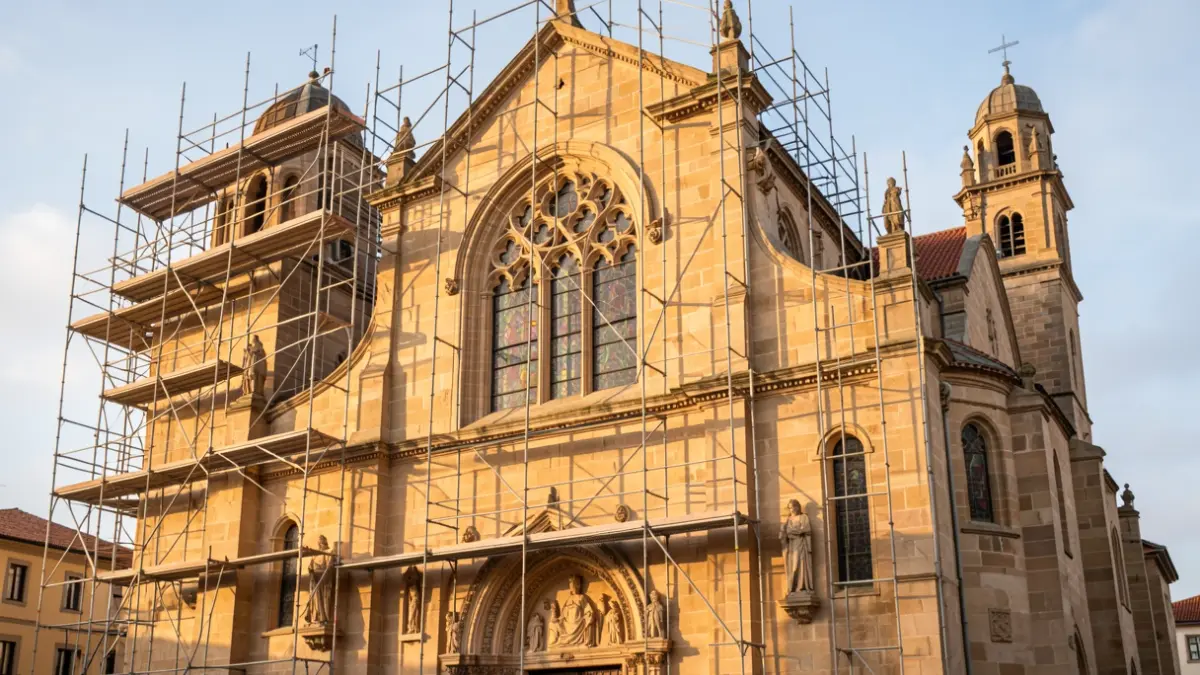
This intervention will focus on the west side of the cathedral, rehabilitating the facade and its stone elements, as well as the stained glass windows. Additionally, roofs and metal finishes will be repaired. The project architect, Aitor Zubia from Zetabi Arkitektura, explained that the sandstone from Igeldo used in construction is workable but requires specific maintenance.
All stone decorations will be secured and repaired, and the stained glass windows will be dismantled for restoration. Once reinstalled, an exothermic protection system will be implemented, involving an external glass layer to shield them from thermal variations, thereby easing maintenance and enhancing durability. The clock mechanism, currently located at the lower part of the cathedral, will be moved to its original floor where the clock faces were situated, allowing public viewing when the tower opens for visits, though a date for this is yet to be set.
“"We will have the support of traditional guilds working with stone and stained glass."
The first restoration phase began in 2019 with the tower, and the east half was completed in 2023. The final phase now starts. Protective fencing will be erected in phases as needed. The cathedral, construction of which began in 1888, will soon showcase its best appearance following these significant restorations, which are more extensive than previous ones conducted roughly every 40 years, particularly on the tower.
The total investment for the three phases exceeds 6.7 million euros. The Spanish Government contributed 4.6 million euros (68%), the Diocese of Gipuzkoa 900,000 euros (13%), the City Council of Donostia 7.5%, the Provincial Council of Gipuzkoa 6%, and the Basque Government 5%. Marisol Garmendia, the Government delegate, recalled that the aid is provided through the 2% Cultural Program, which accounted for over 2.1 million euros in this final phase. "We are satisfied and proud to contribute to the recovery of artistic and architectural heritage, especially with the Buen Pastor Cathedral, one of the city's most emblematic architectural elements," she stated.
“"I am delighted that the State recognizes the importance of ecclesiastical buildings, which are part of our country's cultural heritage."
The bishop of San Sebastián, Fernando Prado, expressed his pleasure that the State acknowledges the significance of ecclesiastical buildings as part of the nation's cultural heritage. "These types of interventions are very costly, and the Church could not afford them alone," he added, thanking the "totally necessary" institutional collaboration.