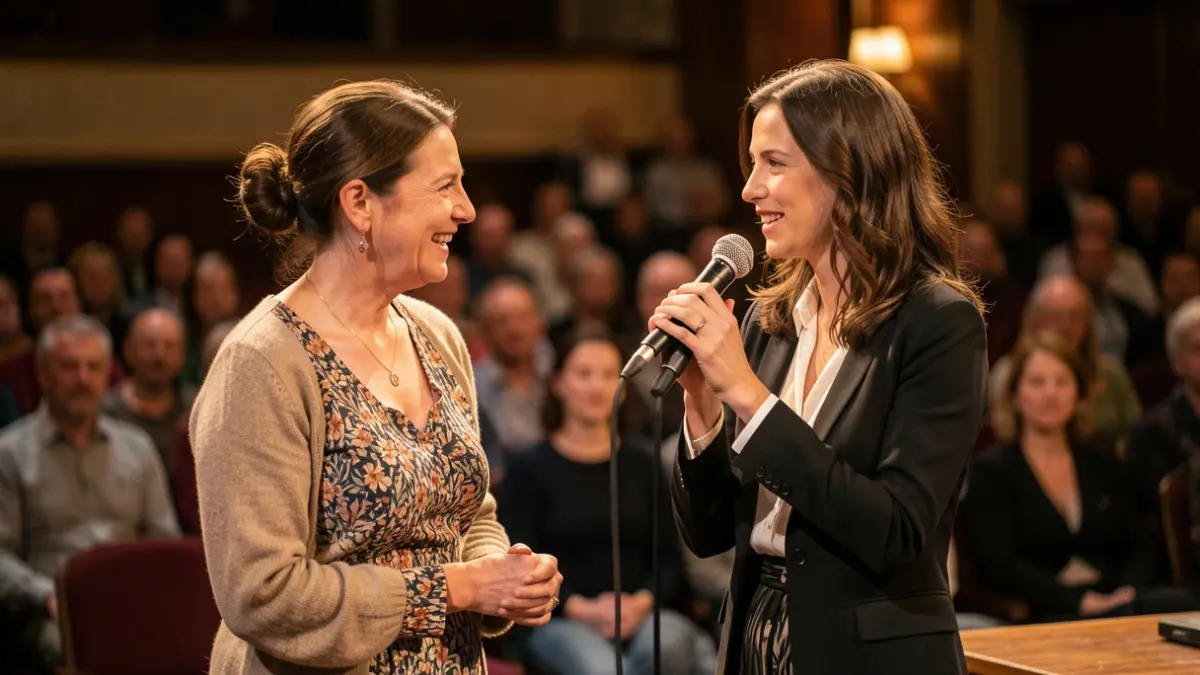
The concept, once used to order good wine, now serves the comedians' work. Idoia Torregarai (Usurbil, Gipuzkoa, 1974) and Mirari Martiarena (Oiartzun, Gipuzkoa, 1986) are maturing with the years and age, and in their latest stand-up show, Eskailerapekoa, they aim to bring to the stage, with their usual touch of humor, topics that are kept well hidden.
They began this journey of stand-up comedy in 2018. In the creative process, each starts from her personal desires and chooses what to talk about based on the topic they feel like addressing. In a show lasting over an hour, they offer their point of view and critique or laugh at what they observe.
Mirari Martiarena explains that 'Eskailerapekoa' contains many everyday things that are well-kept and hidden, not just from their own lives, but from the lives of women of their age and generation, topics that are often not discussed. They want to draw attention to these aspects and bring them to light with humor and a critical perspective.
Idoia Torregarai adds that the content of the show is new, and with eight years of experience, they are accumulating more expertise and knowledge while maintaining the format. Despite belonging to two different generations, she highlights that the audience identifies with their experiences.
Martiarena focuses on topics such as her turning 40 and the surrounding discussion of a '40s crisis,' the idea of still being young, or the need to travel. Additionally, she wants to talk about the body, the experience of living as a fat woman, and making a social critique about it. Torregarai, on the other hand, addresses the journey of motherhood, adolescence at home and the experience of being an adolescent oneself, and perimenopause.
They state that using humor is a tool to more easily bring hidden topics to the public. They emphasize that while society often discusses these issues theoretically, they do so from their lived experiences and with laughter. They say humor is a strategy for critique and enjoyment, thus attracting people who might not attend more formal talks.
Although they initially want to share it with all audiences, they admit it's easier to connect with people their own age, especially women. However, they say they have a broad audience from around 30 years old upwards, due to shared references.
They emphasize the need for humor created by women, denouncing that while male humor is often considered universal, female humor is sometimes labeled. They say it's important for men to see that they too can enjoy their stand-up shows. They mention being hired more often by equality departments than cultural ones, and that women have moved from being objects to subjects in humor.
Since they started eight years ago, they highlight that the Basque stand-up scene has become richer, with more women taking the stage. They state that it is fundamental to perform in Euskal Herria, in Basque, and with Basque references.
They recall that the Basque Country has a strong tradition of humor, present in theater, bertsolaritza, and television. They express that going on stage gives them strength, enjoyment, and fulfillment, and they feel it's a personal analysis.
Regarding their evolution in recent years, they emphasize empowerment and the belief that they have a place on stage. As a couple, they add that they maintain the desire and enthusiasm to do and share things together.
“"We are from two different generations, Mirari and I, and it's very nice that the audience identifies with the moment they are living."
There's a bit of everything in this record, there are bullets, but also reflection directed at ourselves