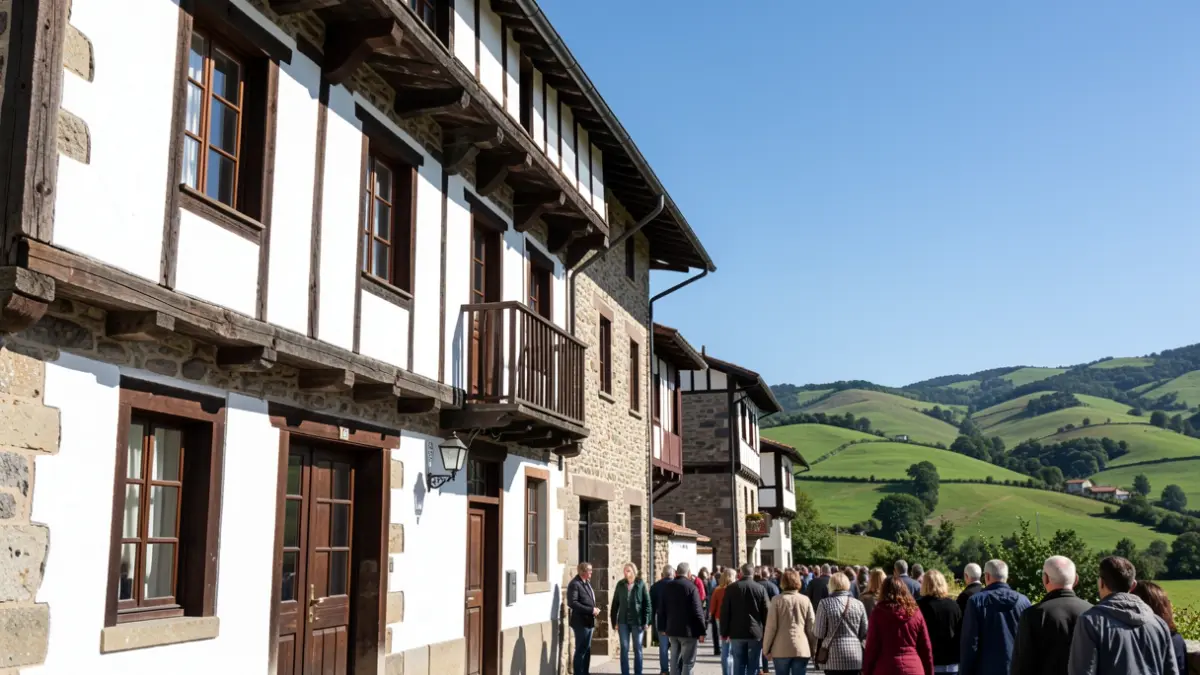
Renowned actress Amaia Salamanca has her roots in Abadiño (Bizkaia), located in the Durangaldea region and near the Urkiola Natural Park. According to a recent publication, the actress deeply honors her origins, as her mother was born in this municipality.
Abadiño features historical constructions such as the Muntsaratz Tower and the Sanctuary of the Holy Antonios of Urkiola, the oldest in Bizkaia. The sanctuary's origins date back to the 8th to 11th centuries, with the current structure being of neo-medieval style.
The architectural complex also includes a rectory, a bell tower, an old hospital, and an inn. Legend has it that Saint Anthony of Padua visited the site and celebrated mass there.
Beyond its historical heritage, the Urkiola Natural Park is a natural treasure spanning nearly 6,000 hectares. It encompasses the Aramotz-Eskubaratz mountain range, the mountains of Duranguesado, and the Arangio range, separating the Arratia Nerbioi and Durangaldea regions.
One of the most famous routes is to Mount Anboto, an iconic peak in the area, traditionally considered the dwelling place of the goddess Mari.
Amaia Salamanca (Madrid, 1986) is a film and television actress. She gained fame for her role as Catalina Marcos in the series 'Sin tetas no hay paraíso' and has appeared in projects like 'Gran Hotel' and 'Velvet'. On the big screen, she has featured in films such as 'Fuga de cerebros'.
'National Geographic' is a globally recognized magazine covering science, travel, history, and nature with high-quality photography. It also supports research and conservation projects.