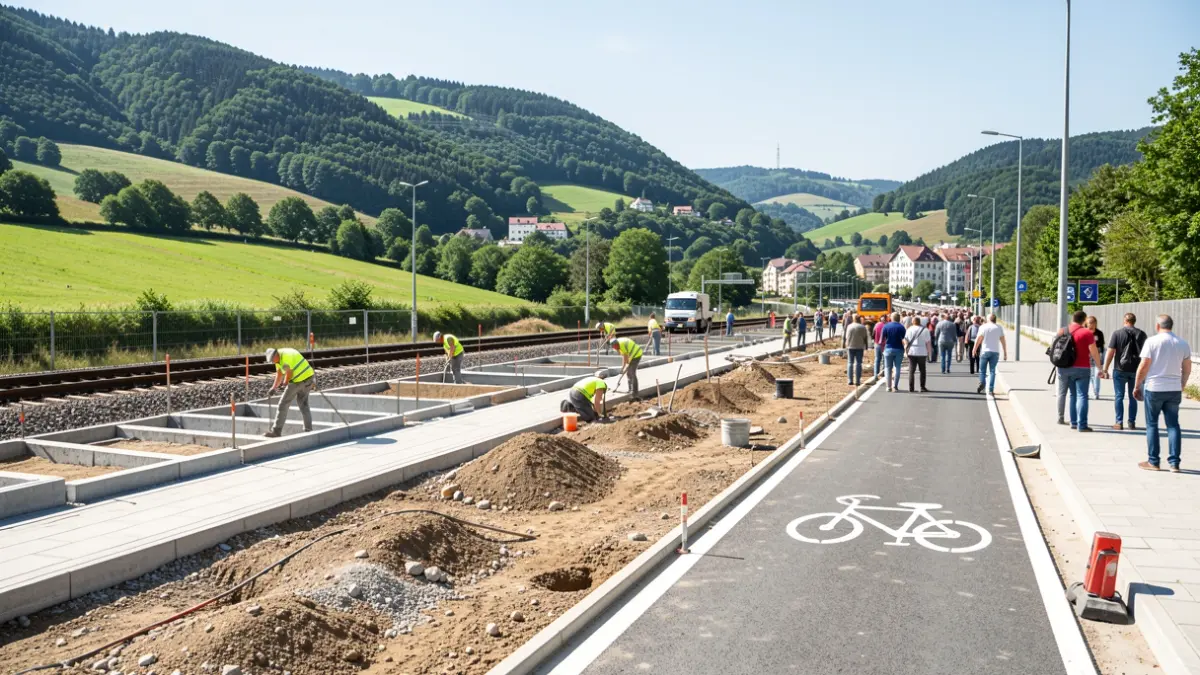
The second phase of works to redevelop the old railway line in Durango, which began three weeks ago, is moving forward. The work is currently focused on the area near Matxinestarta, where the walls of the old railway have been demolished, and foundations for the new sidewalk and the planned bike path, along with curbs and the lighting network, are being prepared.
This is the final action of a comprehensive urban transformation project aimed at permanently connecting the two halves of the municipality after the train was buried in 2012. This intervention completes the overall development planned for the old railway line, carried out in three phases. The first and third phases were completed and opened to the public in 2025, focusing on the outer sections of the route, which allowed for the creation of new green spaces and areas for coexistence. With the commencement of this second phase, the comprehensive intervention planned for the old railway line is finalized.
The works will extend from Olleria street to Ermodo, following the path of the old railway line from east to west. The project covers approximately 500 meters within the urban center and has a nine-month execution period. The project has an allocated budget of 878,731.53 euros and is part of an agreement signed in April 2024 with Euskal Trenbide Sarea (ETS), through which the municipality acquired over 9,300 square meters of land freed up after the railway was buried.
The intervention is divided into two main areas. Firstly, the section between Olleria and Matxinestarta street, approximately 220 meters long, foresees the reorganization of the urban space, widening sidewalks, improving accessibility, creating green areas, and connecting with the bike path network. Secondly, the section between Matxinestarta street and Ermodo, about 280 meters long, will allow for the establishment of a large green and accessible pedestrian axis, continuing the previous phases and strengthening the connection with Ibaizabal Park and the area around the Music School.
Among the notable actions is the rehabilitation of the metal bridge over the Mañaria river, built in the early 20th century and historically used by the Bilbao-Donostia railway line. The bridge will be restored for pedestrian and bicycle use, integrating it as a heritage element of the municipality. Furthermore, the project includes the creation of new viewpoints and green spaces, planting trees, renovating street furniture and the lighting system, as well as removing architectural barriers to ensure universal accessibility.
Traffic will also be reorganized at strategic intersections, such as Juan Mari Altuna and Olleria, through elevated crossings. Additionally, the bike path network will be expanded, and specific environmental measures will be incorporated to protect the Mañaria river and conserve its biodiversity.