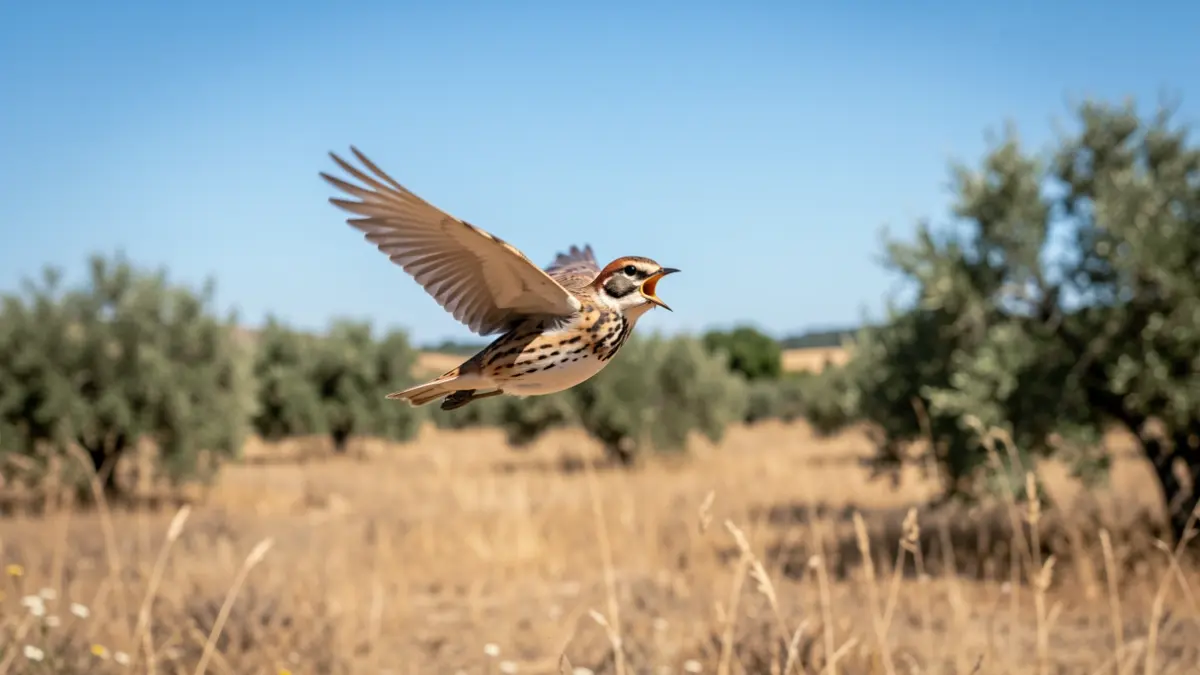
On the slopes of the Cantabrian mountain range, in an ancient meadow amidst vineyards and holm oaks, resides the common skylark (Alauda arvensis), in the most Mediterranean zone of Álava. This bird spends hours continuously singing in spirals while flying in the air during spring and summer.
Its plain, low-contrast plumage offers perfect camouflage on the ground, where it nests directly. However, when singing in the air, it appears particularly proud, asserting its dominance to other males and attracting females. "Humans get out of breath climbing stairs!" it jokes, referring to the birds' "air sacs" respiratory system that allows for continuous singing.
The skylark sings at height for two reasons: "pure romantic posturing" to make its presence known and as a safety measure, as singing on the ground would increase the risk from predators like foxes. "Singing at eighty meters high, I am the king of the world!" it proudly states.
Regarding its habitat, these birds do not favor dense forests; instead, they are "minimalists" and prefer open, flat areas without trees, such as cereal fields, pastures, and low scrub. They are cosmopolitan, enjoying coasts and high mountains, but migrate south in winter to prevent the ground from freezing and to continue feeding.
Its diet in summer includes beetles and plump caterpillars for protein, while in winter, it becomes more herbivorous, eating seeds. However, life is not always easy. Due to predators like kestrels and sparrowhawks, it must constantly watch the sky and, if any shadow appears, immediately stop singing, close its wings, and fall to the ground to camouflage itself. "If I make a mistake, I can go from being a singer to being the day's menu," it confesses.
Modern agriculture also presents significant challenges. New machinery and the massive use of pesticides destroy nests and reduce food availability, threatening the sustenance for chicks. The skylark asks for "a little space and respect": to allow strips of tall grass for concealment, use fewer chemicals, and for humans and their dogs not to stray from paths during the breeding season.
The skylark also commented on its appearance in Shakespeare's "Romeo and Juliet," where Juliet mistook it for a nightingale. The bird clarifies: "It was the skylark! And it dawned." Finally, it highlights the difference with the crest of its cousin, the crested lark, describing its own as "more subtle."
“"You're welcome! We'll see each other in the clouds! And do us a favor: Keep your eyes open and take care of the countryside!"
The common skylark (Alauda arvensis) belongs to the order Passeriformes and is classified as vulnerable according to the Spanish Catalog of Threatened Species. Its habitat includes cereal fields, pastures, and scrubland, and it measures between 18 and 19 centimeters in length.