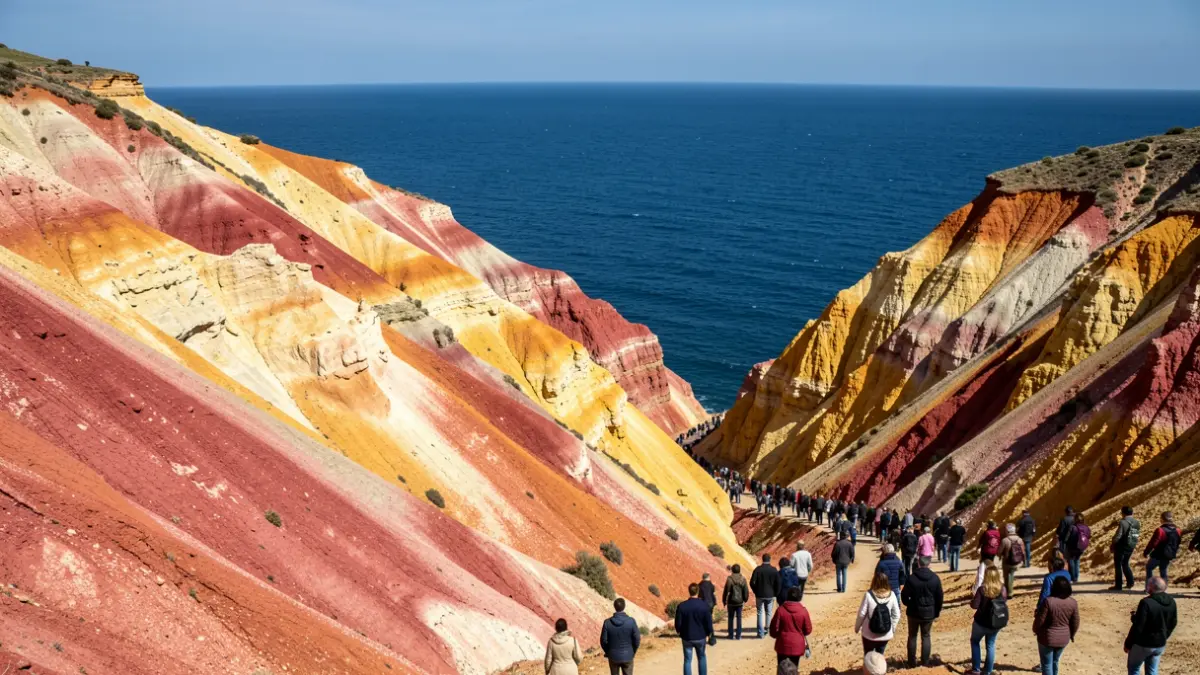
This coastal spot completely breaks with the usual Basque landscape aesthetic, offering a scenario that seems taken from a science fiction film, where erosion has sculpted rock and sandstone into impressive shapes. Its strategic location, midway between Pasaia and Hondarribia, makes it an ideal day trip for those seeking a different adventure close to home.
The uniqueness of this place lies in its mineral composition. The sandstone formations have been shaped over millions of years by saline wind and waves. Different layers of sediments and minerals, especially iron oxides, dye the rocky walls in shades of red, yellow, ochre, and white, contrasting with the blue of the sea. The Department of Environment of the Gipuzkoa Provincial Council notes in its cataloging studies that the Jaizkibel cliffs constitute "a geological heritage of international relevance due to the presence of paramoudras and tafonis."
Despite the images of this valley becoming popular on social media, it's important to understand that this is not a comfortable walk or a route to be taken lightly. The usual route ranges between four and eight kilometers, with an accumulated elevation gain of about 400 to 500 meters, requiring familiarity with mountain hiking. The trail is not clearly marked, and it's common to lose the path among vegetation or encounter muddy and slippery rock sections if it has rained recently.
To organize the day safely, consulting the tide table is essential, as some of the most spectacular rock formations and colored cavities are only exposed during low tide. Furthermore, due to the lack of mobile coverage in the ravines leading to the sea, it is advisable to have the map or route downloaded on your phone. It's a demanding hike of about three hours, but the views are well worth it.
After the effort of hiking in Jaizkibel, one can regain strength in two of the territory's most traditional fishing towns. Descending towards the bay of Pasaia, the local villages offer an environment where fish is the absolute king. Dishes like hake neck, grilled hake, or squid in its ink are must-tries in the area's taverns. In Hondarribia, the Hermandad De Pescadores is highly recommended for its fish and food quality.
The day's plan doesn't end with the hike and meal, as the slopes of Jaizkibel connect with magnificent alternatives for the afternoon. If the Pasaia area is chosen, an essential visit is Albaola, the Basque Maritime Factory. Here, in a shipyard converted into a museum, one can witness the artisanal reconstruction of the galleon San Juan, a 16th-century whaler, using the same traditional carpentry techniques.
If an afternoon stroll is preferred, Hondarribia offers a beautiful area to visit. Walking through the La Marina neighborhood with its colorful fisherman's houses or climbing to the walled old town to admire its Palace and Plaza de Armas allows one to make the most of the remaining daylight in a worthwhile location.