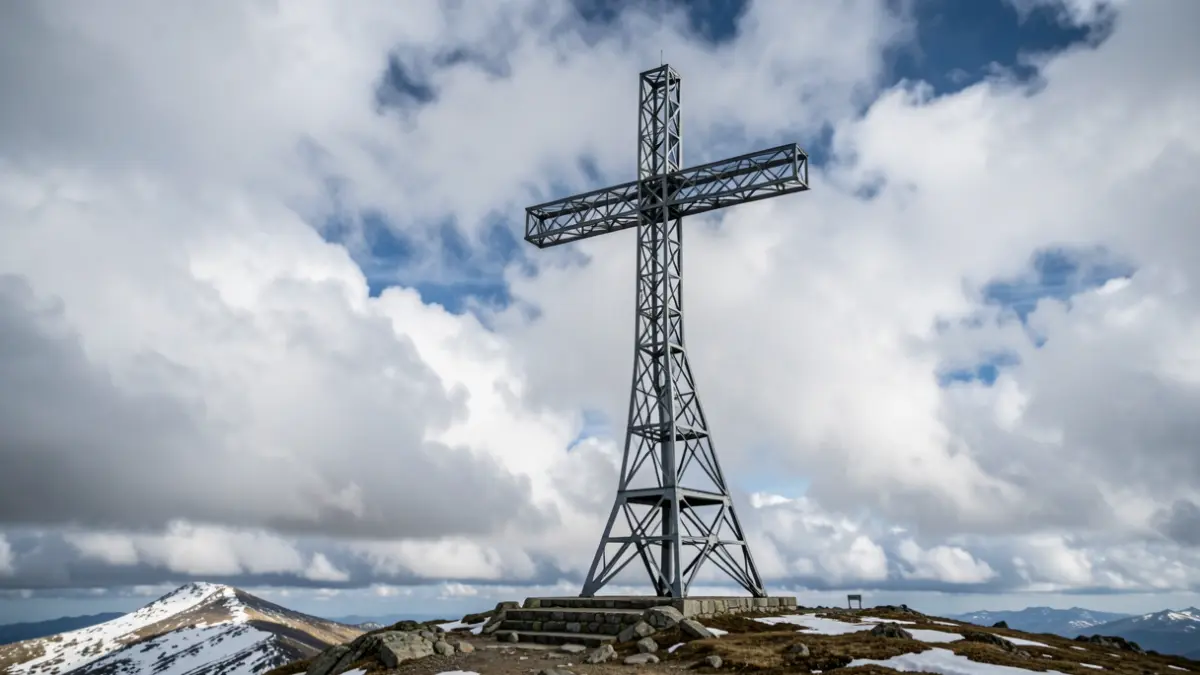
The monumental cross of Gorbea began its development in 1900, following a papal request to commemorate the arrival of the new century. The parish priest of Zeanuri took up this initiative in 1899, forming a commission to raise funds. Architect Casto de Zabala designed four proposals, all 33 meters high, representing Christ's age. The first cross was inaugurated on November 12, 1901, but stood for less than a month.
Strong winds and accumulated snow caused its collapse, breaking at a height of six meters on the Biscayan slope. Chronicles from the era state that local residents collected the fragments and melted them down for use in their farmhouses. The second cross was inaugurated on October 1, 1903, but was again toppled by a gale on February 12, 1906.
A third cross was constructed, but the secrecy surrounding its completion is such that the exact date remains unknown. It is estimated to have been around 1910, built by Talleres de Zorroza, standing 17 meters tall and replicating the lower section of the previous structures.
In 1931, an orientation table was installed, made of enameled lava by Fabrique de Lave Emaille Usine de St. Martin, based on a design by Ángel de Agirre and data from the Alavese mountaineer Lucio Lascaria, who identified 104 surrounding mountains. This table was later replaced by the current one, with a slightly different design, though the date of this replacement is unknown.
On June 18, 1963, a stone statue of the Virgen de Begoña was placed beneath the Cross. It was vandalized in 1966 and replaced the following year with the current bronze figure. In the same year, Adolfo Pinedo, a resident of Arrigorriaga, painted it, and would do so again in 1977 at the request of the 75th Anniversary Commission. In 1991, the Diputación Foral de Bizkaia (Provincial Council of Bizkaia) carried out a restoration, repairing concrete foundations and replacing damaged metal structure profiles, followed by sandblasting and painting with protective coatings.