The solemn ceremony, rich in symbolism, marked the central event of a year-long calendar celebrating five centuries of a text crucial to the legal, political, and institutional development of the Basque Country.
The event was led by the lehendakari, Imanol Pradales; the presidents of the General Assemblies, Ana Otadui, and the Basque Parliament, Bakartxo Tejeria; and the deputy general of Bizkaia, Elixabete Etxanobe. It was attended by a broad political and institutional representation, including former lehendakaris like Iñigo Urkullu and Patxi López, and former deputy generals.
«Today we reaffirm our roots and the historical uniqueness of our self-government and our status as a political entity reflected in the Fuero Nuevo», proclaimed Pradales. He highlighted the «reciprocal oath» that consolidated the 'pase foral' in 1526, adopting the legal formula «Obedézcase pero no se cumpla» (It shall be obeyed but not fulfilled) for royal decrees deemed incompatible with the fuero.
«It is not about idealizing the past, but about acknowledging it. Pactism and liberties already existed in the Basque context before the English Bill of Rights or the Declaration of the Rights of Man and of the Citizen», emphasized the lehendakari. These «specific liberties» and fiscal provisions from five centuries ago, he argued, point «point by point to the model we defend today in different words to update and expand self-government».
For Pradales, the commemoration is «bittersweet» as it also marks 150 years since the abolition of the fueros in 1876. He called for «new political capacities» to address contemporary challenges such as migration, European projection, and «full national development».
Promulgated in 1526 and sanctioned a year later by Emperor Charles I, the Fuero Nuevo crystallized centuries of institutional practice, organized the Lordship's own law, and shaped a specific understanding of governance, society, and taxation in Bizkaia, serving as a territorial constitution.
The wide range of topics it covered explains its lasting influence beyond its historical and political symbolism. Drafted by representatives of the 'Tierra Llana' (rural parishes), it extended its influence to towns, the Duranguesado, and Las Encartaciones, which had distinct legal identities. It remained in force until its abolition in 1876.
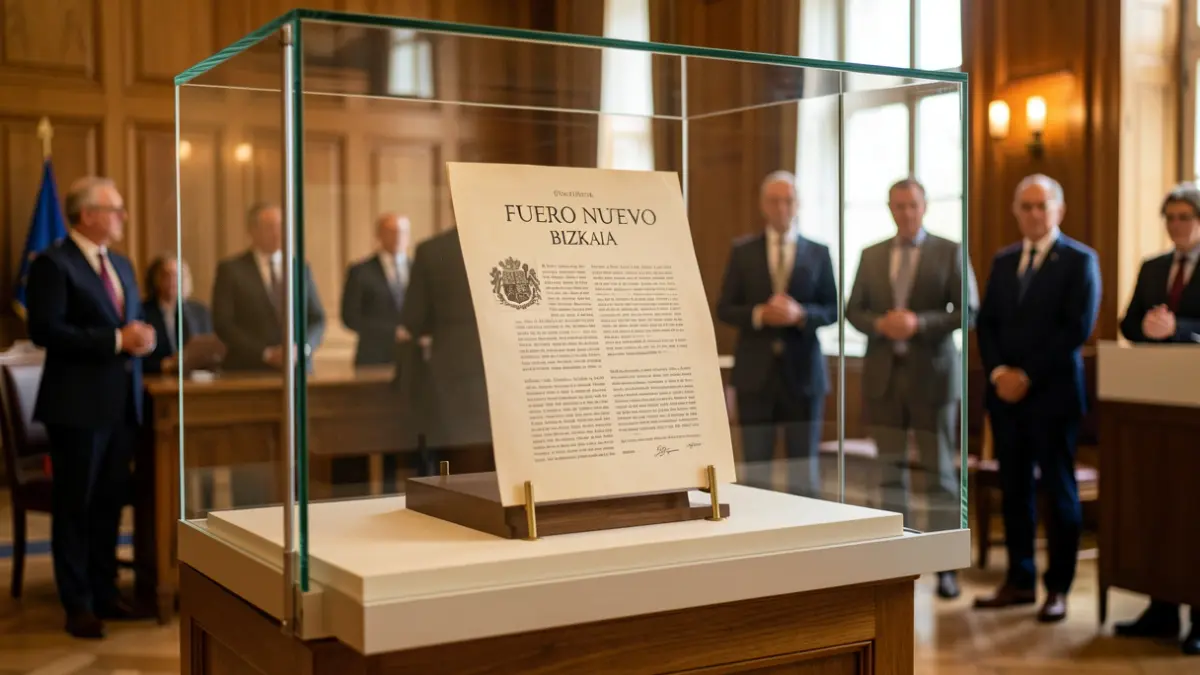
Under the motto 'Izan zirelako gara' (Because we were, we are), the hour-long event featured institutional speeches, an 'aurresku de honor' (honorary dance), a theatrical performance, and a musical piece by the Navarrese violinist Pablo Sarasate. The original Fuero Nuevo was displayed in a vitrine throughout the celebration.
Ana Otadui, president of the General Assemblies, praised the values within the Fuero Nuevo, identifying them with the current Welfare State: universal nobility, limitation of absolute power, judicial guarantees, inviolability of domicile, and fiscal and military exemptions. «The fuero was not just a legal text, but the consolidation of a political culture where power was only legitimate when born from a commitment to society», she stated.
Elixabete Etxanobe, deputy general of Bizkaia, highlighted the «spirit» of the Fuero Nuevo as the best tool to face current challenges like population aging, globalization imbalances, and climate or digital transitions. «When a person pays taxes to the Provincial Treasury and not to Madrid, it is thanks to the fuero», she affirmed, adding that the Economic Agreement and provincial competencies are the contemporary translation of what was discussed here 500 years ago.
Last January, the Provincial Council and General Assemblies formally requested UNESCO to declare the Fuero Nuevo a World Heritage site. A traveling exhibition and a summer course by the EHU are also part of the commemorative program.