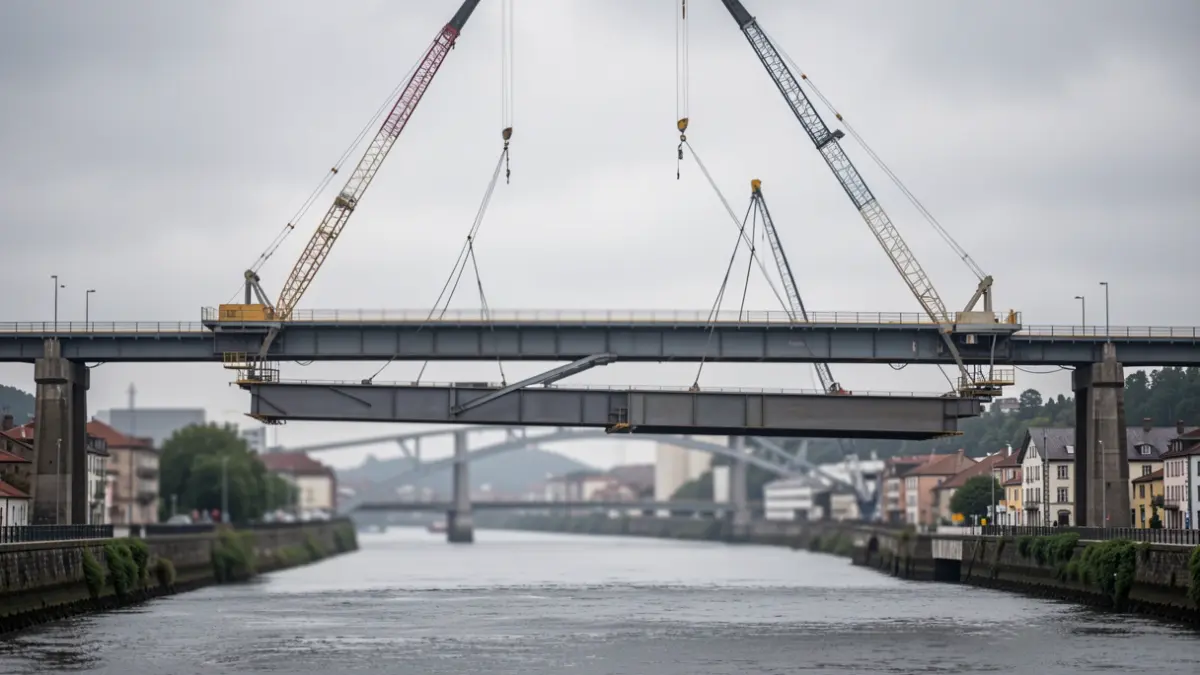
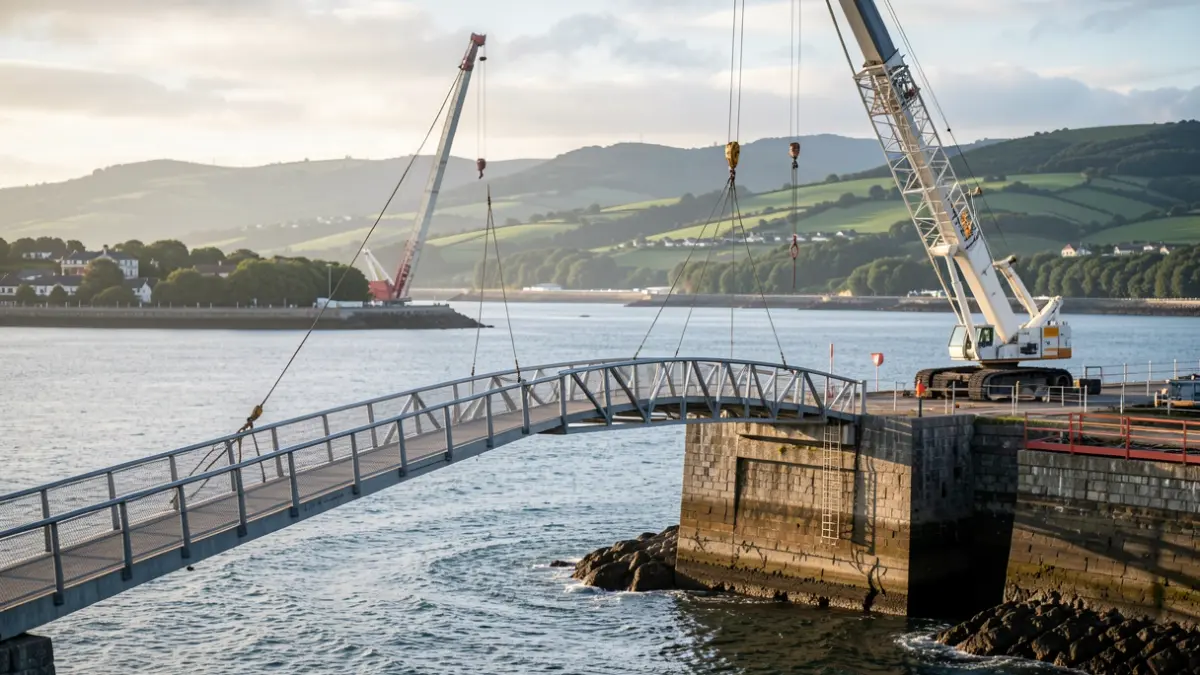
The Bilbao estuary saw the first major visual milestone in the construction of the All Iron pedestrian and cycle bridge this Wednesday, with the installation of the first section connecting Barakaldo and Erandio. Following a complex road transfer from Gasteiz, the spectacular assembly of section 10, the bridge's initial structure and the only one to be placed directly from land, began early Wednesday morning.
The maneuver, described by engineers as an operation of "millimeter watchmaking," required the deployment of two large cranes to lift and precisely fit a gigantic metal box and its lateral cantilever, pieces totaling over 65 tons. With the placement of this first element on the Erandio bank, the assembly phase of this ambitious curved and mobile infrastructure officially begins, a true prototype of advanced engineering that will transform sustainable mobility between the two shores.
“"It is a project that requires a lot of concentration and work."
At the worksite, Alesander Gallastegi, head of the project, emphasized the extreme difficulty of the tasks, confessing that “it is a project that requires a lot of concentration and work.” The manager also revealed that divers are currently preparing underwater bases for the metal piers connected to the bridge, an invisible but vital subaquatic task to support the infrastructure.
The placement of the block by cranes is just the beginning of a meticulous subsequent process. As Gallastegi himself advanced, "once this first piece is placed, welders have to perform a fixed weld that will take them at least two weeks," highlighting the scale and technical care required for each step. The Provincial Deputy for Infrastructures and Territorial Development, Carlos Alzaga, highlighted the infrastructure's "triple geometric reading": it is curved in plan, has vertical curvature, and features a movable central span of 60.2 meters.
This central section will function as a rotating bridge powered by three electric motors, allowing an opening with a horizontal clearance of 60 meters for large tonnage vessels. The daily transit of regular vessels will be guaranteed beneath the structure without needing to open it. The entire metal structure has been divided into 10 large sections, manufactured by the company Goros S. Coop., which have in turn been subdivided into smaller parts in the workshop to facilitate their subsequent transport and assembly.
According to Alzaga, one of the "most complex and spectacular" phases of the entire project is the perfect assembly and fitting of the mobile sections (5 and 6). As it is an asymmetrical structure, engineers will have to resort to filling the shorter span with a special heavy concrete made with metallurgical aggregate to balance the section and act as a counterweight.
To ensure success, a preliminary test will be conducted on land with a sacrificial piece before transporting the final sections by barge. Technicians have sought to allay public concerns about potential future sliding problems on the walkway, confirming that the steel plate platform will receive a final micropavement treatment composed of resin and aggregate to provide a rough and completely safe surface. Given the required level of calm and millimeter precision, Carlos Alzaga has avoided setting an exact inauguration date, estimating that the completion of the works will extend until the summer of 2027.